Narendra Modi has asked the younger generations of India to understand the national obligations to their generation and play a leading role in the country’s journey towards a Viksit Bharat.
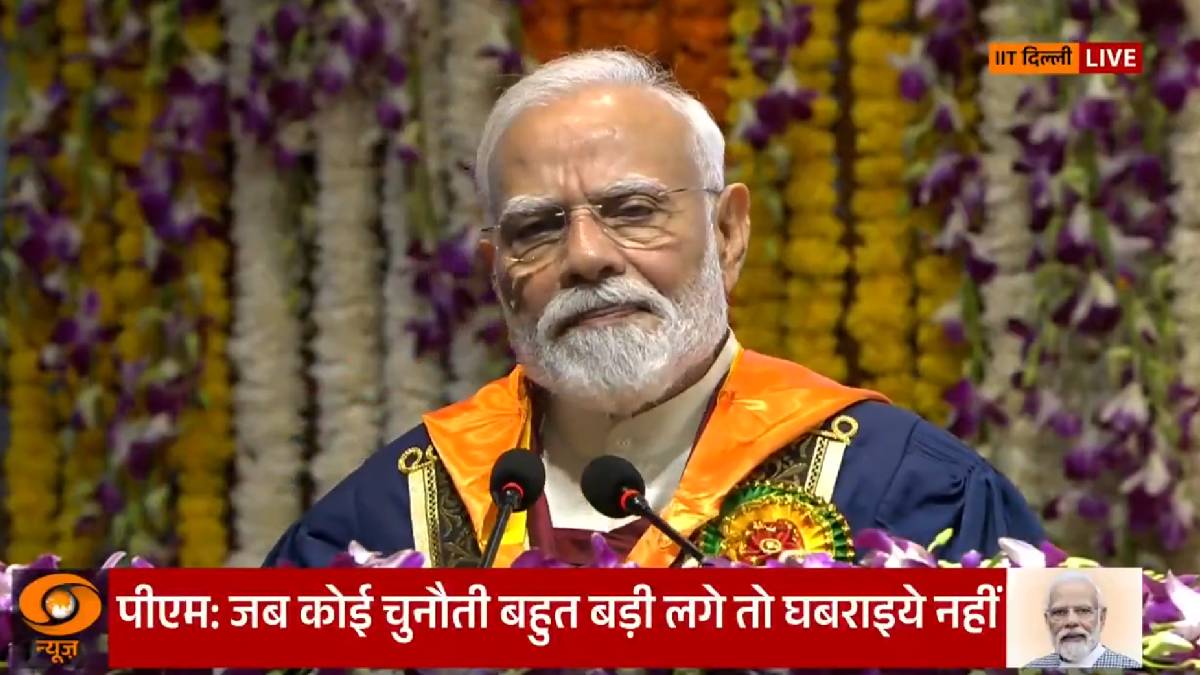
As for the importance of youth participation in India’s development, PM Modi compared the challenges faced by earlier generations against those faced by today’s generation. He said, “Every generation has its own set of challenges and therefore has an identity, but it has its own set of responsibilities which are unique to the time, too, and every generation has the same.”
#WATCH | Every generation faces its own challenges and has its own national responsibilities. Our country once faced the challenge of colonial rule, when the sole goal of an entire generation was India’s freedom. They made immense sacrifices and endured a long struggle to secure… pic.twitter.com/nisMEUBkvT
— DD News (@DDNewslive) August 8, 2026
Recalling India's struggle for independence, the prime minister said an entire generation faced the challenge of colonial rule, with the country's freedom being their primary national objective. Millions of Indians waged a long and difficult struggle and made enormous sacrifices to secure independence.
Modi says the freedoms enjoyed by citizens today are due to the dedication, courage and sacrifice that generations have made for these generations’ hard work, courage and sacrifice.
But he stressed that the challenges facing today’s generation are fundamentally different. Whereas previous generations fought for political freedom, the present generation is responsible for building India’s economy and growing it as an independent country.
The prime minister specifically referred to the next 30-35 years as the turning point for India's transformation. He said the decisions and actions of today’s young people will have a significant impact on the country’s future trajectory.
Modi told young Indians to look beyond individual considerations while making important decisions and also ask a broader question: How will this benefit the nation?
He stressed that decisions need to be weighed not only based on personal benefit but on the basis of the national need it serves.
The prime minister’s message places India’s youth at the heart of its long-term development aspirations. In pursuing a developed country (India), the younger generation is expected to be instrumental in technology, entrepreneurship, manufacturing, research, education, infrastructure and innovation.
Modi also highlighted India's efforts to build greater self-reliance in many sectors. Economic, technological and industrial self-reliance are central to the development strategy of the country, he said.
The focus on self-reliance is consistent with the government’s Atmanirbhar Bharat vision, which aims to enhance the country’s domestic capabilities and make India more competitive in the international marketplace.
As countries around the world compete in artificial intelligence, semiconductor manufacturing, advanced telecommunications, defence technology, and clean energy, technological independence has been essential. Development of domestic capabilities in these domains can reduce dependence on external supply chains and create new opportunities for Indian businesses and workers.
Industrial self-reliance is also intimately linked to production capacity, employment and domestic supply chain growth. Young people from India’s young population could play a key role in driving these changes through entrepreneurship, innovation and skilled employment.
Modi’s remarks therefore place a great responsibility on the youth to contribute to national development rather than to treat nation building as the province of the government alone.
The Prime Minister’s reference to the freedom struggle also provides a historical framework for understanding this responsibility. Just as an earlier generation dedicated itself to securing independence, the current generation is being asked to devote itself to building a stronger, more prosperous and developed India.
The vision of Viksit Bharat has become a central theme in the government’s long-term development story. The aim is to transform India’s economy and institutions while improving living standards and increasing opportunities for citizens.
For India’s youth, the next three decades could usher in major technological, economic and social changes. And the decisions taken in this period could affect India’s place in the world economy in the long run.
Modi’s message is therefore an appeal and a challenge: the generation that benefits from India’s independence must now accept the responsibility of strengthening that freedom through economic progress, technological capability, innovation and national self-reliance.
As India strives to achieve its long-term development goals, from the Prime Minister’s perspective, nation-building is a generational responsibility and the choices made by today’s youth will determine India’s road to Viksit Bharat.