The Russia-India-China (RIC) grouping is once again receiving strategic attention after the 18th BRICS Summit in New Delhi where the three countries have expressed an interest in global governance, economic cooperation, technology, energy and international security.
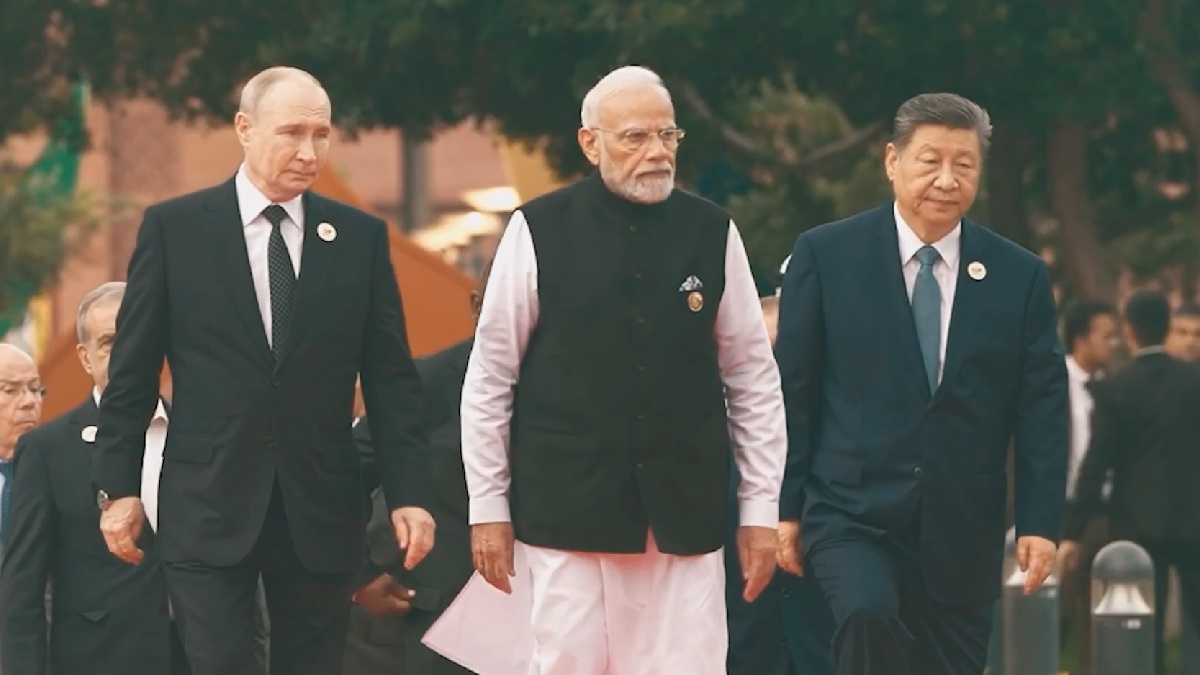
RIC has never developed into a formal alliance but is crucial because India, Russia and China need to coordinate on issues where they have common interests.
The 2026 BRICS summit held in New Delhi on September 12 and 13 produced a 140-point leaders’ declaration that focused on multilateralism, economic cooperation, sustainable development, technology and a stronger voice for emerging and developing economies. BRICS also reaffirmed its commitment to multipolarity, and also the sovereign equality, consensus and cooperation among members.
BRICS Provides A Wider Platform For RIC
The expanded BRICS framework has made the three-country relationship a much larger diplomatic arena. Instead of being a closed Russia-India-China relationship, these three countries can now work together on common interests with a larger group of economies.
So India has room to engage Russia and China on certain areas without turning RIC into a formal strategic bloc. The New Delhi declaration emphasized the role of emerging markets and developing countries in global decision-making and called for reforms to make international institutions more representative.
China and Russia also reaffirmed support for India’s aspirations for a larger role in the United Nations, including the Security Council.
The BRICS platform also offers opportunities for cooperation in artificial intelligence, financial systems, investment, supply chains and scientific research. AI as an economic driver for growth and development, safety, security, inclusiveness and reliability were highlighted in the declaration to be adopted.
India-Russia Ties Remain An Important Factor
Russia is still a key component of India's strategic calculation in energy, defence, technology and other areas of economic cooperation. Narendra Modi and Russian President Vladimir Putin met on the sidelines of the 2026 BRICS Summit and discussed bilateral cooperation for political, economic, defence, energy, space, skills and people-to-people links.
The two leaders also discussed regional and global developments including conflicts in maritime trade, as well as the safety of Indian seafarers. India reiterated that dialogue and diplomacy are essential in dealing with conflicts, and both sides agreed to continue to work on their special and privileged strategic partnership.
This bilateral relationship sets up RIC. At the same time, India’s engagement with Russia does not mean an agreement with Moscow on every international issue. New Delhi has continued to stress its strategic autonomy and its desire to remain in close touch with a number of major powers.
India-China Relations Remain The Critical Variable
The future of RIC is closely linked to the course of India-China relations. India and China are closely connected with major economic ties and have common interests in many multilateral forums but there are differences in terms of the boundary question, trade imbalances and supply chain issues.
At the BRICS Summit in September, Modi met Chinese President Xi Jinping in New Delhi. Both leaders said bilateral ties had improved since their last meeting but both sides also stressed that a strategic and long-term strategy was needed to move forward.
Peace and tranquillity on the border are necessary for the continuation of bilateral relations at present, Modi said. The two sides also discussed trade, market access, supply chains, cultural exchanges and mobility.
The meeting also suggests that the engagement is still in place but also highlights the limits of cooperation. India has made very clear that economic and other bilateral relations are linked to stability on the border and to the resolution of differences.
Areas Where RIC Could Cooperate
Energy security is one area where the interests of all three countries can intersect. Russia is a big energy producer while India and China are among the world’s largest energy consumers. Cooperation regarding energy trade, infrastructure and supply security could be relevant even if these three countries pursue different national plans.
Technology and artificial intelligence are another promising area. The BRICS declaration advocated for international cooperation on AI resources, safety, security, inclusiveness and trustworthy technologies. India, Russia and China have a technology ecosystem but have regulatory and strategic frameworks that differ.
Supply chain resilience may also provide a realistic space for dialogue. The BRICS declaration also recognized work to enhance trade and investment and build resilient supply chains among member states. That cooperation might have benefits for India, too, as it allows for diversification and minimizes exposure to disruption without being too dependent on one partner.
Financial and insurance cooperation is another emerging issue. The New Delhi declaration also welcomed discussion of a BRICS Risk Lab and efforts to enhance reinsurance capacity, while also ongoing investment-related activities. Such mechanisms might also provide additional options to participating countries, but their real impact will be based on implementation and voluntary participation.
The Limits Of The RIC Format
Despite areas of common interest, RIC has structural limitations. India, Russia and China have different economic interests, security relations and approaches to major international disputes. Their interests may overlap on issues such as multipolarity and reform of global institutions while diverging on regional security, trade and strategic competition.
India also maintains extensive relationships with the United States, Europe, Japan, Australia and countries in West Asia. Consequently, deeper engagement with Russia and China does not necessarily mean reducing India's cooperation with Western partners.
The BRICS declaration itself reflects this broader approach. It is not a military or ideological alliance but a forum for multilateral cooperation such as BRICS. The document repeatedly stresses sovereignty, consensus and inclusive cooperation and also the role of the G20 in global economic dialogue.
What RIC Could Mean For India
For India, the practical benefits of RIC might lie in issue-based cooperation rather than the establishment of a formal institutional structure. Energy security, connectivity, technology, supply chains, global financial reform and dialogue on international conflicts are areas where discussions can continue without having to agree on every strategic question.
India’s position is also shaped by its broader concept of strategic autonomy. New Delhi can use BRICS, the Shanghai Cooperation Organisation, the G20 and bilateral partnerships at once, therefore negotiating with different powers according to the issue at hand.
The 2026 BRICS Summit reinforced that approach. India hosted Russia and China alongside a much wider group of countries and encouraged greater representation for emerging and developing countries.
China will take over the BRICS chairmanship in 2027, giving Beijing another opportunity to shape the grouping’s agenda. And so the RIC triangle is an open space for dialogue and not a set geographic bloc.
The future of the RIC Triangle will depend on whether India, Russia and China can find concrete areas of common interest while negotiating their differences. So for New Delhi the key will be to keep decisions independent and use multilateral channels to achieve its economic, security and diplomatic objectives.