Russia has reportedly suggested joint production of the advanced Product 177S aero engine for India's ambitious Advanced Medium Combat Aircraft (AMCA) Mk2 programme, a potentially significant development in India's quest to build an indigenous fifth-generation stealth fighter.
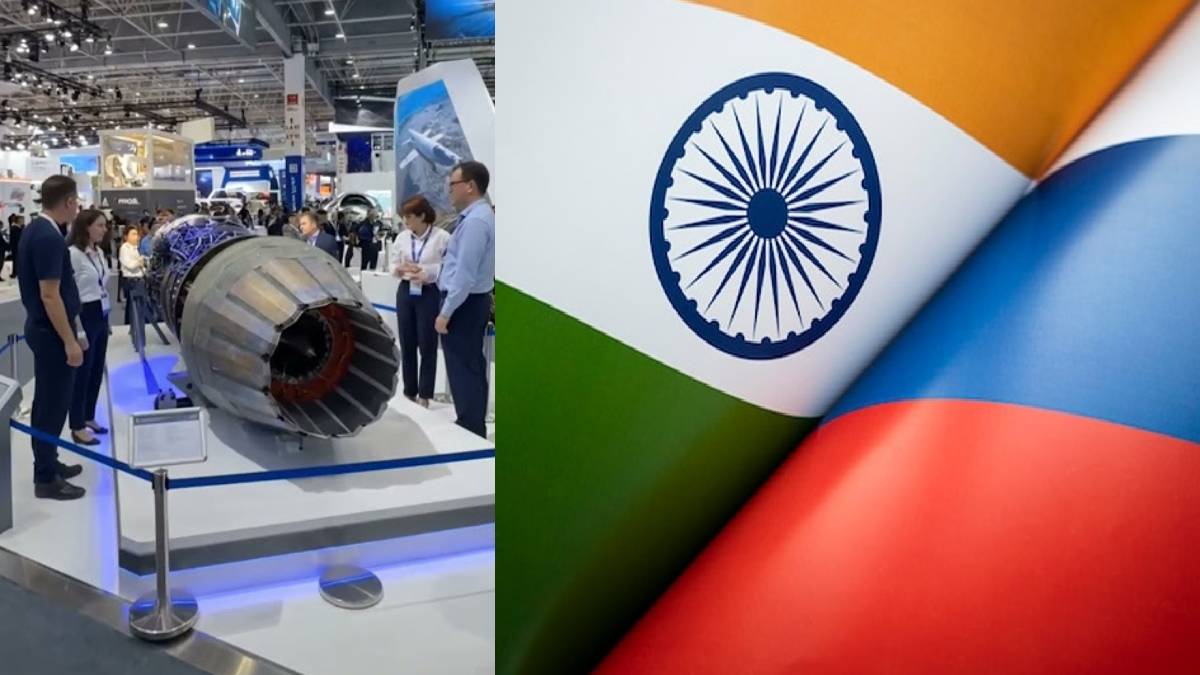
If the proposal is implemented, it will be one of the most important defence-industrial cooperations between India and Russia in recent years because it will combine advanced engine technology with domestic manufacturing under India’s vision of Aatmanirbhar Bharat. The proposal is consistent with India’s long-term goal of strengthening indigenous aerospace capabilities and reducing reliance on imported defence equipment.
The AMCA is India’s flagship fifth-generation fighter aircraft development programme being led by the Aeronautical Development Agency (ADA) and the Defence Research and Development Organisation (DRDO). Designed as a twin-engine stealth fighter, it would have advanced avionics, sensor fusion, electronic warfare systems, supercruise capability, and internal weapons bays, making it one of the most advanced combat aircraft ever developed in India.
The programme is planned in two main stages. The AMCA Mk1 is expected to be powered by an existing engine solution, and the AMCA Mk2 is to be powered by a much more powerful next-generation engine capable of delivering considerably higher thrust. The selection of the engine is one of the most important points in the programme, as propulsion has a direct impact on speed, payload, range, manoeuvrability, and overall effectiveness of the aircraft.
Russia’s proposed Product 177S engine is thought to be a high-performance powerplant to meet the demands of modern stealth fighters. Joint production could enable the Indian industry to contribute to manufacturing, assembly, maintenance, and possibly technology development, depending on the terms of any future agreement. Partnership in that regard would enhance India’s domestic aerospace ecosystem by giving opportunities to local suppliers, engineers, and research institutions.
For India, the biggest advantage of joint production would be increased self-reliance in a field where only a handful of countries have advanced technological expertise. Aircraft engines are still among the most complex systems to design and manufacture, involving cutting-edge metallurgy, precision engineering, high-temperature materials, and sophisticated digital control systems.
The proposal also reflects the ongoing defence cooperation between India and Russia that has historically included fighter aircraft, tanks, submarines, helicopters, missiles, and air defence systems. India has diversified its defence procurement in recent years by expanding cooperation with several countries, but Russia is still one of the key partners in many critical defence programmes.
At the same time, India is putting more effort into developing indigenous jet engine technology through international collaboration and domestic research. The country’s long-term goal is not only to create advanced fighter aircraft but also to build a sustainable ecosystem that would be able to produce aerospace technologies critical for India’s development.
If the Product 177S proposal is to be launched, negotiations would likely focus on technology transfer, intellectual property rights, production responsibilities, lifecycle support, and the scale of indigenous manufacturing. These will be the key factors in how much technological capability India gains from the partnership.
A successful AMCA Mk2 with the next-generation engine would be a game changer for the Indian Air Force. In the next decades, the aircraft will be a critical piece of equipment to maintain air superiority, carry out precision strikes, and operate in hostile terrain with other advanced platforms.
Although the Russian proposal is an encouraging step forward, the engine selection process for the AMCA Mk2 will still need to be done with technical evaluation, government approval, and future talks. If this collaboration is reached, it could significantly improve India’s bid to develop a world-class indigenous stealth fighter and make it a world-leading defence manufacturing centre in the next decade.