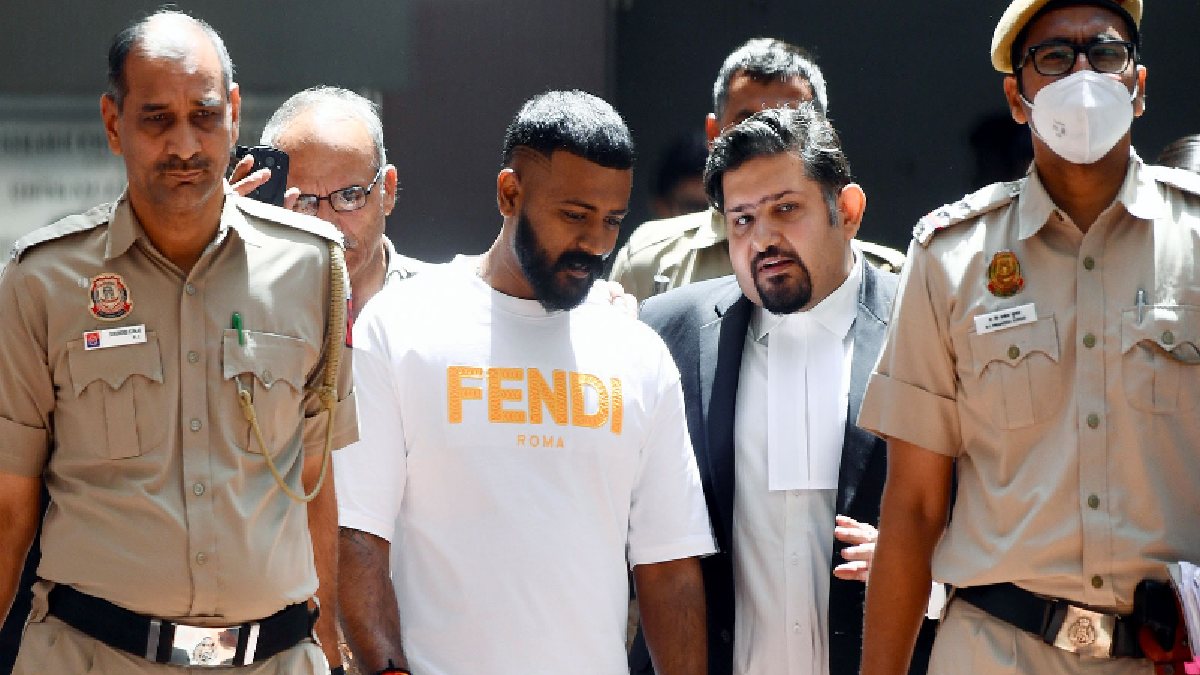
A Delhi court has convicted jailed conman Sukesh Chandrasekhar of impersonation of a Supreme Court judge and attempting to influence a judicial officer on the bail matter. Chief Judicial Magistrate Harshita Mishra of Tis Hazari Courts found Chandrasekhar guilty under Sections 170, 189 and 507 of the Indian Penal Code of impersonating a public servant, threatening a public servant and criminal intimidation in anonymous communication.
The court termed the alleged attempt to interfere with the judicial process as an “absurd theatrical production”. It said the evidence on record was sufficient to establish Chandrasekhar’s guilt beyond reasonable doubt, despite several deficiencies in the investigation conducted by the Delhi Police.
Chandrasekhar was purported to be a Supreme Court Judge.
The case relates to a case when Chandrasekhar was in police custody in April 2017 for a corruption matter before Special Judge Poonam Chaudhary. According to the prosecution, Chandrasekhar had access to Constable Manjeet's mobile phone and used it to contact the judicial officer.
The calls were allegedly made from the judge’s personal mobile number as well as her official landline. The initial conversation was told that the caller was the personal secretary of the Supreme Court judge’s personal secretary (KJ, the initials “KJ” used in the judgment), according to the judgment.
The prosecution alleged that another person then joined the conversation and presented himself as the judge. The caller claimed to be acting on behalf of the Union Home Ministry and the Supreme Court Collegium and directed the judicial officer to grant Chandrasekhar bail or interim bail.
The judicial officer was warned of serious professional consequences if she failed to comply with the alleged instructions. The judge was forced to check the authenticity of the communication directly with the Supreme Court.
She then contacted the actual private secretary of the judge concerned and was told that no such call had been made. She was also told that the person who had claimed to be the judge’s secretary was not employed in the judge’s office.
The court says Judicial Orders Cannot Be Secured Through Calls
With that in mind, the court stressed the importance of judicial independence while considering the allegations. Judicial decisions are based on the material before the court and cannot be dictated by individuals claiming to be in power.
The court said, “Orders are passed in courtrooms, not dictated over clandestine telephone calls,” the court observed. It said judicial discretion is exercised on the basis of the court record and applicable law, not the designation or influence claimed by someone communicating with a judicial officer.
The court also observed that Chandrasekhar appeared to have become convinced by the deceptive methods allegedly used by him over a period of time, such as impersonation of persons holding positions of authority and the alleged use of spoofed caller identities.
The court said that impersonating a Supreme Court judge or the judge’s secretary was not only an attempt to influence an individual judicial officer but dangerous to the authority and integrity of the judicial system.
Delhi police investigation came under criticism
In convicting Chandrasekhar, this court also raised serious concerns about the way the case was examined by the Delhi Police. The probe was superficial and not done properly, the court said.
And the court highlighted several gaps in the investigation, including failing to recover the mobile phone allegedly used in the incident, obtain CCTV footage from Crime Branch premises and collect potentially crucial call records. Some witnesses who could have provided relevant information were not thoroughly investigated; investigators also failed to examine.
A crucial question was how Chandrasekhar got access to a mobile phone while in police custody. The court said, “The investigation did not explore the circumstances as to how the phone’s access was obtained.”
The court orders examination of Constable’s role.
The court said the circumstances surrounding the mobile phone raised concerns about whether Constable Manjeet had simply lost control of the device or whether he had facilitated Chandrasekhar’s access to it. However, the court said raising the matter did not constitute a finding that the constable was guilty of any offence.
The court directed the concerned Commissioner of Police or Deputy Commissioner of Police to examine the constable’s role and determine whether fresh departmental or criminal proceedings were necessary.
It also stressed that an investigation should follow the evidence wherever it leads, even when the evidence points towards a member of the police force. The direction explicitly calls for further scrutiny of an aspect of the case that the original investigation allegedly failed to examine adequately.
Despite its criticism of the police investigation, the court felt that the evidence as it was then available was also sufficient to prove Chandrasekhar’s involvement beyond reasonable doubt.
Additional Public Prosecutor Amit Yadav was in charge of prosecution and advocate Praveen Dabas represented Chandrasekhar. The conviction adds another legal setback for Chandrasekhar, who is in custody for different charges and has been held since then.