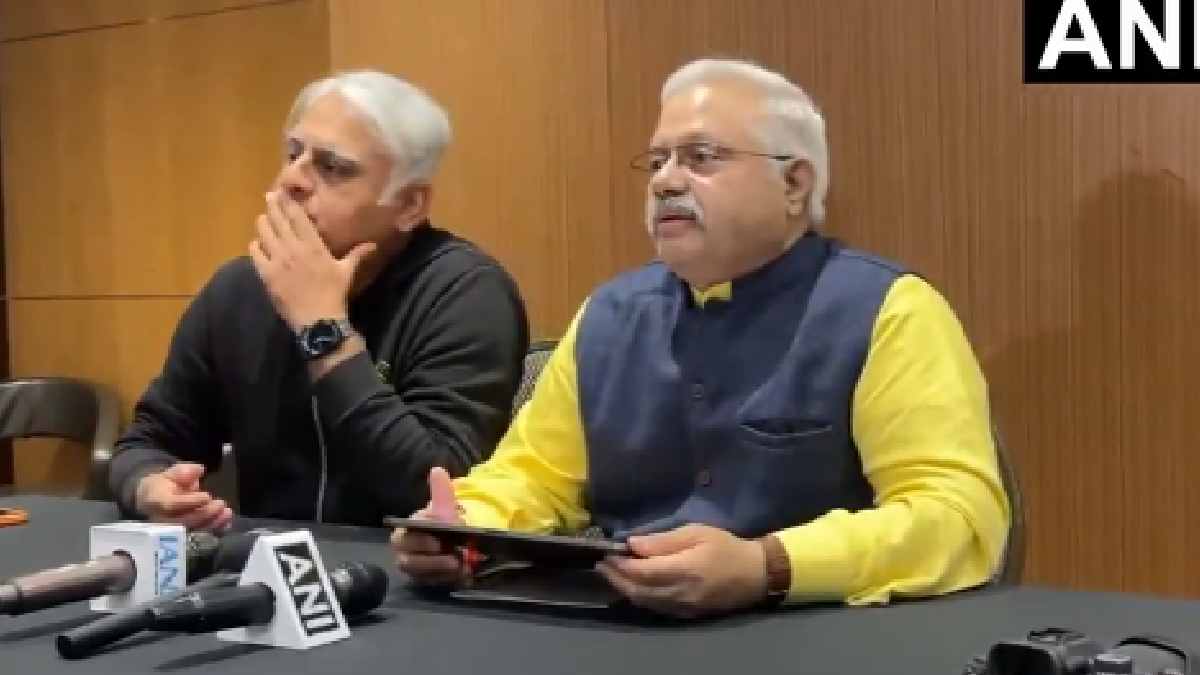
London, UK: RSS Prachar Pramukh Sunil Ambekar has said that there are many misconceptions about Hindutva and the idea of Bharat in Western academic and public discourse.
Ambekar described Bharat as a cultural concept rather than simply a political nation-state and said discussions and visits could help create a clearer understanding of these ideas.
Ambekar also said that the concept of Hindutva is often interpreted through frameworks which are not entirely representative of its meanings in the context of Indian culture.
"There are a lot of misconceptions," Ambekar said, while explaining the RSS perspective on Bharat. Bharat, he said, cannot be understood only through the traditional definition of a modern nation-state, which is the way it is seen by conventional thinking.
Rather, he explained that Bharat is a cultural concept with a long history and civilisational identity.
Ambekar also distinguished Hindutva from religion. Hindutva should not be seen as a fixed religious concept or associated with one particular religion, he said.
Rather, he presented it as an approach that acknowledges different forms of religious belief and practice.
"Hindutva is not like any religion; it is not a fixed concept,” Ambekar said. The idea is about truth and acceptance of different religious traditions and practices, he added.
#WATCH | London, UK: On the Hindutva narrative in Western academia, RSS Prachar Pramukh Sunil Ambekar says, “There are a lot of misconceptions. Bharat is not like a nation-state political concept; it is a cultural concept. Hindutva is not like any religion; it is not a fixed… pic.twitter.com/EeR2C6f22y
— ANI (@ANI) September 4, 2026
The comments come as debates continue to play out in universities, think tanks and public forums outside India about what Hindutva means, how it relates to Hinduism and how it plays into contemporary Indian politics and society.
The term has been given different readings, with supporters calling it culture or civilisational and critics Hindu nationalist in nature.
Ambekar wants to place RSS notions of Hindutva in a cultural context. By stressing respect for other religions and practices, he argues that such a concept should not be seen as belonging to one particular religious tradition.
He added that international engagement could help to address what he described as misunderstandings about Bharat and Hindutva.
Direct interactions and discussions are also crucial in helping to explain these concepts to people outside India, Ambekar said.
His London remarks are certain to add to the growing international debate about India’s cultural identity, Hindutva and RSS.
Indian political and cultural ideas continue to receive more and more attention overseas, and terminology and interpretation are of interest in academic and public circles.
Ambekar’s main message was that Bharat and Hindutva should be understood in terms of cultural and civilisational context rather than only as political or religious categories.
He said that more dialogue and engagement would help clarify these ideas for international audiences.