A YouTuber’s unusual social experiment at the 2026 Kawad Mela in Haridwar has drawn attention online after he reportedly dressed as a beggar and spent eight hours asking devotees for money.
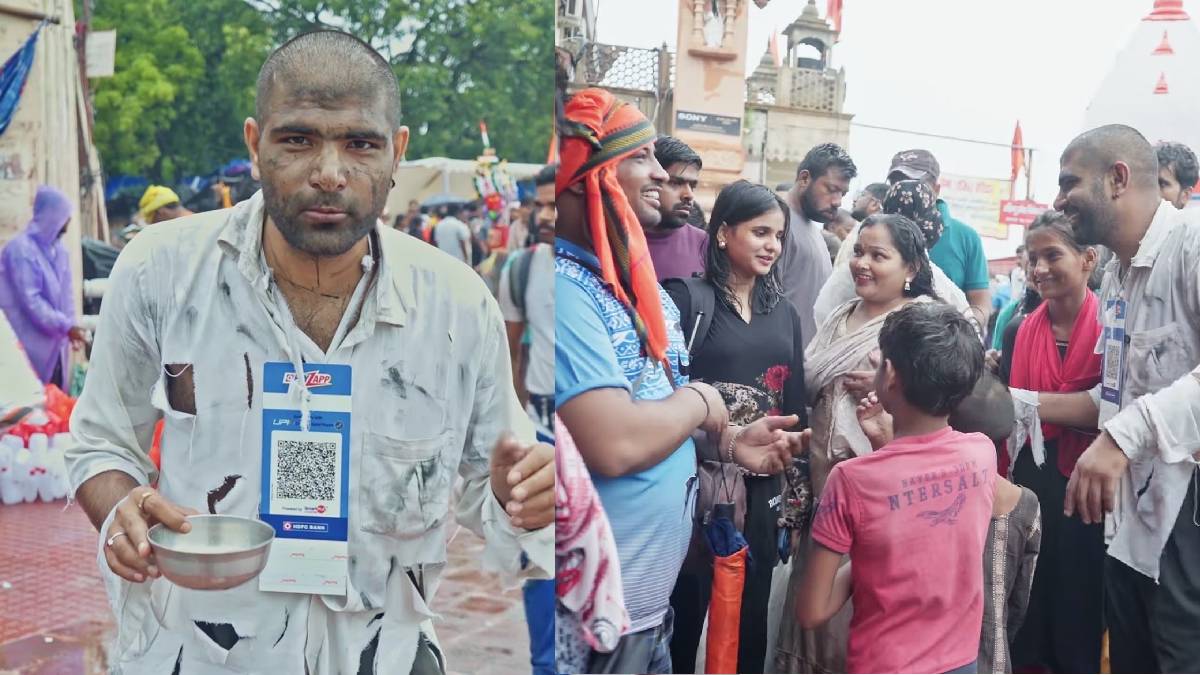
YouTuber Puroshottam Vashisht had his look changed to that of a street beggar and even walked into the crowded pilgrimage area during the Kawad Mela. As part of the experiment, he also wore a UPI QR code around his neck to help devotees transfer money digitally rather than just using cash.
Vashisht spent about eight hours walking around the area and asking people for money, the authors of the experiment said. His experience was different from one person to another, they said, and some people allegedly harassed or mistreated him while others were kind and gave him money.
The most striking aspect of the experiment was the amount he supposedly collected during those eight hours. Vashisht said he received around ₹4,000, which works out to about ₹500 per hour during the experiment.
This number has been of great interest because it shows how much money can be raised repeatedly through small donations in a population of pilgrimage followers. The Kawad Mela has a lot of devotees, so one can expect big crowds during a day’s visit.
The experiment also demonstrated the changing nature of street donations. In the past, beggars have mostly relied on coins and cash from passers-by. A UPI QR code shows that the increased popularity of digital payments in India has also reached informal and street-level transactions.
But the reported ₹4,000 collection should not be seen as a typical or guaranteed income for people who beg. The amount came from a specific experiment conducted at a major religious gathering with unusually high footfall. Location, crowd size, timing, appearance, individual interactions, and public sentiment can dramatically affect donations.
But the arithmetic around the experiment has become a major talking point. At the average rate of ₹500 per hour, increasing the rate to 12 hours would theoretically generate ₹6,000. A longer day with good conditions might result in higher collections. But those calculations are just hypothetical extrapolations, not daily or monthly ones.
And claims that someone could consistently make ₹8,000–₹10,000 per day or potentially ₹2.4–₹3 lakh per month through begging should be treated cautiously. The experiment was only eight hours long and provides no proof of sustainable income patterns.
The experiment showed the very different responses people have when they are seen as poor or vulnerable. In his disguise, Vashisht faced harsh treatment and compassion. And that contrast was a big part of the experience.
The incident also raises broader questions about poverty, street begging, and society’s attitude towards people seeking financial assistance. A person sitting by a roadside asking for money can be humiliated and rejected, while another passer-by may offer food, cash, or assistance.
At the same time, the staged experiments on begging need to be distinguished from the lived lives of people who depend on donations because of poverty or lack of employment opportunities. When someone is homeless or in extreme financial crisis, begging is not a short-term social experiment but a daily reality.
The use of UPI in the experiment adds another contemporary dimension to the story. India’s digital-payment infrastructure has made it possible for even very small transactions to take place instantly, possibly changing how donations are made in public spaces.
Vashisht’s reported ₹4,000 collection in eight hours has become something more than a surprising number. It has also spurred discussion about digital payments, public generosity, poverty, and the economics of street begging.
The experiment also reminds us that one day’s collection can’t be used to calculate the whole community’s earnings. But the stunt itself is unusual, and reactions by everyone involved have made it a widely discussed social media story.