
Professor Ashoke Sen has received the coveted Oskar Klein medal and is the first Indian physicist to be awarded the prize internationally.
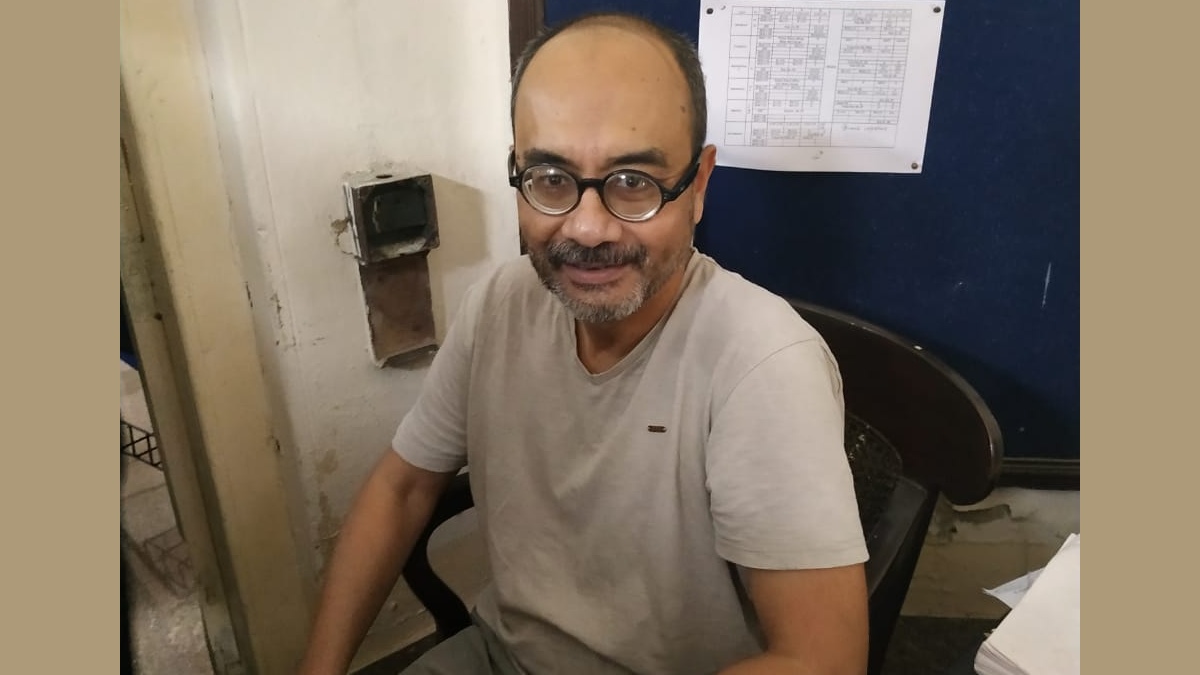
Ashoke Sen was awarded the prize in the context of string theory, black hole entropy and string field theory, three of the fields of research that have played a fundamental role in the development of the theory of physics today.
On October 22, 2026 it was announced by the International Centre for Theoretical Sciences (ICTS), Bengaluru, for India to be considered as a world leader in the field of fundamental scientific research. Professor Ashoke Sen is currently an ICTS-Infosys Madhava Chair Professor.
The Oskar Klein Medal is one of the most prestigious international awards in theoretical physics. It was established in 1988 by Swedish theoretical physicist Oskar Klein and awarded annually by Stockholm University and the Royal Swedish Academy of Sciences.
The medal is awarded to the scientists who have contributed to the study of physics and has been awarded to many of the world's most celebrated scientists including Nobel Laureates Chen-Ning Yang, Steven Weinberg and Hans Bethe.
Physicists Stephen Hawking and Peter Higgs have been awarded as well, which is the long-standing tradition of the Nobel Prize. Sen is among a group of scientists whose research is directly relevant to modern physics.
Sen's recognition is so great because he was at the forefront of string theory. String theory is the theory that the fundamental constituents of matter might be tiny, vibrating, one-dimensional strings and not the point-like particles. It is a theory that researchers are searching for in order to bring quantum mechanics and gravity into one unified theory.
String theory is a very recent scientific work in the field, it has produced many mathematical ideas and theoretical developments that are currently being studied in basic particles, forces and space-time. Sen has helped us to understand some of the relationships in string theory and its consequences for the laws which govern the universe.
His main contributions are the research on S-duality (the relation between different descriptions of the physical theory). His work has helped physicists understand how apparently different formulations of string theory may be related.
Sen is also known for his work on precise counting of black hole entropy. Black holes are among the most mysterious objects in the universe and their entropy is related to the information about their physical properties. It is the ultimate problem in theoretical physics to understand how it arises from the quantum states.
Sen's calculations have also been used to explain the properties of black holes with quantum theory. His contributions to string field theory have also made him one of the most prominent researchers in the field.
Sen delivered the Oskar Klein Memorial Lecture “Gravity from Strings and Strings from Gravity” at Stockholm University’s AlbaNova Centre on October 22. The lecture addressed string theory and gravity and asked how string theory could produce a consistent and coherent description of gravity which could be useful in the research of black holes.
The memorial lecture is as important as any of the award papers and is the opportunity for distinguished scientists to present work to the scientific community.
The medal adds to Sen’s long list of national and international awards. He received the ICTP Prize in 1989 and the Shanti Swarup Bhatnagar Prize in 1994. He received the Infosys Prize in Mathematical Sciences in 2009 and the Breakthrough Prize in Fundamental Physics in 2012 in recognition of the unification of string theory.
In 2014 he received the Dirac Medal, another major international award for theoretical physics. And in 2001 he received the Padma Shri and in 2013 the Padma Bhushan. He was also elected a Fellow of the Royal Society in 1998.
Sen's achievement is an important step in India's scientific community for theoretical and fundamental physics researchers, especially ICTS in Bengaluru. His partnership with ICTS also underscores the integral role of Indian research institutions in international scientific debates and the contribution of Indian science to the scientific community.
The Oskar Klein Medal not only praises his achievements but also the importance of continuing research to understand the basic issues of matter, gravity and the universe.
As scientists explore the interplay between quantum mechanics and gravity, Sen's work is a crucial part of the wider science process in understanding the physical framework of the universe. His recognition as an international leader in mathematics and theory would further add to the knowledge and recognition that India is leading the way in theoretical physics in the world.




Comments