
In a key step towards global remittance efficiency, the government has replaced Form 15CA with a new Form 145 – Declaration for Foreign Remittance – as a mechanism to make it easier for people and businesses who do business in foreign countries to do so.
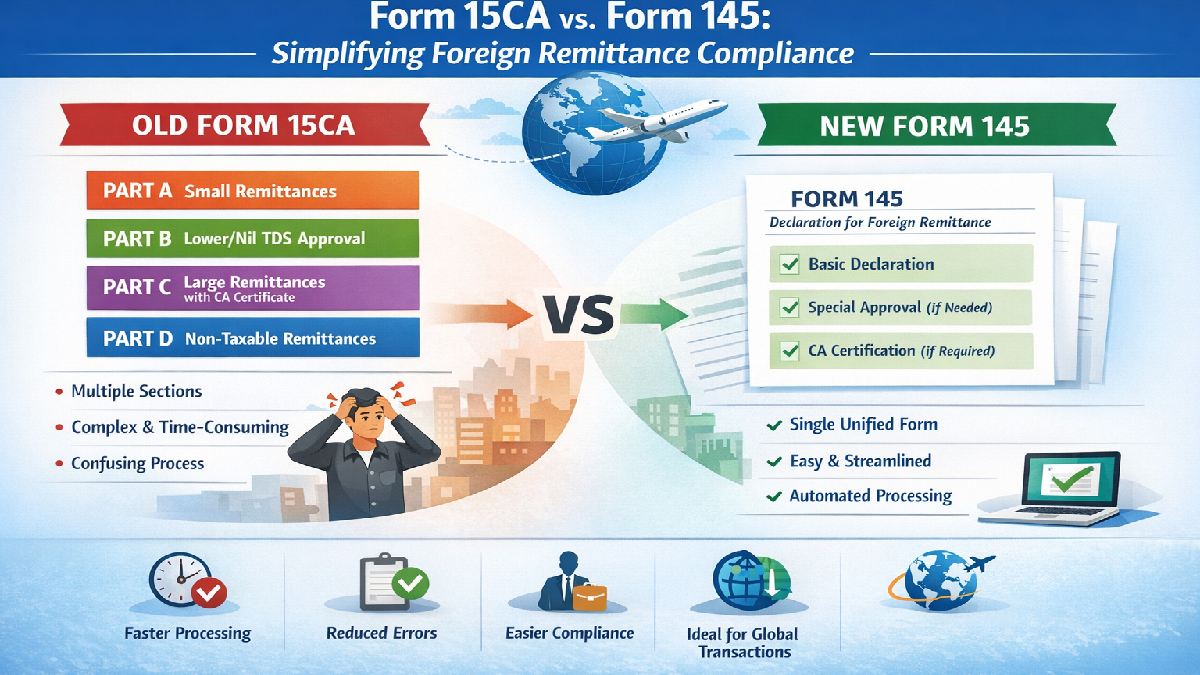
What was Form 15CA?
Form 15CA was mandatory when making foreign remittances. It made sure applicable taxes were properly deducted before transferring funds outside India. But the structure—which was divided into multiple parts—was cumbersome, time consuming, confusing.
Old Form 15CA (Part A, B, C, D)
The earlier system classified remittances into different parts:


- Part A – Small Value Taxable Remittances. Applicable when remittance ≤ ₹5 lakh (in financial year). Taxable payments. No CA certificate needed.
- Part B – Lower/Nil TDS with approval. Used when lower or no TDS is applicable. Requires approval from Income Tax Department (Sections 195(2), 195(3), 197). No CA certificate needed.
- Part C – Large Taxable Remittances. Applicable when remittance is above ₹5 lakh. Taxable payments. Requires CA certificate (Form 15CB).
- Part D – Non-Taxable Remittances. Payments not taxable in India. No CA certificate required.
As structured as it was, this system frequently led to confusion in selecting the correct part.
Introducing Form 145
The new Form 145 replaces all these parts in one declaration system. Users no longer need to choose between several sections; now, they are guided to use a clear outline of the compliance process.
Old vs New: Concept Mapping
- Part A – Small taxable payments → Covered under basic declaration.
- Part B – Lower/Nil TDS approval → Covered under special approval section.
- Part C – Large taxable payments with CA certificate → Covered under detailed + CA section.
- Part D – Non-taxable payments → Included under non-taxable declaration.
Key Highlights of Form 145
- Single Form Structure – Not having to choose between different parts.
- Simplified filing process – Easy to understand format for all users.
- Automated Classification – The system determines taxability and requirements based on inputs.
- Reduced Errors – Structured flow minimizes mistakes.
- Digital-Friendly Approach – Designed for faster online processing.
How Form 145 Works
Instead of selecting Part A/B/C/D, the new system follows a logical flow:


- Basic Declaration – Remitter details, amount and purpose of remittance, taxability assessment, nature of income.
- Special Approval (If Applicable) – Details of lower/nil TDS certificate.
- CA Certification (If Required) – Mainly for high-value taxable remittances.
Why This Change Matters
The introduction of Form 145 is part of a broader initiative to modernize tax compliance and ease of doing business.
Benefits
- Saves time in documentation
- Reduces dependency on consultants
- Improves reporting accuracy
- Speeds up remittance processing
Impact on Businesses and Individuals
- Businesses: Easier compliance with import/export and service payments.
- Freelancers: Better reporting on international income.
- Individuals: Easy-to-do for education, travel, and investment abroad.
Challenges to Watch
- Initial phase of transition and learning curve.
- System updates and implementation delays.
- Awareness among small taxpayers.
Final Thoughts
The shift from Form 15CA to Form 145 is a major step toward simplifying foreign remittance compliance in India. The underlying tax rules may be the same, but now the process is smarter, faster, and easier to follow than it has ever been.
Simple takeaway: Earlier you had to choose the right part. Now you just fill the form—the system does the rest.
The official guidelines must be followed in order to have smooth and compliant international transactions.
Disclaimer
This information is provided for general awareness only and does not constitute professional tax advice. It is advisable to consult a qualified tax professional before taking any action.










Comments