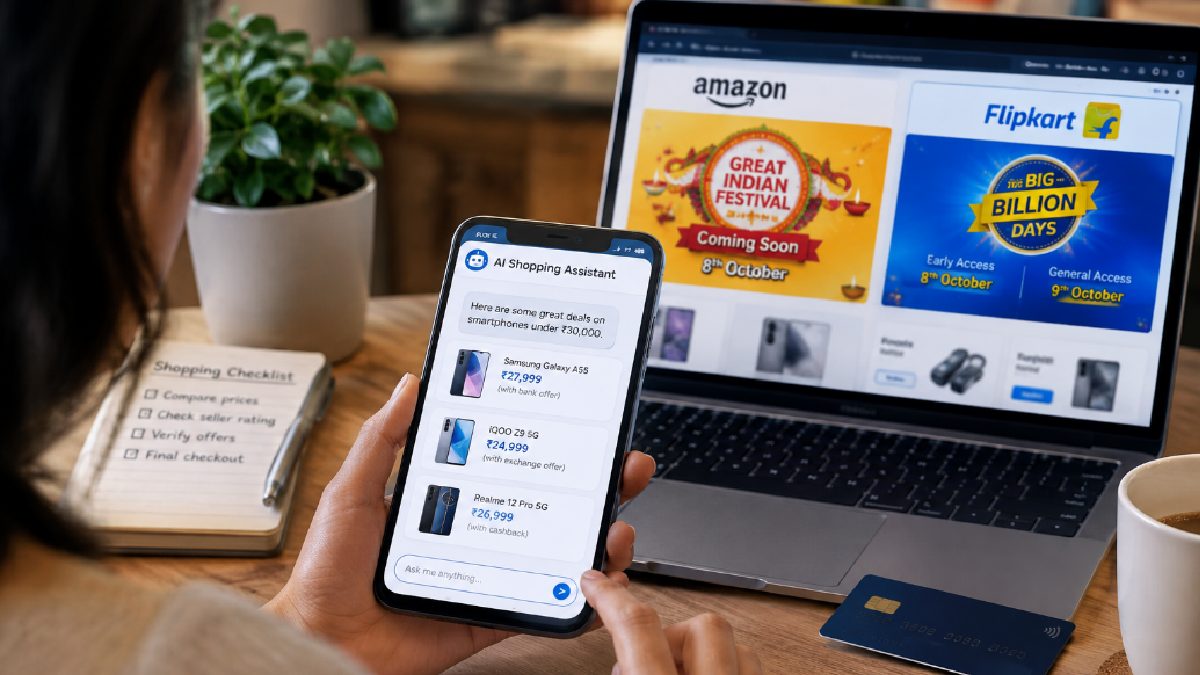
Artificial intelligence is rapidly changing how people search for products online, compare prices and decide what to purchase. During big festive shopping events like Amazon’s Great Indian Festival and Flipkart’s Big Billion Days, AI shopping assistants could help shoppers find discounts on thousands of products. But giving an AI agent the power to actually purchase brings with it new security and financial risks.
Six international banks, including NatWest and Bank of America, have all pointed out the need for stronger safeguards around agentic commerce, where AI systems can act on behalf of users when shopping and payment transactions happen. The principles were published on September 22 and cover transparency, safety, privacy, consumer choice, interoperability and more.
The news comes as Indian shoppers set up for the 2026 festive sales. Amazon has announced that its Great Indian Festival will start on October 8 and Flipkart has introduced early access for October 8 and general access from October 9. With shoppers looking for the best prices, AI assistants could be used to compare products and place orders and so on.
Why AI Shopping Agents Need Extra Caution
There is a crucial difference between asking an AI assistant to research a product and allowing it to spend money.
A shopper might ask an AI tool to compare two smartphones, identify the specifications or find the lowest advertised price. The consumer is still responsible for opening the retailer's website and completing the purchase.
An autonomous shopping agent might go further. Depending on the service, it may choose a product, choose a seller, apply an offer and proceed toward checkout using previously granted permissions.
The six banks, NatWest, ASB Bank, Bank of America, Capital One, Commonwealth Bank of Australia and ING, have put forward principles to address some of these challenges. Their proposals are voluntary and non-binding, and they are an industry model rather than binding rules that every shopping assistant already follows.
The concerns are excessive spending, privacy issues, unsafe handling of payment information and uncertainty over responsibility when an AI-assisted transaction goes wrong.
AI Recommendations Do Not Guarantee A Genuine Bargain
One of the biggest risks during festive sales is assuming that an AI-generated recommendation automatically represents the best or safest deal.
Online marketplaces can have multiple sellers offering the same product. Prices may vary depending on the seller, product condition, storage configuration, colour or warranty. A discounted price may also depend on a particular bank card, exchange offer, coupon or membership benefit.
An AI assistant might find a low price but fail to take into account a condition that does not apply to the shopper.
For example, a smartphone may be available at a very low price, but the final price could be higher after delivery charges or because the advertised bank discount is not available to customers. The assistant should therefore be considered as a research tool only if its purchasing permissions are clearly understood.
Set Clear Limits Before Giving An AI Permission To Buy
Consumers who use AI-powered shopping services should have clear boundaries before allowing an agent to complete a purchase.
The instructions can include the exact product or acceptable alternatives, the maximum amount that can be spent, the permitted seller and whether refurbished or open-box products are acceptable.
An unauthorised transaction and an authorised purchase can be crucial if an AI agent makes a surprising choice. A shopper who asks an assistant to find a new smartphone under a certain price has different instructions from someone who gives the system unrestricted permission to purchase any phone it considers suitable.
Technology standards such as the Agent Payments Protocol, or AP2, are being developed to address how payment authorisation can work in agentic commerce. Such systems differentiate between purchases directly approved by users and transactions made under previously established conditions. But the existence of a payment protocol does not mean a particular shopping application, merchant or seller is trustworthy.
Check The Seller Before Completing Amazon Or Flipkart Orders
When major sales are on the rise, shoppers should be sure to look at the actual seller before they order. The product title and image are not enough.
Consumers should verify the seller name, product variant, condition, warranty information, return policy, delivery charges and final payable amount. This is particularly important when an AI assistant has compared listings across different sellers.
The last checkout screen should be treated as the last verification point. Shoppers should verify that the product selected by the AI agent is the same product they intended to buy and that the price matches the amount they expected to pay.
If the assistant tells the shopper to go to an unfamiliar website for payment, it is better to stop and check on the transaction using the retailer’s official platform.
Never Share OTPs, UPI PINs Or Banking Passwords With AI
Payment credentials require a different level of caution. Consumers should never provide banking passwords, UPI PINs or one-time passwords to a chatbot just because they believe that the information is required to make a purchase.
A legitimate payment approval screen may ask the customer to authenticate a transaction, but that is different from asking the customer to reveal confidential credentials inside a conversation.
Shoppers should also check the recipient and transaction amount before approving a UPI or card payment. A request to enter a UPI PIN to receive a refund is another warning sign because receiving money does not require a customer to disclose or enter the PIN for that purpose.
What To Do If An AI-Assisted Purchase Goes Wrong
If an order contains the wrong product, comes from an unexpected seller or involves a disputed payment, consumers should preserve the relevant records. Order confirmations, transaction references, screenshots and the instructions given to the AI assistant can help establish what was authorised.
The retailer should be contacted through its official customer-support channels. If an AI service was involved in the purchase, its support team may also need to be contacted.
For suspected financial fraud or an unauthorised debit, customers should contact their bank or payment provider immediately through an official channel. In India, cyber financial fraud can also be reported through the National Cyber Crime Reporting Portal or by calling 1930.
AI Can Simplify Shopping, But Final Approval Still Matters
AI shopping assistants could make festive shopping quicker, comparing products, tracking prices and explaining complicated offers. But the convenience becomes more sensitive when the technology moves from recommending products to spending money on behalf of the user.
Amazon and Flipkart’s upcoming festive sales can use AI to create shortlists and compare deals while retaining control over the final checkout. Checking the seller, product specifications, applicable discounts and final price takes only a few moments but can help prevent an expensive mistake.
As agentic commerce develops, clear spending limits, transparent permissions and reliable payment protections will be more critical than they were in the past. And until the safeguards are made clear and implemented, consumers need to view the final purchase approval as a decision that’s at their very core.