A microsurgery robot has worked with exquisite precision to stitch up a corn kernel, illustrating how robotic systems might be employed by surgeons to do delicate tasks that require movements far smaller than the human hand can do.
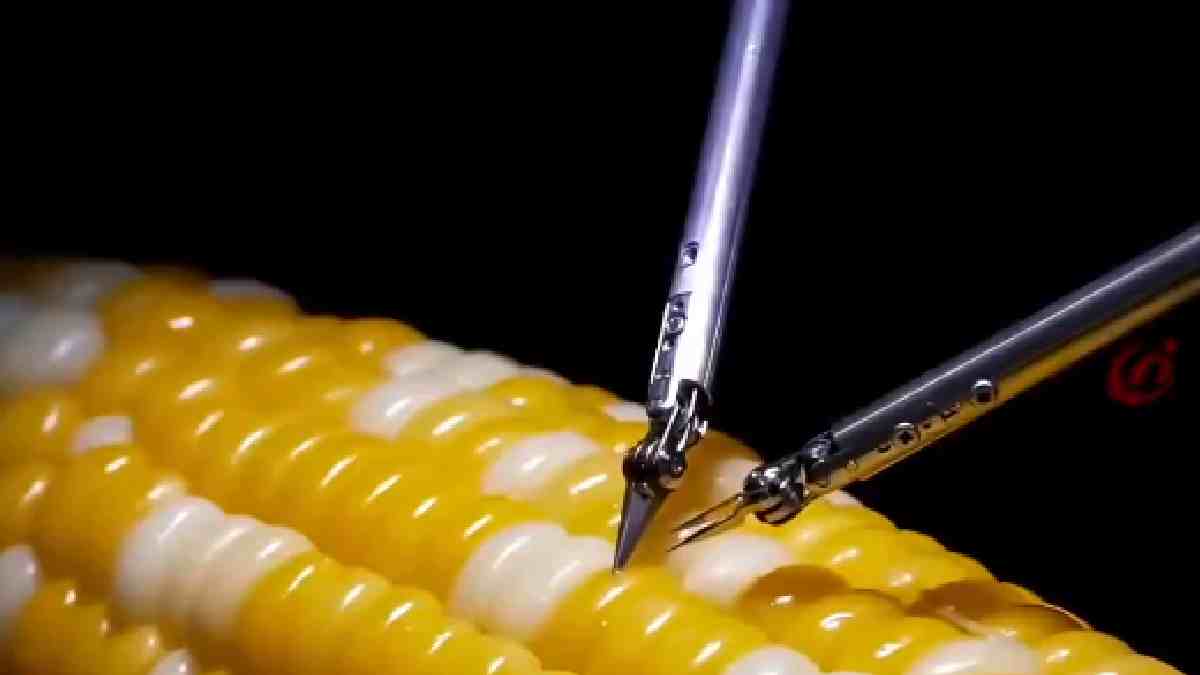
The unusual demonstration was a robot suturing a corn kernel, a small object that helps to visualize the precision needed to be performed.
Rather than a human patient, for example, the small kernel was used as a tool to show the machine’s ability to move with precision.
Microsurgery involves the operation on very small pieces of tissue (e.g. tiny blood vessels, nerves and tissue). Even slight unwanted movement can change the outcome of such surgical procedures.
Robotic systems are being developed to help surgeons control instruments with greater stability and precision especially when working at microscopic scales.
The corn kernel experiment is a vivid illustration of how this technology can work. A task which is virtually impossible for humans to do manually becomes manageable if the robotic system can carefully place its surgical instruments and make little movements.
Such systems are not meant to replace surgeons. Rather, robotic microsurgery platforms are designed to be tools that can extend a surgeon’s skills.
A surgeon can do the work in the system while the robot helps translate those commands to controlled and highly precise movements.
Microsurgery robot stitches up a corn kernel showing millimeter-level precision pic.twitter.com/MMil0ntcez
— Massimo (@Rainmaker1973) September 10, 2026
The technology might be used in areas where precision is important. Microsurgical procedures include reconnecting tiny blood vessels, restoring nerves or manipulating delicate tissue.
And there could be more robotic help needed to make the process more precise and repeatable.
The demonstration also illustrates how robotics is moving beyond the traditional notion of large surgical machines used for large surgical operations.
Robotics, imaging and instrument control are revolutionizing the way researchers are getting to see machines capable of doing more delicate tasks.
But stitching a corn kernel is a demonstration of precision and not proof that the technology is ready for routine medical use.
Real surgery is a much more challenging task, with living tissue, bleeding, movement, anatomy and the need for rapid clinical decision-making.
Such systems will need to be evaluated by researchers on their safety, reliability and effectiveness in clinical settings before they can be widely adopted.
But the little experiment is a fascinating preview of the future of surgery. If robots could consistently give millimeter- or even finer-scale control, they could be useful assistants in procedures where precision is key.
The humble corn kernel here is a great test subject for showing how far surgical robotics is going.