
A new estimate of stubble burning in northern India has called into question official farm-fire numbers: Dr Hiren Jethva, an aerosol remote-sensing scientist with Morgan State University and NASA’s Goddard Space Flight Center says that between October 1 and November 9 last year there were about 34,000 farm fires in Punjab and Haryana.
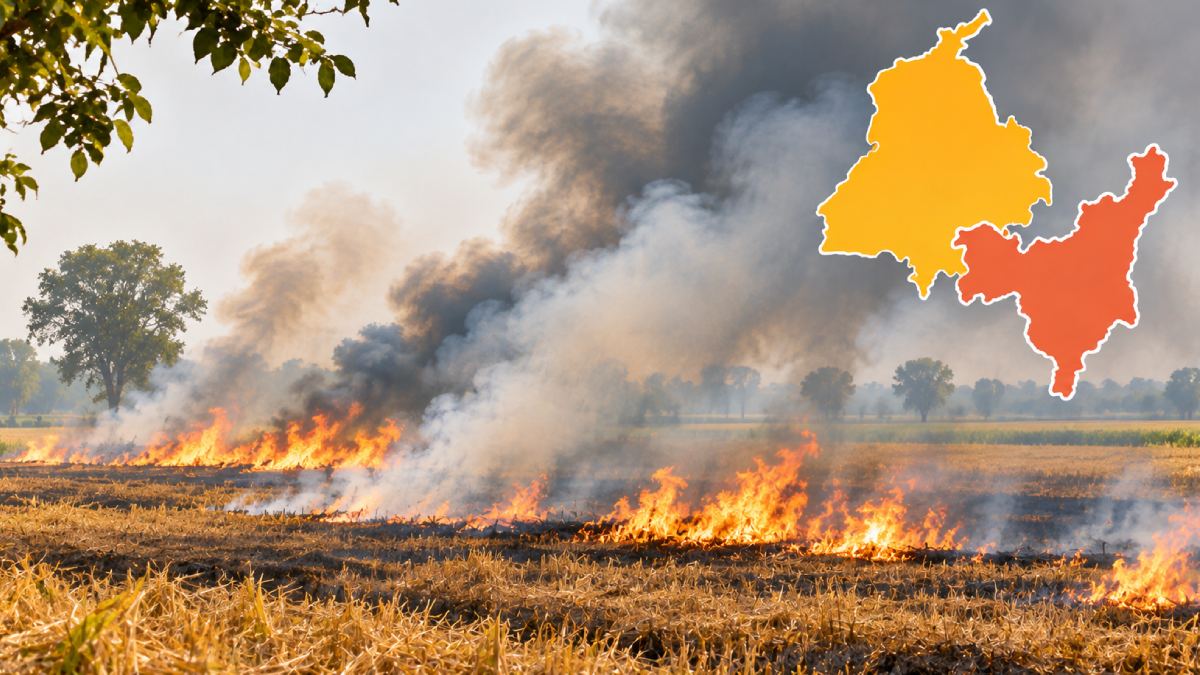
The number is much higher than the official count of 4,459 incidents recorded in Punjab alone by CAQM till November 8. The gap has reignited fears that conventional satellite monitoring systems are not picking up all agricultural residue burning.
“The main reason for this difference is that stubble burning timing has changed,” says Jethva. “Farmers have moved the activity to late afternoon and evening so many fires may escape normal satellite observation window.”
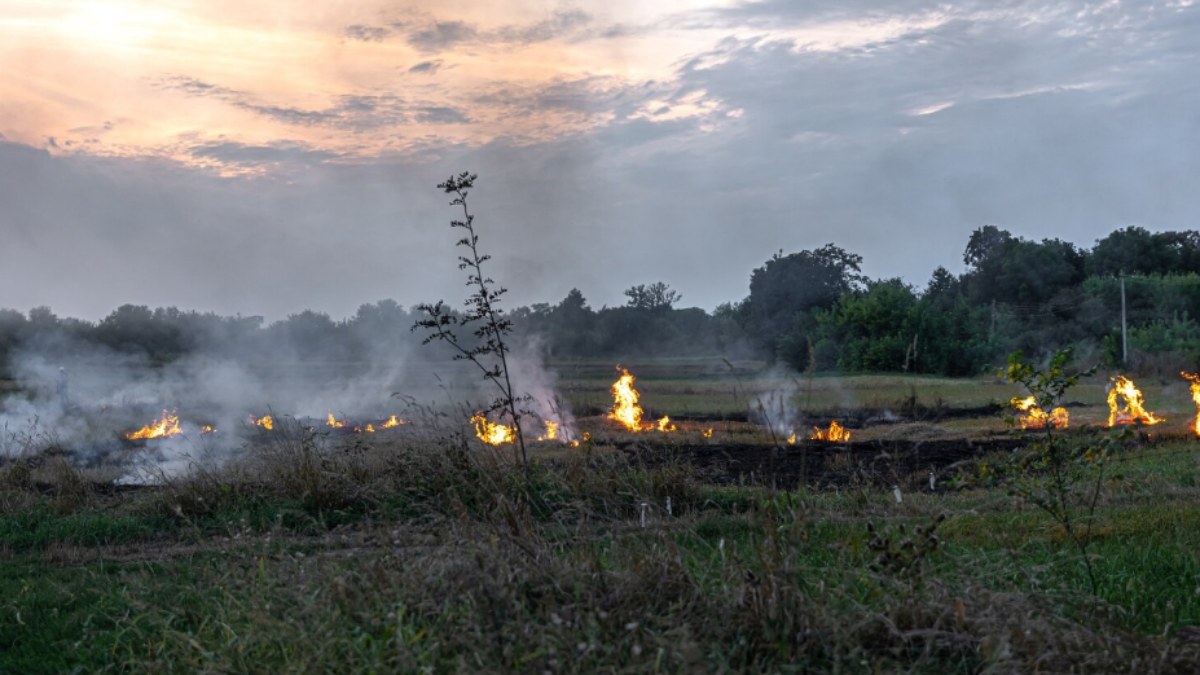
The research comes as air quality in Delhi and other parts of northern India deteriorates after Diwali. The debate has also brought attention back to the role that agricultural burning plays in seasonal air pollution.
NASA-Associated Scientist Estimates 34,000 Farm Fires
Jethva issued his latest satellite based assessment on 9 November which covered Punjab and Haryana from October 1 to 9.
His analysis used data from two satellite instruments:
- NOAA-20 VIIRS detected 4,089 fires around 1:30 PM local time.
- Aqua MODIS that detected 4,196 fires at about 4 PM local time.
Jethva then made an empirical adjustment to the higher resolution VIIRS fire count baseline and estimated that total farm fires could be as many as 34,000.
The point is that 34,000 isn’t a count of 34,000 independently verified fires — it’s an adjusted estimate from satellite data and then a calculation to account for fires which may not be detected by conventional monitoring.
Jethva had earlier done the same calculation using a similar methodology and estimated around 27,000 fires in Punjab alone between October 1-November 5.
Why is there such a big difference in farm fire numbers?
The gap between official records and scientist’s estimate has exposed the limitations of satellite-based fire monitoring.
Government agencies often use satellite instruments such as MODIS (Moderate Resolution Imaging Spectroradiometer) and VIIRS (Visible Infrared Imaging Radiometer Suite) to detect active fires.
These instruments detect thermal anomalies caused by burning activity. Polar orbiting satellites only observe a location on a scheduled pass. A fire that starts and burns out between windows of observation may not be recorded.
The problem is more acute when agricultural burning occurs outside the normal monitoring hours.
“Now the timing of stubble burning in Punjab and Haryana has changed from early afternoon to late afternoon (4 PM-5 PM),” Jethva said. “The timing has changed because earlier it was early afternoon, now its 4 PM-5 PM,” he added.
If fires start after a satellite has passed over a region they may have been put out before the next pass. Fewer incidents are recorded than burning events.
Farmers' Stubble Burning Timings Have Shifted
Changes in timing of agricultural residue burning across Punjab and Haryana have been noted previously.
Researchers at the Indian Space Research Organisation’s Space Applications Centre studied this change in timing of farm fires for a paper published in Current Science journal (November 2025).
The study found that the peak time of agricultural burning had shifted from about 1:30 pm in 2020 to around 5 pm in 2024.
This change is important because traditional satellite monitoring systems were set up around observation schedules that picked up more fires when burning activity was concentrated around midday.
If more fires get into the late afternoon hours then monitoring systems that rely on satellite passes to capture only part of the picture won’t get it all.
An analysis by the International Forum for Environment, Sustainability and Technology (iFOREST) also brought this monitoring gap to light. It found that a large proportion of farm fires in Punjab and Haryana had moved into later hours so fire count methods weren’t as reliable as measure of total burning activity.
What Do Official Punjab Figures Show?
As per CAQM figures quoted in reports Punjab reported 4,459 stubble-burning incidents till November 8, 2026.
The state also saw an increase in reported farm fires on Diwali (November 8) 1,152 incidents were reported. It was the highest single day count of the season so far.
The official data also contained the following district-level figures:
- Tarn Taran: 654 incidents
- Ferozepur: 592 incidents
- Sangrur: 488 incidents
- Bathinda: 406 incidents
- Patiala: 288 incidents
Physical inspections were carried out at 2998 reported sites. Evidence of stubble burning was found in 1310 sites.
Environmental compensation of Rs 62.55 lakh was levied in 1,228 cases out of which Rs 32.60 lakh has been recovered reportedly.
However these figures are official Punjab count whereas Jethva’s figure of around 34,000 covers Punjab as well Haryana. So the two figures have different geographical coverage and methodologies and cannot be used for like-for-like comparison.
How does stubble burning affect Delhi’s air quality?
Stubble burning is a seasonal contributor to air pollution in northern India (post-monsoon and winter).
After paddy harvest farmers have limited time to prepare the fields for the next crop. Burning leftover crop residue is one way agricultural land is cleared quickly after paddy harvest.
The smoke contains particulate matter and other pollutants which degrade air quality. Weather, wind direction and mixing in the atmosphere determine how much of this pollution reaches neighbouring regions (including Delhi-NCR).
The Council on Energy, Environment and Water (CEEW) has also said agricultural burning contributes to Delhi’s pollution in peak days. It has estimated that stubble burning can contribute as much as 40% of Delhi’s daily PM2.5 pollution on some days in late October/early November.
However it varies very day to day. Delhi’s air pollution is also influenced by vehicle emissions, industrial activity, construction dust, waste burning weather conditions and other regional sources too.
Therefore stubble burning should be seen as an important cause but not the only explanation for air quality problems in the region.
Why India Needs Better Satellite Monitoring
The gap between conventional official counts and the adjusted estimate has led to calls for better monitoring of agricultural fires.
Experts have said satellite observations need to be more frequent so they can record burning activity throughout the day (late afternoon and evening included).
Combining data from different satellites might help authorities find fires that individual instruments miss. Burnt area mapping may also be more complete than active fire counts alone.
Active fire counts count detected burning events at the time of satellite imagery acquisition. Burnt-area mapping looks at land affected by fire over time (i.e., burned area).
Using both methods could help policymakers estimate how much agricultural burning is happening more precisely and whether government interventions are reducing the overall area affected.
Monitoring would also help authorities identify districts and periods where stronger action is needed; assess crop-residue management programmes more reliably.
What Happens Next?
The latest estimate has raised questions about the effectiveness of existing stubble-burning monitoring systems in Punjab and Haryana.
Official records only record detected incidents and enforcement action taken but Jethva says if observations outside the satellite windows were also counted the actual number of fires could be much higher.
The results don’t independently show that every additional estimated fire was a separate confirmed incident but they do point to a major monitoring challenge that needs further investigation.
As northern India moves into another winter pollution season fire detection will remain part of the response; support for farmers with alternatives to residue burning and enforcement will also be important.
The bigger problem isn’t counting farm fires it’s making sure that data used to assess agricultural burning reflects what is actually happening on the ground.


Comments