
In an incredible feat of engineering and extreme sports, Spanish B.A.S.E. jumper Dani Roman and French athlete Fred Fugen became the first people to be launched out of a chimney with a giant human catapult. The record breaking stunt took place at the 360 metre high Trbovlje chimney in Slovenia where the athletes were catapulted vertically into the sky before entering freefall and deploying their parachutes.
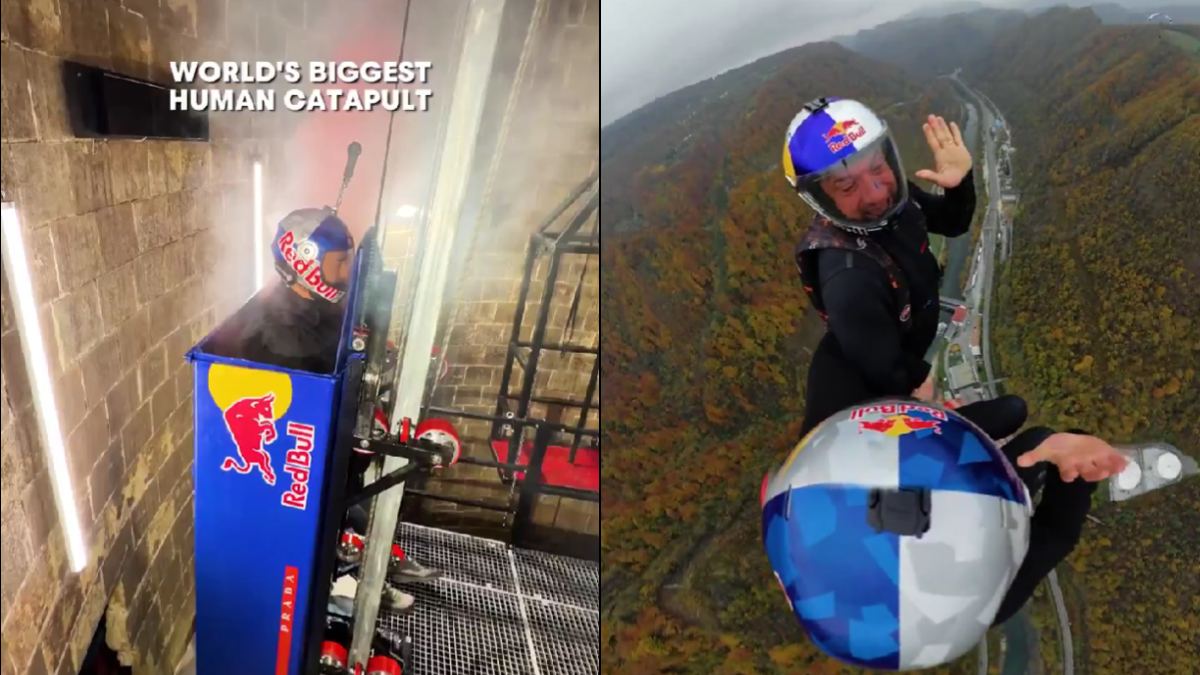
Human Catapult was organised by Red Bull in association with Prada Linea Rossa. A specially built 60-metre long launch system was installed inside the chimney and accelerated the athletes from zero to 180 kilometres per hour in 2.15 seconds.
from chimney to sky @FredFugen and Dani Roman just became the first-ever humans to catapult out of a chimney presented by #PradaLineaRossa @Prada https://t.co/1k8KmcnGo4
— Red Bull (@redbull) November 9, 2026
The daring challenge also yielded two Guinness World Records. Roman set the record for greatest height by human catapult in an individual launch while Roman and Fugen jointly broke the record for greatest combined height during simultaneous launch.
The project took about two and a half years to develop; extreme sports experience, specialised engineering and a well thought out launch mechanism all came together.
How Did the Human Catapult Stunt Work?
The launch took place inside the Trbovlje chimney (360 metres high industrial structure in Slovenia; Europe’s tallest chimney).
A specially built 60-metre catapult was installed inside the structure to launch the athletes vertically. Instead of jumping from a fixed structure or elevated natural location (as in B.A.S.E.) this project used a mechanical launch system to give initial speed and upward momentum.
Roman and Fugen were inside the launch capsule before the system was fired off. The catapult took them from zero to 180 km/h in just 2.15 seconds.
They kept going up after leaving the capsule (briefly feeling weightless at the highest point of their trajectories). They then entered freefall before deploying their parachutes and landing safely.
The launch forces (acceleration forces) on the athletes were up to 4.2G so it was a very demanding physical experience.
Dani Roman and Fred Fugen Set Two Guinness World Records
The Human Catapult project produced two separate Guinness World Records.
In his individual launch Spanish athlete Dani Roman went up to 100.36 m above the release point of the catapult which is the highest height reached by a human catapult.
The second record was set during a simultaneous launch of both athletes.
Roman went 75.97 metres above his release point and Fugen reached 75.75 metres. Their combined height (officially measured as 151.72 metres) became the greatest combined height ever by human catapult.
The successes show how the project integrated a specialised mechanical system with the athletes’ experience parachuting, wingsuit flying and B.A.S.E. jumping.
Who Are Dani Roman and Fred Fugen?
Dani Roman is a Spanish B.A.S.E. jumper, skydiver and wingsuit flyer who participates in ambitious aerial projects. He has competed in wingsuit flying, coached and been involved in several human flight related projects.
French athlete Fred Fugen is a skydiver, wingsuit pilot and B.A.S.E. jumper; he is also member of aerial sports team Soul Flyers and has been involved in several high profile extreme sports challenges.
Both athletes had a lot of experience with the Human Catapult project but chimney launch was a different beast because it didn’t start with a jump (mechanical system kick) as opposed to normal jump.
The athletes had to control the launch forces before entering into familiar freefall and parachute deployment stages.
The Engineering Behind the World's Biggest Human Catapult
The catapult was designed by DD Squad, a Slovenian team of stunt performers and engineers. The 60-metre system had a two-tonne multi-spring mechanism for vertical launch only.
The engineering team worked on the project for about two and a half years. Smaller catapult experiments were done before the team scaled up the design for the final chimney installation.
The project had to be done with acceleration, launch control and athletes’ safety in mind. “We weren’t looking for the most powerful launch,” DD Squad said, “but how to find a balance between performance and controlled movement.”
The final construction took about two months inside the chimney and the team worked long hours to finish the installation.
The project was inspired in part by an earlier aerial obstacle course by Roman and Fugen with smaller catapult systems to launch wingsuit flyers.
Red Bull and Prada Linea Rossa's Partnership
The Human Catapult project was funded by Prada Linea Rossa, the performance-focused line of Italian luxury fashion house Prada.
The partnership brought Red Bull’s involvement in extreme sports and Prada Linea Rossa’s technical clothing and accessories together.
Roman and Fugen wore functional outfits for the challenge (technical jackets, trousers, shoes, eyewear).
The collaboration is part of an existing partnership between the two brands that have supported athletes who take on unconventional sporting challenges.
A New Direction for Extreme Aerial Sports
The Human Catapult project was an unusual take on B.A.S.E. jumping and human flight as the athletes did not jump off a fixed structure or aircraft but instead used a mechanical launch system to generate their initial upward motion.
The stunt also shows how specialised engineering can be combined with experience of professional aerial athletes.
The project used a highly controlled launch system and experienced participants but it is still an extreme sport that should not be attempted without specialised equipment, professional supervision and extensive safety planning.
With two Guinness World Records under their belts Roman and Fugen have also brought another unusual thing to extreme aerial sports world. Their launch from the Trbovlje chimney has also put Human Catapult project into the list of most unconventional attempts to push the limits of human flight.






Comments