
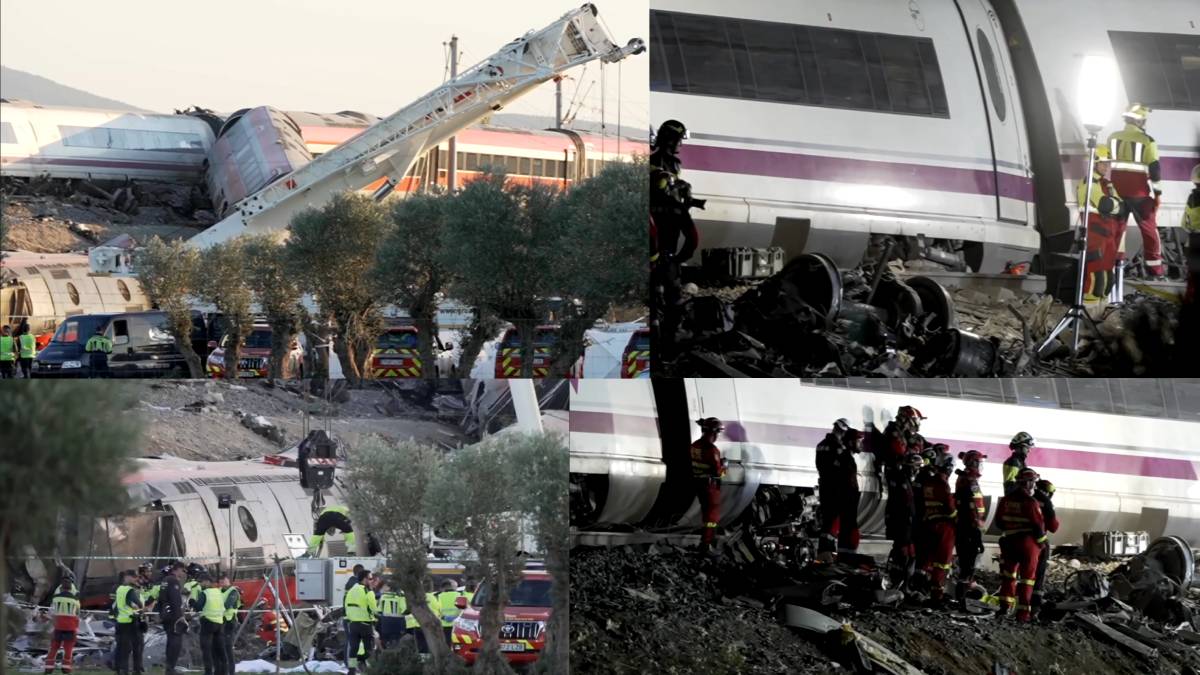
At least 68 people have been killed and dozens injured after two high-speed trains collided in central Spain on October 28, 2026, in one of the country’s deadliest railway disasters in recent decades. The collision involved a state-owned Renfe high-speed train and a privately operated Iryo train that had stopped on the tracks near Urda, in the province of Toledo, south of Madrid.
What exactly happened?
According to regional authorities, the Renfe train was carrying 397 passengers, while the Iryo train had 147 people on board, including an infant. The two trains were carrying a combined total of 544 passengers when the collision occurred on the Madrid–Seville high-speed line at around 8:54 a.m. local time.
The impact caused several carriages to derail, with some plunging down an embankment. Emergency services rushed to the scene, deploying firefighters, police officers, ambulances, medical helicopters and military emergency personnel to assist with rescue operations. Rescuers worked to reach people trapped inside the mangled carriages, while injured passengers were transported to nearby hospitals.
The death toll reached at least 68, while Spanish Health Minister Mónica García reported that 80 people had been injured, including 15 who were in very serious condition. Rescue workers continued searching the wreckage as authorities worked to identify the victims and inform their families.
The exact cause of the collision remains under investigation. However, Transport Minister Óscar Puente said preliminary information indicated that a communications failure in the railway control system had triggered a red signal and halted train movements. The Renfe train was subsequently authorised to continue despite the stationary Iryo train ahead, according to the minister. Investigators will need to establish the precise sequence of events and determine how the train was cleared to proceed.
The disaster comes just nine months after another deadly high-speed train accident near Adamuz, in Córdoba province, in January 2026, which killed 46 people. Both incidents involved trains operated by Renfe and Iryo and were on the same railway line, although Prime Minister Pedro Sánchez said the causes of the two accidents appeared to be unrelated.
The reactions after the incident
A vigil was held near the crash sight obse3rving a minute of silence.
European flags will fly at half-mast in Brussels as a show of solidarity in Spain's grieving period
Addressing the tragedy, Sánchez said, “Today all of Spain is grieving.” He also spoke of the shattered lives and families affected by the disaster, pledging a full investigation into the circumstances surrounding the collision. The prime minister announced three days of official national mourning, during which Spanish flags on public buildings and diplomatic missions will fly at half-mast.
The accident has also disrupted Spain’s political campaigning ahead of the November 29 election. Most major political parties suspended their scheduled campaign events as a mark of respect for the victims, although the far-right Vox party was reported to be an exception.
Opposition leader Alberto Núñez Feijóo called for answers about the country’s railway infrastructure and safety systems. He argued that the public had a right to know the condition of the infrastructure and called for a thorough investigation. His remarks have added to growing scrutiny of railway maintenance, safety protocols and the government’s response to the two fatal accidents.
Public anger was also visible in Madrid, where more than 1,000 people gathered outside the Transport Ministry on the night of October 28 to demand accountability and call for the resignation of the Transport Minister and the prime minister. The protest escalated into clashes after some demonstrators confronted police lines and threw bottles and flares. Police used tear gas and other crowd-control measures to disperse the gathering.
Meanwhile, Spain’s train drivers’ union, Semaf, maintained a planned 24-hour strike for October 29, citing demands for improved railway safety and the implementation of previously agreed measures. The strike had been called before the latest collision, following disputes over safety standards, staffing and the fulfilment of commitments made after the January disaster. The union said it would avoid speculating about the cause of the latest crash until the investigation establishes what happened.
Tributes were held in several Spanish cities, with local authorities and residents observing a minute of silence for those who lost their lives. At the crash site, rescue crews continued working through the night amid the wreckage, while families waited for information about missing relatives. The tragedy has renewed questions about the safety and maintenance of Spain’s high-speed rail network, once regarded as a major achievement in European transport infrastructure.



Comments