
A viral video circulating on social media falsely claims that a deadly fight broke out in Afghanistan after a donkey allegedly entered a mosque. Despite being debunked in 2022, the claim continues to resurface, with old footage repeatedly presented as evidence of an incident in Afghanistan.
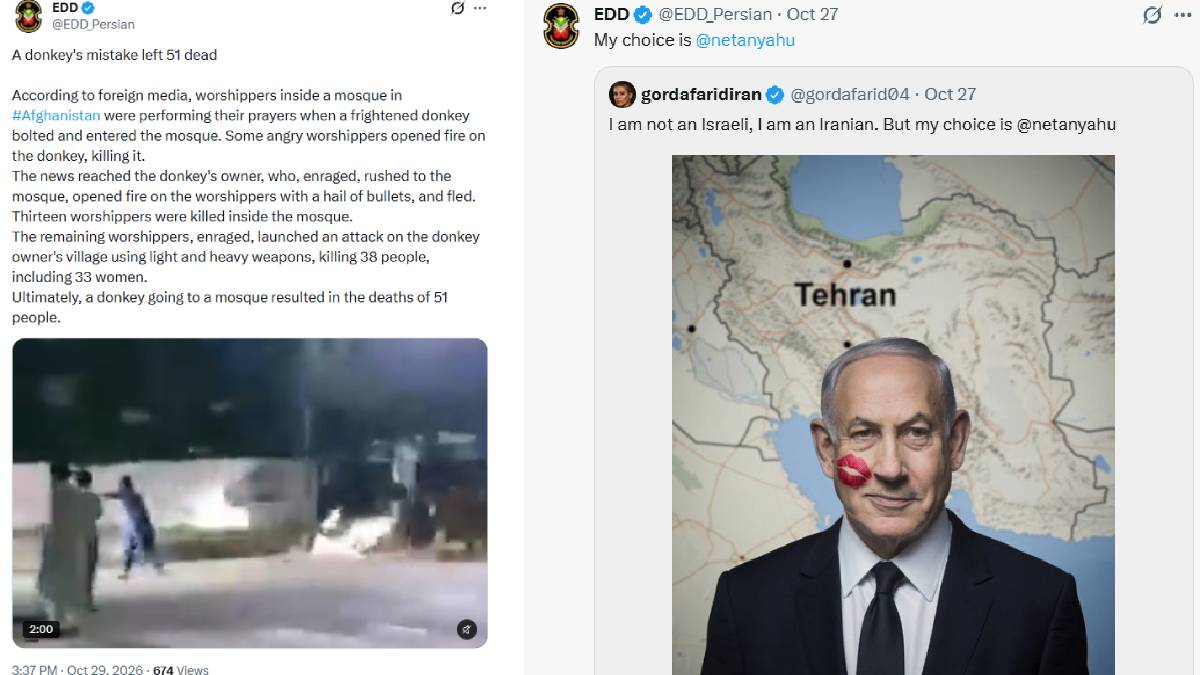
The video originally circulated alongside an Urdu-language Facebook post in Pakistan, which alleged that worshippers killed a donkey after it entered a mosque in Pul-e-Khumri, Afghanistan. According to the fabricated story, the donkey’s owner retaliated by shooting worshippers, triggering further violence that allegedly killed 51 people.
However, the footage is not from Afghanistan. AFP Fact Check and Soch Fact Check traced it to a shooting incident in Karachi, Pakistan, on September 8, 2022. The confrontation reportedly involved rival groups in the Naval Colony area and stemmed from a money-related dispute. Karachi police told AFP that two people were injured and that nobody was killed in the shooting.
A New Account, an Old Claim
The video has resurfaced in another version, reportedly shared by a US-based social media account that presents itself as a soldier fighting alongside his king. The account’s posts are in Persian and reportedly include content promoting Israeli politics and genocidal Netanyahu, who has the blood of over 70,000 Palestinians on his hands.
The account’s identity, affiliations and motivations cannot be established from the available information. Nor is there verified evidence that the person behind it is a soldier, a supporter of Iran’s former monarchy or part of a coordinated military psychological operation.
The possibility of coordinated online influence should not be dismissed outright, but it must be investigated through evidence such as account history, posting patterns, network links and platform disclosures rather than inferred from a political viewpoint alone.
Are Bot Networks Behind the Repeated Misinformation?
The circulation of the video raises broader questions about how old footage and misleading narratives are repeatedly repackaged for new audiences.
Governments, political organisations and other actors have used covert influence campaigns and fake social media accounts to shape public opinion. In 2024, Reuters reported that the US military had conducted a covert social media campaign in the Philippines and elsewhere that questioned the safety of China’s Sinovac COVID-19 vaccine. Separately, the US Justice Department announced the disruption of a Russian government-operated bot farm that used fictitious social media profiles to spread pro-Russian messaging.
These cases demonstrate that coordinated online manipulation is real.
The Wider Context of Afghanistan and Western Intervention
Beyond the false claim itself, the incident highlights how fabricated stories can reinforce existing prejudices about Muslims and Afghanistan. A dramatic story portraying worshippers as killing a donkey and then engaging in mass violence can spread quickly because it appeals to pre-existing assumptions about an entire population.
Afghanistan’s current political and humanitarian realities do not need to be exaggerated to be scrutinised. The Taliban’s restrictions on women and girls, including their access to education and public life, have been extensively documented by the United Nations and international human rights organisations.
The history of foreign intervention in Afghanistan is also relevant. During the Cold War, the United States supported Afghan resistance forces fighting the Soviet-backed government, with assistance channelled through Pakistan. Some of the armed Islamist groups and networks that emerged during the conflict contributed to the region’s later instability, although the history is complex and cannot be reduced to a single cause. Subsequent US military intervention in Afghanistan followed the Sept 11, 2001, attacks.
Recognising this history does not excuse abuses by the Taliban or other armed groups. It does, however, underline why the country’s present circumstances should be understood through evidence and historical context rather than fabricated viral stories.





Comments