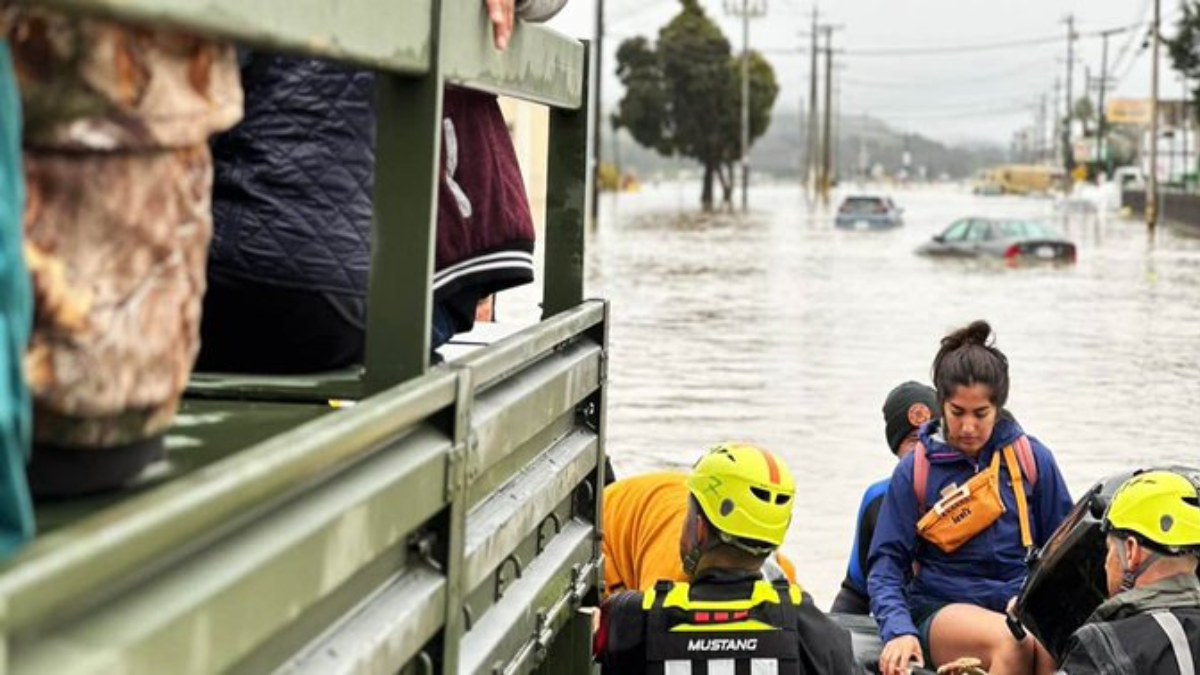
Scientists have issued a warning about the risk of an imminent weather disaster, a so-called ARkStorm 2.0, a hypothetical but theoretically feasible mega-storm that could bring an unprecedented flood in California. Great residential areas would flood to the brink with floodwater volumes up to 20 feet, force the evacuation of more than 1.5 million people and cost more than $1 trillion.
ARkStorm (Atmospheric River 1,000-year Storm) was first coined in 2010 by the United States Geological Survey (USGS) with federal agencies and state and academic partners to assist governments and emergency management agencies in the event of an extreme weather disaster that results from atmospheric rivers: long, narrow bands of moisture in the atmosphere that carry huge amounts of water vapour from tropical regions to higher latitudes.
Atmospheric rivers are so much a part of California’s climate and water system. The atmospheric rivers bring much of the rain that is needed to irrigate reservoirs, rivers and snowpacks needed to replenish them. But when multiple atmospheric rivers go down in rapid succession, they can trigger catastrophic floods and landslides and widespread infrastructure destruction.
If the ARkStorm 2.0 scenario were to occur, a series of powerful atmospheric rivers would batter California’s coast for nearly a month. It would rain and snow all over the state; rivers, reservoirs, flood control systems and urban drainage systems would be overwhelmed. Scientists say some areas could experience floodwater as high as 20 feet, submerging neighbourhoods, roads and critical infrastructure.
The scenario is based on California’s historic Great Flood of 1861-62, one of the most destructive natural disasters in the state’s history. These storms pummeled California for 45 days and turned the Central Valley into a huge inland sea about 500 kilometres long. People were drowned, agricultural land was destroyed, and government operations were disrupted. California has seen storms like that many times in the past 1,800 years, and another serious flood is possible.

Climate change is making that more likely. Scientists say global warming is amplifying the atmosphere’s ability to hold moisture. This phenomenon, also called the “expanding atmospheric sponge effect,” means that for every 1.8 degrees Fahrenheit (1 degree Celsius) of warming, the atmosphere can retain approximately 7 per cent more water vapour. Warming up more quickly, storms can draw on more of it and the risk of flooding increases.
Researchers also fear that warmer temperatures are reducing snowfall in the Sierra Nevada mountains. No longer falling as snow that slowly melts over time, more precipitation is coming as rain. Existing snowpacks are also melting faster and leading to a surge in runoff into rivers and reservoirs. The runoff levels in an ARkStorm event could rise by 200 to 400 per cent, putting a huge strain on California’s flood management systems.
The USGS has said in the past that many of California’s flood defences (e.g., levees, canals, reservoirs and pumping stations) were not able to withstand an event of the magnitude of ARkStorm 2.0. While state authorities are investing heavily in infrastructure upgrading and flood mitigation projects, experts say adaptation efforts must accelerate to keep pace with growing climate risks.
California is currently investing more than $30 billion in flood protection and disaster preparedness over the next 30 years. Scientists say upgrades may need to be shortened because these days extreme weather events are more frequent and dangerous.
Even if you can’t predict when an ARkStorm-scale event might take place, experts say it is necessary to be prepared. Climate change is a threat to the world’s infrastructure, and it’s a cause of serious consequences that we need to be prepared for, and all people need to be prepared for, to respond.