A reported clash between the China Coast Guard (CCG) and Philippine Navy near Ayungin Shoal (international name Second Thomas Shoal) has reignited tension in the disputed South China Sea. A Filipino sailor was attacked on the head with a wooden baton near the BRP Sierra Madre, the grounded naval vessel that is Manila’s military base in the Spratly Islands, Philippine authorities said.
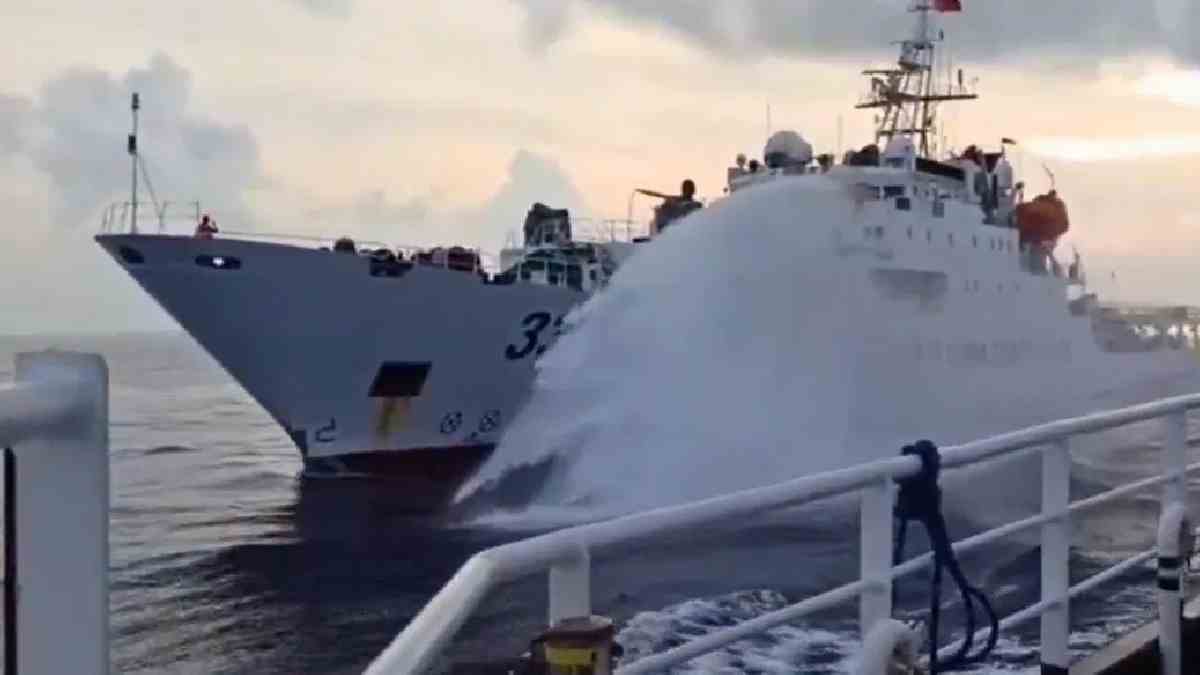
The Armed Forces of the Philippines described the incident as part of a continuing pattern of what it called provocative and hostile behaviour by Chinese maritime forces.
Why Ayungin Shoal Matters
The BRP Sierra Madre has been stationed at Ayungin Shoal since 1999, when the Philippines intentionally grounded the ship to reinforce its territorial claim in the Spratly Islands.
Since then, the location has become one of the most sensitive flashpoints in the South China Sea, with repeated confrontations between Philippine resupply missions and Chinese coast guard vessels.
The latest clash was a physical one, but analysts say it is just one of many in the region.
What is the strategy beyond individual incidents?
Security experts believe that China’s actions around Ayungin Shoal aren’t isolated incidents but part of a long-term strategy for military expansion of control in the South China Sea.
So Beijing is trying to establish its dominance in the region by utilizing the following elements:
- Coast Guard patrols.
- Maritime militia operations.
- Administrative control.
- Infrastructure development.
- Persistent pressure on rival claimants.
Rather than relying only on conventional military conflict, China has frequently been accused by other claimant states of using “grey-zone” tactics that apply sustained pressure while remaining below the threshold of open warfare.
Which is important to the First Island Chain?
The First Island Chain is a strategic issue for a group of islands that extend from Japan all the way to Taiwan and the Philippines and then to Southeast Asia.
Among many defence analysts, there is a perception that this chain limits the Chinese navy's unrestricted access to the wider Pacific Ocean.
According to strategic assessments, greater control over the South China Sea would enhance China’s ability to operate beyond this geographical boundary and strengthen China’s maritime presence throughout the Indo-Pacific.
Regional and Global Implications
The incident has reignited anxieties among regional governments and international observers as well as international shipping experts about maritime security, freedom of navigation and stability on one of the world’s busiest shipping routes.
The South China Sea accounts for a significant share of global trade and the tensions there are of great concern internationally.
The United States, Japan, Australia and a few Southeast Asian nations continue to monitor the situation closely and support international maritime law.
Arbitration Ruling Remains Central
The renewed tensions also come at a time of intense debate on the landmark 2016 Permanent Court of Arbitration ruling, which turned down many of China’s sprawling maritime claims in the South China Sea.
China has consistently rejected the tribunal’s decision, and the Philippines continues to point to it in favor of its maritime rights in international law.
Growing Strategic Competition
The reported clash near Second Thomas Shoal is a prime example of the ever more interrelated geopolitical competition in the Indo-Pacific.
While China and the Philippines continue diplomatic operations alongside maritime activities, the recurring incidents at disputed reefs and shoals underline the precarious security condition in the South China Sea and the struggle for balance between national interests, regional stability, and international law.