A futuristic Chinese fire truck concept is catching attention for its unorthodox approach to firefighting, combining drones, fire-extinguishing bombs and centralized command-and-control technology into a single emergency response system.
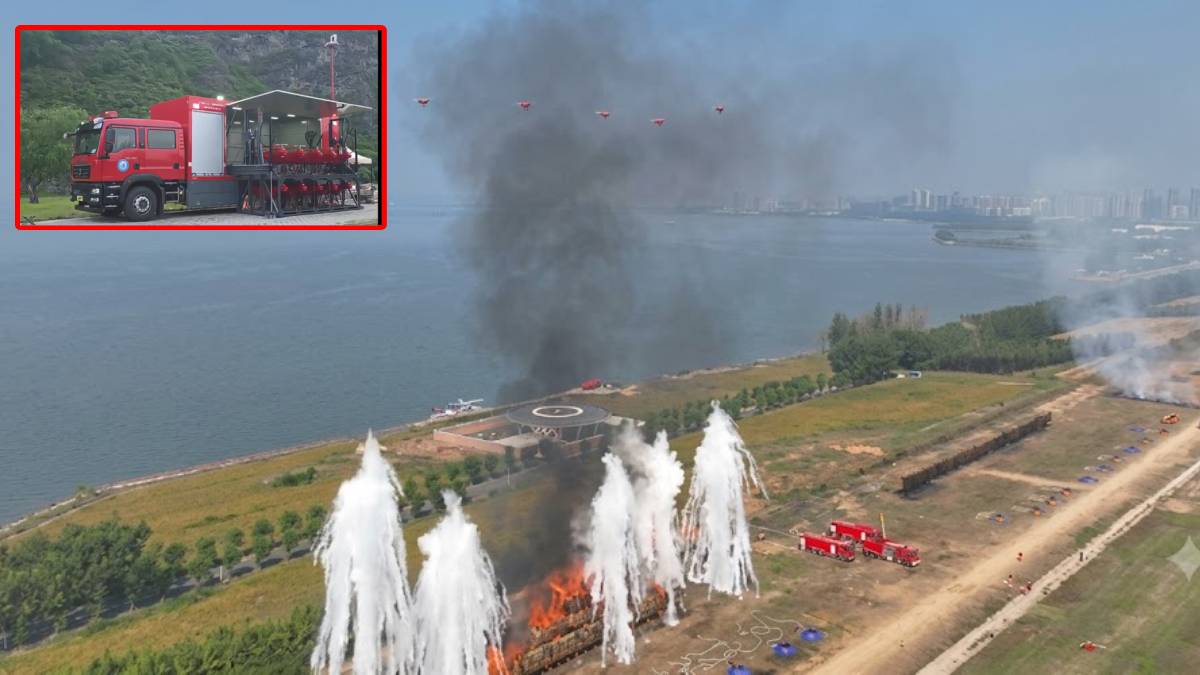
Unlike traditional fire engines that depend on firefighters getting to the site of the problem building and spraying water or foam from ground-based equipment in the process, the model aims for a coordinated system that can be deployed on multiple levels. Drones could provide aerial surveillance, deliver firefighting equipment, and attack difficult-to-reach areas while the main vehicle remains at a safer distance.
The concept in general has one of the most striking elements: drones. Unmanned aerial vehicles can assist emergency teams in the short run to get a look at a fire scene quickly, especially when smoke, collapsing structures, or blocked roads hinder access to a fire scene. Aerial cameras would help locate and assess the location and intensity of the flames while communicating such information to the command vehicle operators.
Another unusual aspect of the system is fire-extinguishing bombs. Such devices could carry fire-suppression materials into areas that firefighters are unlikely to reach and/or unsafe to do so. Instead of firefighters going immediately into a burning building to suppress or slow the flames, remote-controlled systems would be used to do so first.
The concept also focuses on centralized command and control. A central command system would coordinate multiple drones and firefighting resources at the same time, and operators would be able to monitor the situation and direct individual units to work as needed.
A Chinese fire truck concept built around drones, fire extinguishing bombs, and centralized command and control. pic.twitter.com/VmPK7AVTw1
— Massimo (@Rainmaker1973) September 9, 2026
It is part of a broader evolution in emergency services to integrate robotics, artificial intelligence, sensors and remote-control systems. Firefighting is particularly well suited to such technologies because fires can become so quickly evolving that they can kill human responders.
Drones could be used to monitor rooftops, upper floors, industrial facilities and other areas where traditional firefighting equipment has limited visibility. Thermal imaging cameras could also help identify hotspots that may not be visible through normal video feeds.
Another advantage is situational awareness. Emergency commanders in a major fire must quickly make decisions in the face of a rapid shift of information. A network of drones could be used to offer multiple views on the scene to inform responders on where fire is spreading, where open areas are still available for fire victims to access, and whether people are still in danger.
The centralized system could integrate data from drones, ground vehicles and other sensors into a common operational picture. This could help emergency teams coordinate their response more efficiently than individual crews simply communicating on radio.
But the technology would not replace firefighters or fire engines. Water hoses, foam systems, ladders, rescue assets and trained personnel would be important for many types of emergencies. Drone-based systems would more realistically serve as an additional layer of support.
There are practical issues too. Drone operations can be affected by extreme heat, smoke, strong winds and limited visibility. Battery endurance is also critical, and multiple autonomous or remotely controlled drones around buildings, power lines, and other obstacles are also very important and require coordination.
Fire-extinguishing payloads would also require strict safety procedures and regulatory approval. All aircraft with suppression material would need to be controlled, and any airborne device would need to be carefully controlled to avoid unintentional damage or injuries.
Despite these challenges, the Chinese fire truck concept shows how emergency response may change as robotics and autonomous systems become more advanced. Instead of treating a fire engine as a vehicle transporting firefighters and equipment, future platforms may be used as mobile command centers for humans, drones and robotic systems.
And if developed and deployed, such technology could potentially improve response times, increase situational awareness and reduce the immediate exposure of firefighters to extremely hazardous environments.
The idea is ultimately a move towards technology-enabled firefighting, and humans will still make the decisions that will need to be made while machines will be doing reconnaissance, remote intervention and other dangerous tasks.
As cities become more densely populated and buildings taller and more complex, new firefighting technologies could be even more important. The Chinese concept offers a glimpse of what that future could look like: a connected fire-response vehicle that guides a fleet of drones from the ground and gives commanders an accurate view of the emergency.