NASA has discovered evidence of one of the largest recent impacts on the Moon after its Lunar Reconnaissance Orbiter (LRO) discovered a huge new crater formed in 2024.
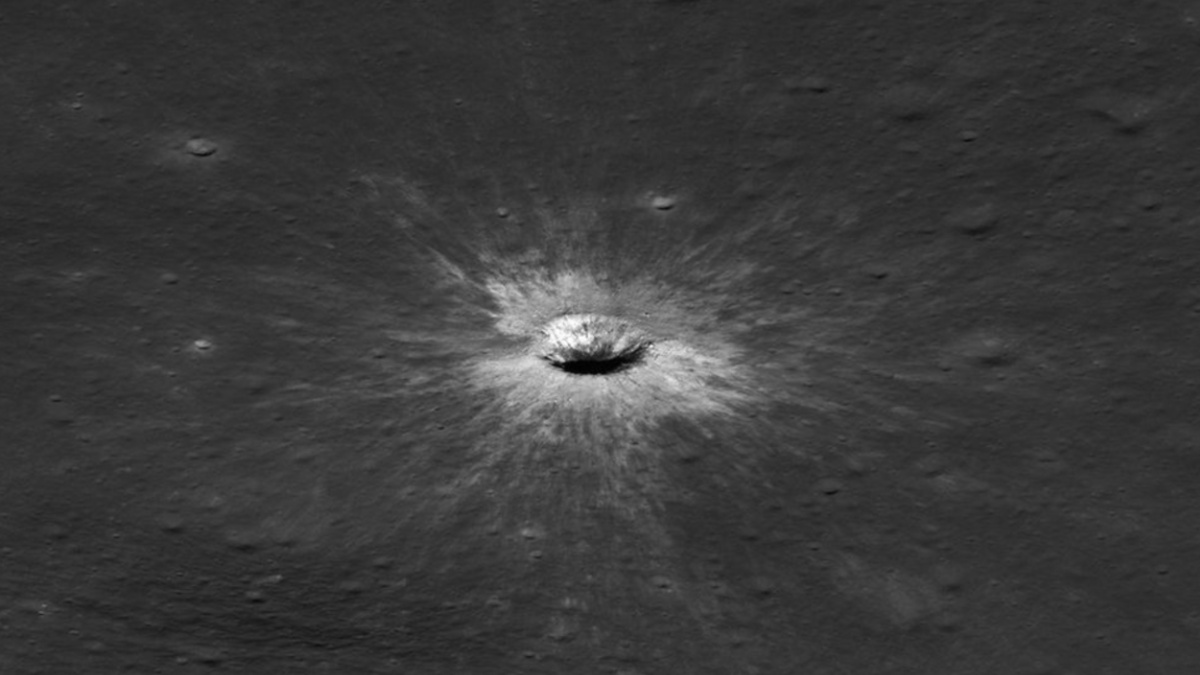
The crater is officially called the McGetchin crater and is about 222 metres (728 feet) across and is about 43 metres deep. Scientists say the impact was caused by a piece of an asteroid or comet that was about the size of a three- to six-storey building.
The impact occurred somewhere between April 11 and May 22, 2024, on the eastern part of the Moon's near side. As the Moon has no atmosphere to burn up incoming space rocks, objects can strike its surface at extremely high speeds and create new craters.
How NASA Found the Crater
The amazing thing about the discovery is that the impact was not detected from Earth or identified in real time.
NASA's LRO had taken photos of the region before and after the collision. From a routine analysis on October 24, 2025, scientist Robert Wagner noticed an unusually bright area surrounded by a darker pattern in images from the spacecraft's Wide-Angle Camera.
Scientists then compared older and newer images and confirmed that a new impact site had appeared. LRO's Narrow-Angle Camera later revealed the crater's size, shape and surrounding debris in higher resolution.
Impact Changed More Than the Crater
The collision did not just leave a hole in the lunar surface. Rocks and dust were thrown out into the lunar space and disturbed an area far beyond the crater.
NASA's Diviner instrument also detected a cold region about four miles wide around the crater. Scientists say the impact loosened and “fluffed up” the lunar soil, or regolith, so it could not retain heat during the lunar night.
The Moon’s got a big new crater! 🕳️
— NASA Solar System (@NASASolarSystem) September 16, 2026
Spotted by NASA’s Lunar Reconnaissance Orbiter, the McGetchin crater formed when a rock as big as a six-story building crashed into the Moon. It’s 141 feet deep and wider than the length of two football fields.🪨💥🌕https://t.co/I2fX7bPts1 pic.twitter.com/Zft4mKUv1Z
Why This Discovery Matters
Scientists estimate an impact of this scale may occur only once every century or longer on the Moon. This makes McGetchin crater a great natural laboratory to study how impacts reshape the lunar surface.
The discovery is also of interest to future lunar exploration. Knowing how frequently large objects strike the Moon can help researchers assess risks to spacecraft, rovers and future lunar infrastructure.
When Did It Happen?
Impact: Between April 11 and May 22, 2024
Crater identified: October 24, 2025
Discovery announced: September 16, 2026
Crater: McGetchin crater
Size: 222 metres wide and about 43 metres deep
The finding was reported in Science Advances and announced by NASA on September 16, 2026.