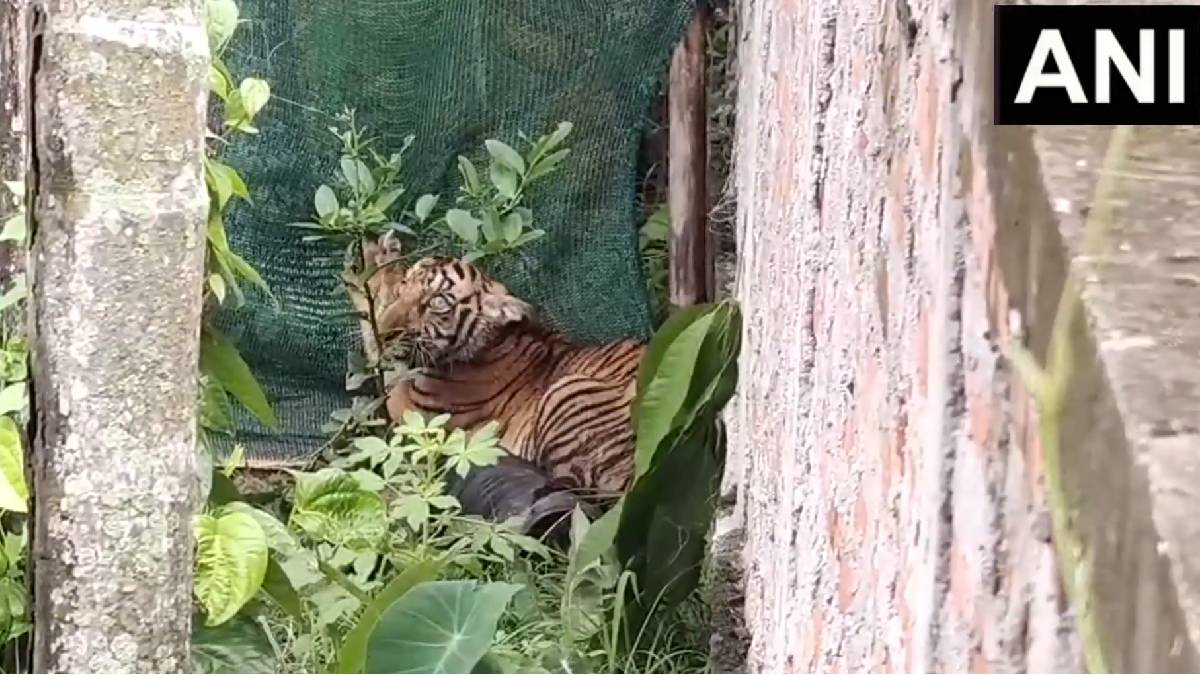
A young Royal Bengal tiger was seen near the Naya Gaon area of Biswanath in Assam, triggering a response from the forest department after visuals appeared to show the animal’s forelimbs trapped in a net.
The sighting has put people living or moving into the area at risk from the tiger. Forest department teams came to the site after hearing about the animal and went through the situation.
Visuals from the scene clearly show the young tiger struggling with a net around its forelimbs. Details of the circumstances that led to the animal being trapped have not yet been established based on the information we have at present. It also has not yet been established how long the tiger had been caught in the net and if it had sustained any injuries.
This is done with care because a trapped wild animal can have some unpredictability when approached, the forest department said. A tiger under stress might escape or defend itself and could strike at the front line of people in proximity. At the same time, that rescue operation must be done with care to minimize the risk of further injury to the animal.
So the officials and wildlife personnel are managing this situation carefully and trying to keep the tiger safe. Residents and others in the vicinity are to stay away from the animal and avoid doing things that could disturb or provoke it.
#WATCH | Biswanath, Assam: A young Royal Bengal tiger was spotted near the Naya Gaon area. From what appears in the visuals, its forelimbs are stuck in a net. Forest department teams reached the spot. Teams are carefully handling the situation to prevent further risk to the… pic.twitter.com/XQOYGRPROl
— ANI (@ANI) September 17, 2026
A Royal Bengal tiger seen near Naya Gaon also shows the challenge of human-wildlife interaction with wildlife in proximity to wildlife habitat and human settlements. Assam is a biodiversity-rich region and has a large number of wild animals like the Royal Bengal tiger.
If a wild animal is found near a populated area, forest officials will need to consider the wildlife in their decision-making process before a rescue or relocation. The animal’s health, behaviour, the environment and people’s presence will all determine how authorities do so.
The tiger’s forelimbs might be entangled in this case, and therefore it is very dangerous. A net can restrict an animal’s movement and leave it unprotected. A longer struggle can even lead to more injuries, and if the public tries to free the tiger unplanned, it can put both the tiger and people at risk.
Forest department teams at the site are working to manage the situation carefully and reduce risk. The tiger must be handled safely, the residents should be kept away from the danger zone, and the tiger should be removed from the area of danger immediately.
We learned today how many things can happen if you let the wildlife people know there is a tiger in the wild and then they have to come and get it out; they have to do this, and if they don’t, they will get hurt.
When the tiger is safely released, wildlife officials will assess its physical condition and decide what the next step is. The animal will need veterinary treatment to be released or transferred to a safe location if it has been injured.
People living in and around Naya Gaon can take comfort in the forest department’s presence in response to the unusual wildlife encounter. Residents will be on guard until officials say that the tiger was rescued and the threat has subsided.
And this incident with the young Royal Bengal tiger has brought wildlife conservation and public safety to the forefront. A very careful release of the animal from the net will not damage the tiger, forest staff, or inhabitants of the area further.
Details about the tiger's condition and the outcome of the rescue operation are expected to be provided next, as the situation for the tiger and the tiger’s condition and the outcome of the rescue operation are still to be determined in the next step into the future.