A digital population clock with a continuously changing estimate of India’s population that updates every few minutes has attracted attention in AIIMS, New Delhi. The display aims to show the scale and rate of population change in India, and to show the population change with the number in India and the time.
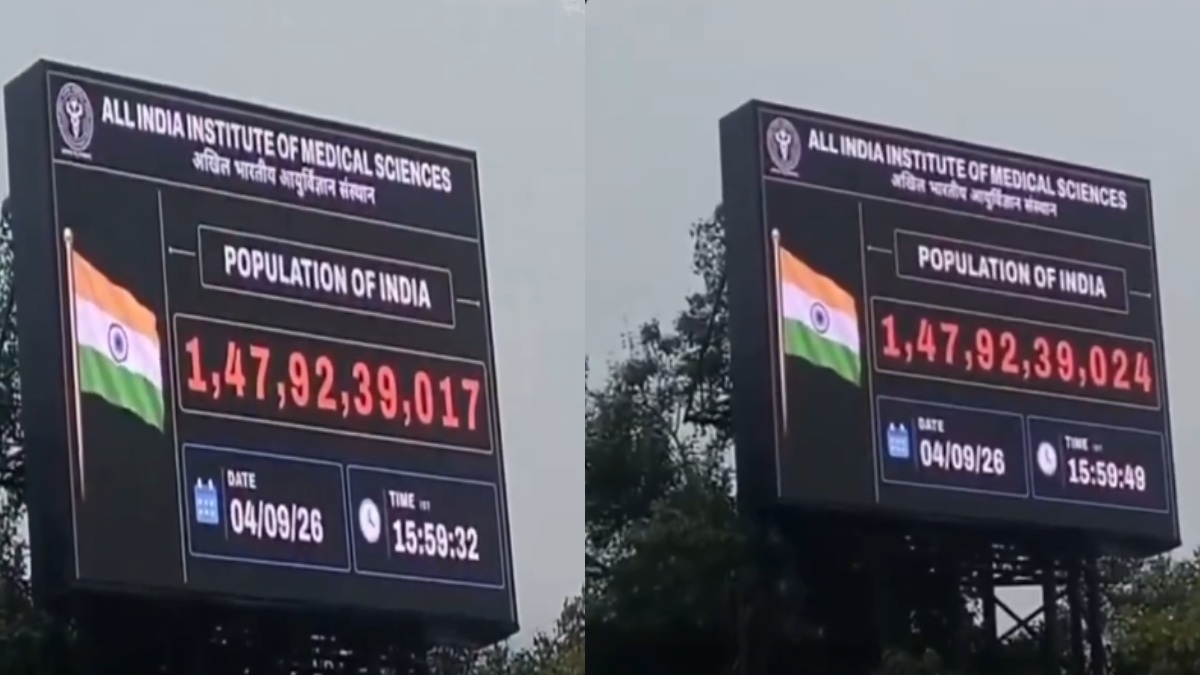
The digital counter has attracted attention on the internet and pictures and videos of the digital counter have been widely circulated.
The population clock provides a visually striking representation of demographics that otherwise is only exhibited in annual reports, census figures and statistical estimates. Rather than a fixed population figure, the digital screen changes from moment to moment, illustrating the correlation between births and deaths and population growth. According to reports, the counter exhibited a figure above 147 crore, but such continuously changing figures should be understood as estimates rather than a real-time headcount of every person in the country.
As such, the concept of a population clock is extremely useful for communicating demographic information to the population. Population figures are usually calculated by large-scale statistical exercises and demographic models rather than by physically counting every person at every moment. A live-style counter uses demographic information— including birth and death rates— to project how the population changes over time. So the number on such a display can change every second without representing a newly conducted census.
India's population is a very important issue for policymakers in that the demographic trends are also affecting every aspect of national development in India and population size is a key issue because demographics impact almost every field of development. Population size affects healthcare needs, education, employment, housing, food security, infrastructure, transportation, social welfare and so forth. And in a country with more than a billion people, a small change in birth rates, mortality rates or migration patterns can have far-reaching consequences on the long term.
The AIIMS display is particularly notable because of its central position in healthcare and medical education. AIIMS New Delhi is one of India’s medical centres that are responsible for medical education and research and patient care. The institute was established in 1956 and has developed into a major centre for medical research and specialist healthcare.
Healthcare and population are closely linked. A growing population can increase demand for hospitals, doctors, nurses, medicines, diagnostic services and preventive healthcare programs. But population growth and the age structure of the population can change the kind of healthcare services that are required. A younger population will need more investment in maternal and child health, whereas an ageing population will have more demand for treatment of chronic and age-related diseases.
India’s official statistical infrastructure also provides population-related information through government platforms. The Census of India website offers a Population Finder and demographic visualisations giving population information at different geographical levels and allowing users to examine demographic characteristics.
The display also serves as a reminder of the importance of reliable population data. India’s last completed population census was in 2011, so demographic estimates are of utmost importance for census preparations. Statistical agencies and researchers use demographic indicators and other datasets to estimate population trends between complete population counts.
It is important to distinguish a population clock from an official census. A census attempts to get some specific information about the population through a systematic enumeration procedure, whereas a live population clock is generally a continuously updated estimate based on demographic assumptions. The rapidly changing number on a digital screen should therefore be viewed as an educational and awareness tool rather than an exact real-time count.
The interest generated by the AIIMS display also demonstrates how technology can make complex demographic information easier for the public to understand. A static statistic like “more than one billion people” can be hard to visualise. Seeing the numbers change continuously gives you a more immediate sense of the scale of population dynamics.
India’s demographic trajectory will be a key issue in the next few decades. Policymakers will need to take a look at not only the total number of people but also fertility rates, life expectancy, urbanisation, migration, education levels and workforce participation into account for population change. And population changes as they relate to the economic development and public services affect the changes of population also and are also a significant factor for the development of India’s economy.
In healthcare institutions like AIIMS, demographic trends are particularly important. The planning of hospitals and medical facilities is based on where populations are growing, which age groups are increasing, and what kinds of health problems are becoming more common. So the population data will play a central role in our future healthcare infrastructure and resource allocation.
The AIIMS Delhi population display has therefore attracted attention not only because of the fluctuating numbers but also because it turns such a complex demographic problem into a situation people can see in person. As India’s population structure changed so rapidly in recent years, such visual tools can contribute to the awareness of the interplay of population, healthcare and national development.
🚨 AIIMS Delhi displays live population count of India. pic.twitter.com/WxxJJwDn1n
— Indian Tech & Infra (@IndianTechGuide) September 7, 2026
Finally, the digital population clock is a reminder that population statistics are not simply abstract numbers. There are people in every figure, families in every figure, and communities in every figure whose needs shape the country’s future. While the number shown here is only an estimate and not a true census count at the time of the data, the visual representation is an easy way to see the continuing change in population in India.