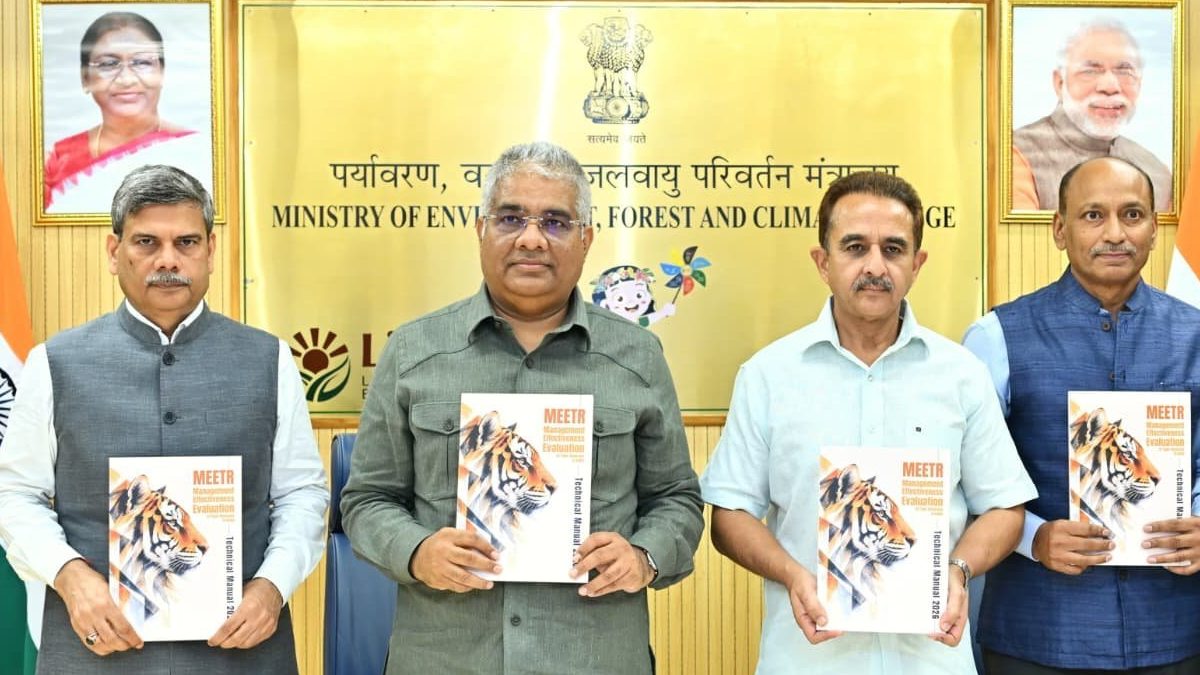
Union Environment, Forest and Climate Change Minister Bhupender Yadav has launched the inception workshop for the sixth cycle of the Management Effectiveness Evaluation (MEE) of Tiger Reserves in India, at the same time as the country is evolving toward safer wildlife conservation and better management of protected tiger habitats. It will test tiger reserves’ performance and identify those where conservation can be improved.
The sixth cycle of MEE is in between several rounds of systematic assessments conducted across India’s tiger reserves. The Management Effectiveness Evaluation framework has been in use in India since 2006 and has been evolving through many cycles to assess management planning, protection, habitat conservation and outcomes. The exercise is conducted in cooperation with the National Tiger Conservation Authority (NTCA) and Wildlife Institute of India, and independent experts in the field evaluate reserve management.
The latest initiative also includes the release of the Technical Manual for MEE-TR 2026. This manual is to provide a structured framework for the upcoming assessment and guide evaluators in applying common criteria across India's diverse tiger landscapes. Because tiger reserves differ considerably in geography, habitats, ecological pressures, human-wildlife interactions and management challenges, standardised assessment methods are important.
The MEE process is designed to look beyond tiger numbers. It assesses management systems and conservation measures including planning, protection measures, habitat management, monitoring, community engagement and other aspects of reserve administration. In a systematic way, we can identify strengths as well as management gaps that might need to be addressed.
India completed the fifth cycle of the Management Effectiveness Evaluation in 2022. 51 tiger reserves were independently assessed in this cycle by the Ministry of Environment, Forest and Climate Change. The assessment was done according to 33 criteria or indicators on six aspects of management effectiveness. The scores were then used to classify reserves according to performance categories. The fifth cycle assessment rated 12 reserves as “Excellent”, 21 as “Very Good”, 13 as “Good” and five as “Fair.”
The sixth cycle takes place at a time when India has expanded the tiger conservation network. According to the February 2026 government response, the number of tiger reserves has increased from 50 in 2020 to 58 in 2025, and 32 tiger corridors have also been identified for ecological connectivity. It has also been noted that camera traps, drones, electronic surveillance and other technologies are being used to monitor and protect wildlife.
The National Tiger Conservation Authority has been increasing its focus on landscape conservation, scientific management and working with state and other agencies. At the 29th meeting in July 2026, chaired by Yadav, the NTCA has taken up the recommendation to undertake the sixth cycle of MEE of Tiger Reserves. The meeting also focused on improving protection, management practices and conservation results in tiger landscapes in India.
Management evaluation has come to play a key role in India’s tiger conservation because conservation is not only about protecting individual animals but also about maintaining good habitats, prey populations, ecological corridors and effective protection systems. Regular assessment is needed to assess whether management interventions are producing the desired conservation results and where corrective measures are needed.
The MEE framework also provides a mechanism to bring in independent expertise to the assessment process. In the fifth cycle, independent regional expert committees evaluated reserves in different tiger landscapes, with the help of the Wildlife Institute of India. These evaluations are intended to provide a structured and relatively consistent assessment of management practices across geographically diverse reserves.
The launch of the MEE-TR 2026 process is therefore the next step in India’s periodic review of tiger reserve management. In addition to the technical manual which is now released, the sixth cycle exercise will also build a framework to assess conservation management at tiger reserves across the country and identify the best way forward.
Union Environment Minister @byadavbjp launches Inception Workshop for 6th Cycle of Management Effectiveness Evaluation of Tiger Reserves in India; Technical Manual for MEE-TR 2026 released
— DD News (@DDNewslive) September 25, 2026
🔗https://t.co/c0K5xuybHX@PIB_India @moefcc pic.twitter.com/CMmQTrS1Uj
India is home to nearly 70% of the world's wild tiger population, according to the Ministry of Environment, Forest and Climate Change. The government has described its tiger conservation approach as one based on scientific monitoring, habitat protection, technology, landscape-level planning and community participation.
When the sixth cycle comes to an end, we will have new insights to make conservation decisions. This evaluation will also help for the survival of tiger populations and the ecosystems and biodiversity of India's tiger landscapes.