The Union Cabinet has approved three major multitracking railway projects with a total investment of ₹10,783 crore in the name of infrastructure for India's railway infrastructure, which will help to create more regional connectivity, the government has said in a statement.
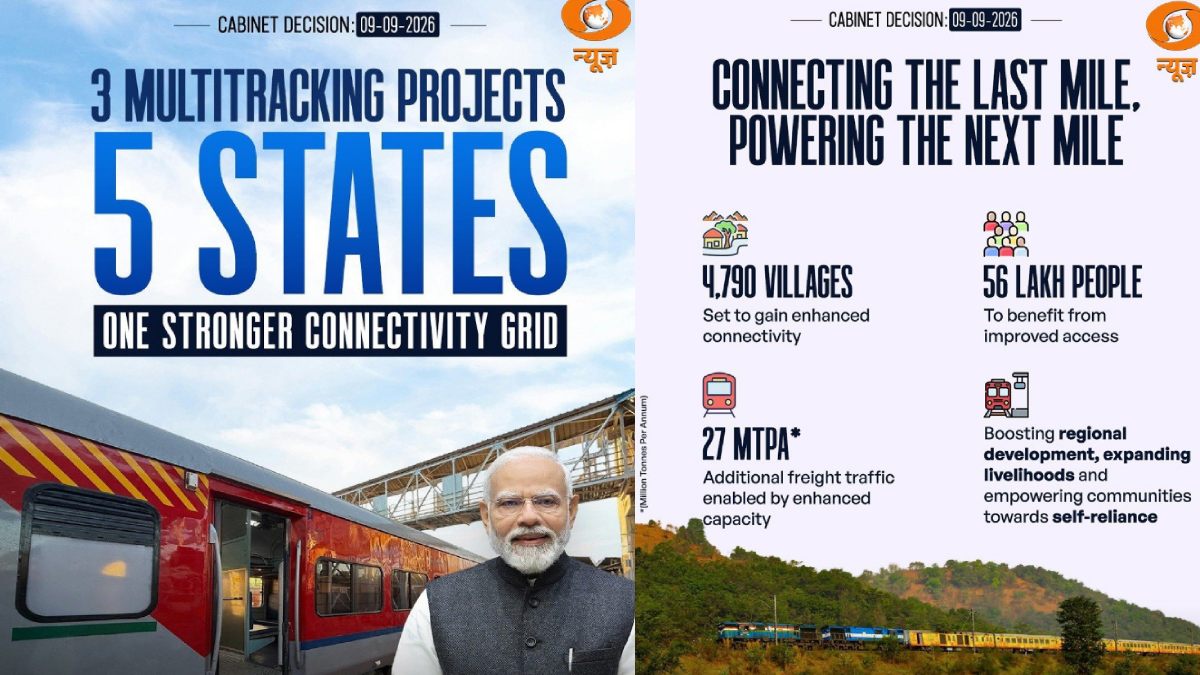
The total distance will be 656 kilometres across five states and will bring a lot of benefits for passengers, freight movement, villages and the local economy.
The railway expansion plans are aimed at increasing the capacity of existing routes and improving the rail network. By adding additional tracks along important corridors, the projects are expected to reduce congestion, improve train movement and create greater opportunities for both passenger and freight services. The investment also reflects the government’s broader focus on infrastructure-led regional development.
The three multitracking projects will improve railway connectivity for around 4,790 villages as per the Cabinet decisions. Together, these areas are home to roughly 56 lakh people who are expected to benefit from improved access to transportation infrastructure.
Better railway connections can make the movement of people, agricultural products, industrial goods and essential goods much faster. With better infrastructure along railway corridors, travel will be easier and so will access to markets, education, healthcare and jobs to a greater extent.

A big component of these projects is the expected freight transportation impact. The improved railway network will be able to carry out an additional 27 million tonnes per annum (MTPA) of freight traffic in the new railway network. This increase in rail freight capacity will help move bulk commodities and industrial goods and improve India’s logistics infrastructure.
Railways make the transport of goods (coal, cement, food grains, fertilisers, minerals and other industrial products) much easier. The more track capacity available, the more efficient the trains will be and reduce the pressure on heavily used routes. Greater rail freight capacity can also aid in making the transport system of the whole country more efficient.
The projects are therefore of great importance from the passenger connectivity perspective as well as from the economic and industrial perspective of India. Efficient transportation infrastructure is imperative for businesses to ensure the supply chain is well-organized, production centres are connected to markets and goods are moved over long distances.
The approval of the three projects will also lead to job opportunities during construction and related infrastructure projects. The new railway corridors may also bring economic activity to the regions they serve. Local businesses, transport operators, suppliers and communities would be more economically stimulated from the economic movement around railway-related areas.
The importance of linking thousands of villages is extremely important for balanced regional development. Railway infrastructure has historically been a major link between rural and semi-urban communities and larger towns and cities. Greater connectivity can alleviate transportation barriers and open up new business and social opportunities for communities.
The projects also fit into India’s larger journey in modernising and expanding its railway network. When there are more passengers and freight to be transported, track capacity needs to be expanded and that is what railway infrastructure planning is really about. Multitracking could help transport railways to handle more trains on busy routes and improve operational flexibility.
The investment of ₹10,783 crore is a significant one to modernise the transport system. In addition to the immediate construction work, the projects will be of long-term value with better connectivity, more freight capacity and economic activity in the five states involved.
The expected benefit to 56 lakh people and connectivity improvements covering 4,790 villages underline the wider social and economic significance of the Cabinet decision. At the same time, the additional 27 MTPA freight capacity highlights the importance of these railway corridors to India’s logistics and industrial ecosystem.
#Cabinet approves three multitracking railway projects worth ₹10,783 crore, covering 656 km across five states.
— DD News (@DDNewslive) September 9, 2026
The projects will enhance connectivity for 4,790 villages, benefit 56 lakh people and enable an additional 27 MTPA of freight traffic, strengthening regional… pic.twitter.com/Uy6PS419CK
As projects are implemented, communities, businesses and industries that rely on reliable railway linkages will be highly influenced by the progress. If it works out, if it is an efficient project, the transportation capacity will increase and the regional economies will grow.
The Cabinet’s decisions in the end prove railway infrastructure is the key to India’s development agenda. It also means that to better enable the country’s economy to grow and transport people in a more efficient way, the government is investing in multitracking, better village connections and more freight capacity.