A message generated under the Ayushman Bharat health insurance system 42 days after the death of a Chhattisgarh police constable has raised questions over the updating and closure of patient records.
Dev Narayan Ram, a police constable from Chhattisgarh, was admitted to Ambikapur Medical College Hospital in Surguja on June 26. He died during treatment on June 30. His family then performed the last rites and got his death certificate.
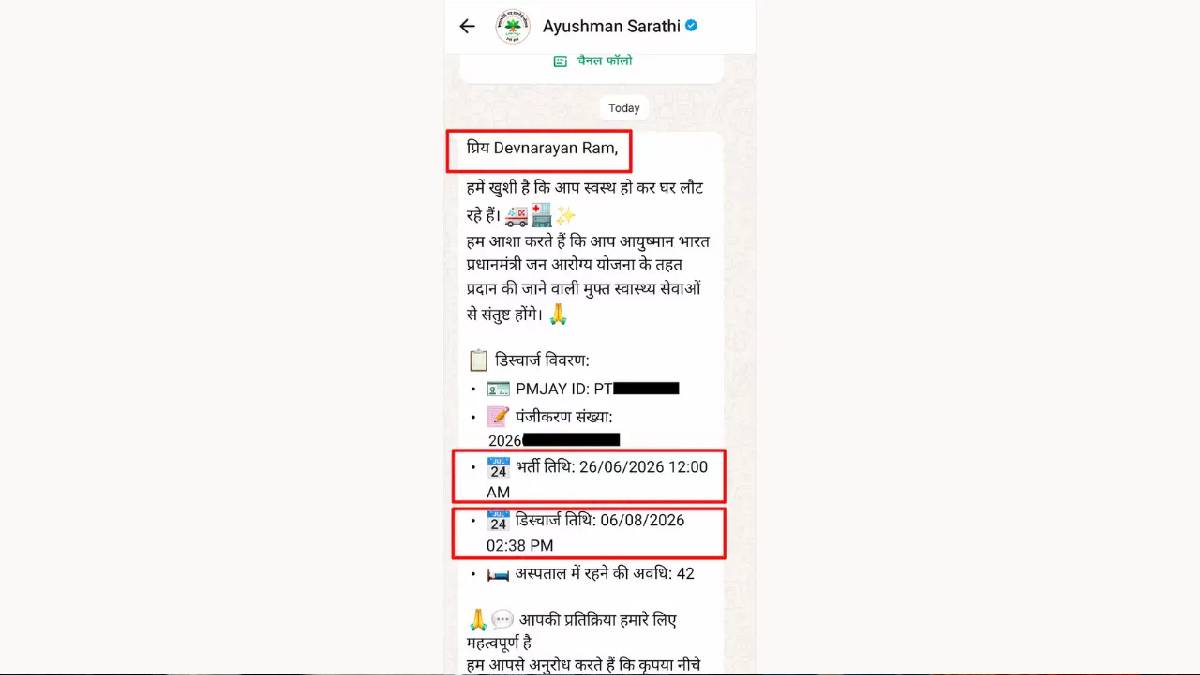
But more than a month after his death, his wife Seema Kujur received a WhatsApp message on his phone saying that he was recovering and returning home.
The unexpected communication shocked the family and raised questions about how a government health insurance system could continue to display the patient as recovering after his death.
Family Questions Ayushman Bharat Record
The message reportedly told Dev Narayan Ram that officials were happy he was recovering and going home. It also referred to the free healthcare services provided under the Ayushman Bharat Pradhan Mantri Jan Arogya Yojana, or PM-JAY.
That was a very painful message for his family because Ram had died 42 days earlier.
His wife questioned how the system could generate a recovery-related communication when the hospital had already recorded his death.
And the family wants an independent investigation into whether the incident was a technical malfunction, delayed data entry, or something else.
Seema said her husband had died while receiving treatment and that the family had already done the necessary procedures after his death. How could a message that he had recovered could be sent more than a month later?
She also said she wants the investigation to result in fines if negligence and other wrongdoing were found.
Hospital Denies Post-Death Ayushman Claim
Hospital authorities have rejected allegations that Ram’s Ayushman benefits were used for 42 days after his death.
Dr Shailendra Gupta said the constable received treatment under the Ayushman scheme for four days and that the hospital claimed payment only for that period.
According to the hospital, Ram was admitted on June 26 and died after four days of treatment on June 30. There was no claim made against their Ayushman card for the next 42 days, said the officials.
Gupta described the family's claim that the card was still used after Ram's death as incorrect.
It is therefore the hospital that has distinguished between the delayed updating of the patient's digital record and any purported financial claim under the scheme.
Data Entry Delay Blamed
Hospital officials admitted that the Ayushman record should have been closed after the patient’s death.
However, they said the record was not updated promptly because of a delay by the data entry operator responsible for Ayushman-related entries.
The employee has since been removed from handling Ayushman-related work, the hospital said.
The hospital maintains that the failure to close the record was an administrative or data-entry lapse rather than evidence that the patient's insurance benefits were being used after his death.
But that explanation did not completely assuage the family’s concerns because the system then produced a message that Ram was recovering and preparing to return home.
What is the message that raised questions?
The incident highlighted the requirement for timely digital health records updates.
Government health insurance programs use electronic databases to record admissions, treatment, discharge, and claims of patients. Accurate and timely updates are therefore very important in the process of payment as well as keeping track of patients' actual status.
In this case, the hospital says the treatment claim was limited to the four days Ram was alive and receiving medical care.
The family, meanwhile, is wondering why his record apparently continued to be active long enough for the system to send him an automated recovery message 42 days after his death.
An independent inquiry could help determine exactly when the patient's death was entered into the relevant system, when his Ayushman case was supposed to be closed, and why the automated communication was generated.
Family Seeks Independent Probe
The family insists that the issue should be investigated even if no post-death financial claim was made.
The main issue for them is the apparent discrepancy between the hospital records and the message generated by the Ayushman system.
The family wants an unbiased investigation and action taken against officials if negligence, procedural violations or irregularities are found.
The hospital, on the other hand, has maintained that there was no misuse of Ram's Ayushman benefits and only four days of treatment were billed under the scheme.
So, the debate is now on record management and how the automated message is generated instead of if there is a proven case of post-death financial fraud.
Such incidents highlight the need for healthcare databases to be updated promptly after major events (e.g., discharge or death). It also raises questions about the safeguards a system like automated messaging should have in place to ensure that messages are not sent to patients whose status has changed.
A more detailed investigation would be needed to determine how the error occurred and if there are other record gaps in the system.