Delhi may soon have a more efficient and quick way to repair potholes, even during the peak monsoon season. Spray Injection Patching, a machine-based road repair technology with high-speed road repair capability for a pothole which can be installed, has begun trials in Delhi and the city.
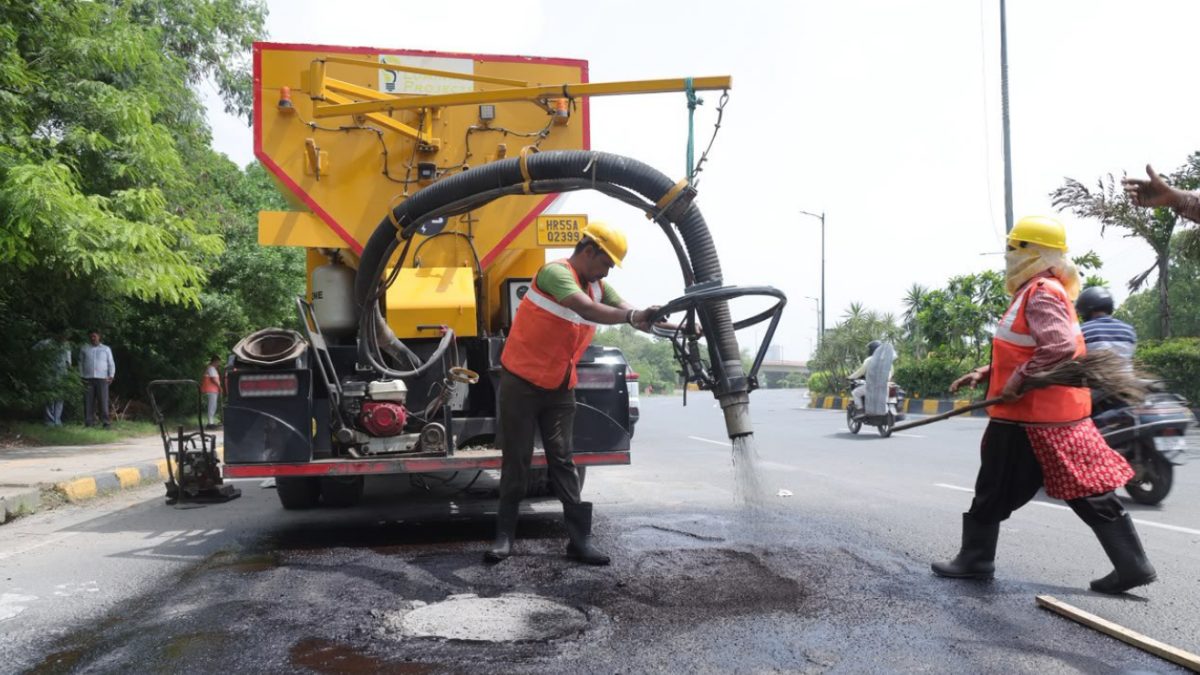
The trial was conducted in Central Delhi on Tuesday in the presence of Public Works Department (PWD) Minister Parvesh Sahib Singh who discussed the technology and how it can rapidly speed up road maintenance in the capital.
A fully mechanised road repair solution
Unlike conventional pothole repair methods which require multiple workers, heavy machinery and road rollers, Spray Injection Patching is performed with a single mobile machine operated by a small crew.
The technology utilizes compressed air, bitumen emulsion and stone aggregates to clean, fill and seal potholes in one continuous process. Due to the machine’s capability to handle all the required materials, repairs can be done on-site and not involve manual mixing or extended lane closures.
PWD Minister Parvesh Sahib Singh said that such technology could help keep Delhi’s roads safer during the rainy season.

Today, a live demonstration of the advanced Spray Injection Patching technology for pothole repairs was held. This fully mechanised solution enables faster, durable and all-weather repairs with minimal traffic disruption, helping keep Delhi’s roads safer and smoother even in the monsoon, even for pothole repair work at night.
How the Technology Works
The repair process is described as four steps
For the first step the machine uses a powerful air compressor to remove dust, loose stones, debris and water from the damaged section of the road.
Next, it sprays a layer of bitumen emulsion which acts as an adhesive for the repair material to stay firmly bonded to the existing road surface.
The machine then injects bitumen-coated stone aggregates into the pothole at high pressure. The spray naturally compacts the material so that there is no need for heavy road rollers.
Finally, a layer of dry aggregate is applied to seal the surface and vehicles can move on the road almost immediately after repair is completed.
According to PWD officials, every pothole can be repaired in 2-5 minutes and traffic can go on normally without any major delays.
A live demonstration of the advanced Spray Injection Patching technology for pothole repairs was held today.
— Parvesh Sahib Singh (@p_sahibsingh) July 14, 2026
This fully mechanised solution enables faster, durable and all-weather repairs with minimal traffic disruption, helping keep Delhi’s roads safer and smoother even during… pic.twitter.com/KnqJFpj17D
Up to 150 Potholes a Day
Officials estimate that a single Spray Injection Patching machine operated by a small team can repair 100 to 150 potholes in a single day.
The technology is also capable of fixing deep potholes, road-edge damage, surface cracks and utility cuts left behind when excavation work is completed.
Since the process uses cold materials instead of traditional hot asphalt, it does not require a hot mix plant. This could reduce fuel consumption, reduce emissions and minimise construction waste, authorities believe.
A Potential Monsoon Game-Changer
One of the key advantages of the technology is that it works on damp road surfaces, which is especially useful in the monsoon season during which conventional road repair is increasingly difficult in Delhi.
Regular rainfall has always been one of the most pressing road maintenance problems for road maintenance in the capital and potholes can be rapidly formed and the maintenance is often delayed due to wet weather.
If applied, Spray Injection Patching would enable the PWD to respond to road damage in a much faster time frame to reduce inconvenience to commuters, and improve road safety during heavy rain.
Already used in several States
Spray Injection Patching is not exactly new in India. Similar systems are already being used by road authorities in Jammu and Kashmir, Haryana, Maharashtra, Madhya Pradesh, Goa, Karnataka and Telangana.
The pilot project will now determine if the technology can manage the high traffic volumes of Delhi and road conditions.
If these trials are successful, the capital could soon adopt the technology on a much larger scale, with commuters driving in a smoother manner and potholes repaired more quickly throughout the year.