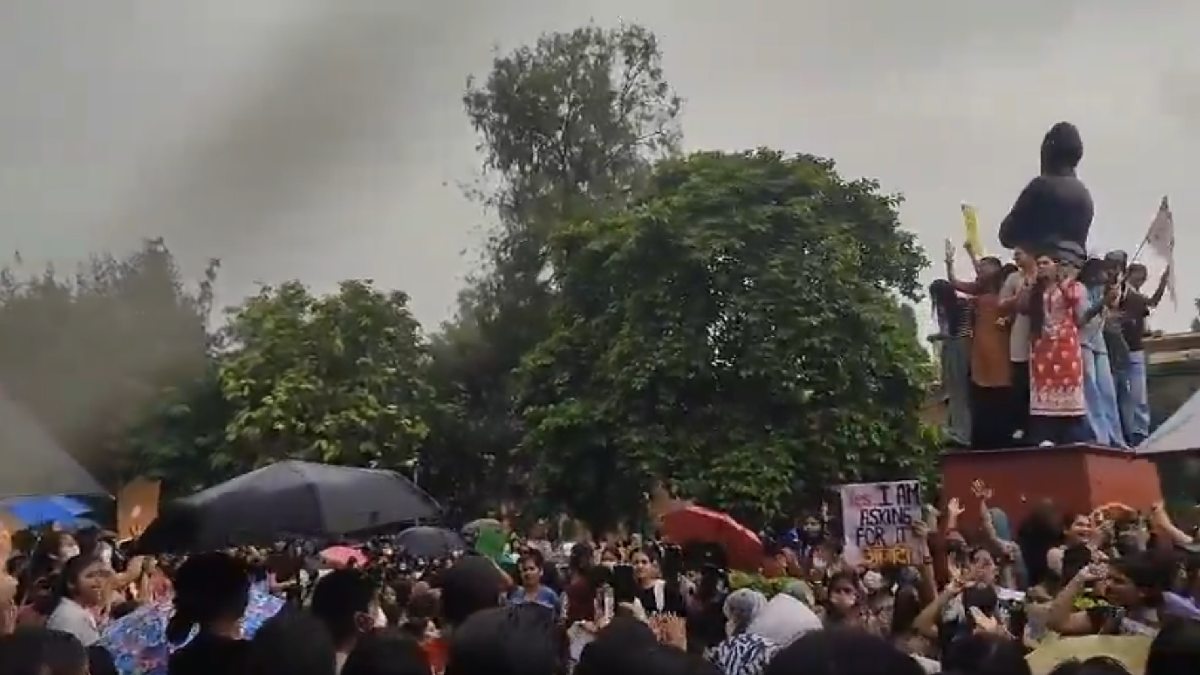
A group of 3,000 Delhi University students marched through North Campus Monday as anger at recent allegations of sexual assault and harassment in the capital turned the spotlight on women’s safety. Students from several colleges joined the demonstrations, demanding safer public spaces, stronger accountability and better measures to prevent harassment around educational institutions.
The protest followed the alleged gangrape of a 17-year-old girl at Aastha Kunj Park in South Delhi and another case in which two women students were allegedly stalked and sexually harassed in Mukherjee Nagar. The two cases have compounded students’ concerns about safety in and around public spaces, especially after dark.
According to the report, Monday’s demonstration brought together students from different parts of Delhi University. The march began at the Faculty of Arts and moved through North Campus. Participants carried placards and raised slogans about women’s safety, accountability and the need for better infrastructure.
The turnout was much larger than earlier demonstrations organised after the Aastha Kunj incident. Student groups said women students, queer groups and other supporters participated in the march, and it was one of the largest recent student mobilisations around women's safety at the university.
Aastha Kunj Case Triggers Student Anger
The protest was organised days after the alleged assault of a 17-year-old girl in Aastha Kunj Park on 21 September. Delhi Police have said that three men allegedly posed as police personnel before sexually assaulting the teenager.
The case raised uproar in Delhi and protests from students and others. Public spaces were especially at stake and security measures should be in place in areas that are frequented by women.
The Aastha Kunj incident also revived conversations about street lighting, surveillance and police presence. There was much debate in Monday’s march about such issues and students called for ways to allow women to use public spaces without facing harassment or fear.
The demonstrations had earlier been held by students from Lady Shri Ram College, Miranda House and Gargi College. Although those protests drew hundreds of participants, Monday’s mobilisation was described as much larger by the organizers.
Mukherjee Nagar Case Adds To Concerns
The demonstration also came against the backdrop of another harassment case involving Delhi University students.
The University of Delhi suspended three Law students, Naman, Abhinav Kumar and Abhimanyu Kumar, in connection with a stalking and sexual harassment incident involving two women students from Hindu College in Mukherjee Nagar on September 23.
The university’s action followed the registration of an FIR by Delhi Police. The three students were suspended from their courses immediately pending further proceedings.
The two women victims faced stalking and sexual harassment by a group of men travelling in an SUV. The case added another layer to the safety concerns being raised by students across the university.
The suspension shows that the university has initiated disciplinary action in connection with the allegations and the police investigation and other actions will determine the facts of the case.
Students Demand Safer Public Spaces
One of the main themes of Monday’s protest was the demand for safer public spaces. Students described lack of lighting, surveillance and security in areas around educational institutions and other areas women visited.
Women’s safety shouldn’t be restricted purely by limiting where or when women can go, participants said. Instead, they called for stronger preventive measures and more accountability for harassment or assault when it happens.
So the protest extended beyond the two recent cases. Student groups used the demonstration to highlight concerns about stalking, harassment and the wider environment faced by women and other vulnerable groups in Delhi.
The mobilisation was also a way for many participants to demand that safety measures be treated as a responsibility of institutions and authorities rather than something women should manage through personal restrictions.
Supreme Court Raises Women’s Safety Concerns
The student demonstrations coincided with more judicial attention to recent sexual assault cases in Delhi. The Supreme Court expressed concern over incidents involving rape and sexual assault and stressed the importance of accountability when there are failures relating to women's safety.
The court’s observations added to the public discussion of the incidents. Student groups focused on campus and public space safety; judicial intervention highlighted the larger institutional responsibility involved in preventing these crimes and responding to complaints.
The developments have brought attention back to security measures in public spaces, the response of law enforcement agencies and the responsibilities of educational institutions when students are involved in criminal allegations.
Delhi University Protest Highlights Wider Safety Debate
The march at Delhi University Monday mirrors the much bigger conversation around women’s safety in Delhi. The participation of students from multiple colleges indicates the extent to which recent cases have affected the university community.
🚨 DU STUDENTS PROTEST FOR WOMEN’S SAFETY 🚨#womensafety #women #justice #protest pic.twitter.com/iq3gUZCUCB
— Delhi University Team (@DUTeam23) September 28, 2026
The immediate demands raised during the demonstration included better lighting, safer public spaces and accountability. But the protests also have opened a broader conversation about how campuses and surrounding neighbourhoods can become safer for women.
As investigations into the Aastha Kunj and Mukherjee Nagar cases continue, the student protests have kept women’s safety at the centre of public attention. The university’s suspension of the three Law students and the Supreme Court’s observations on recent rape cases are also likely to keep the issue under scrutiny.
For Delhi University students, Monday’s large-scale mobilisation served as a public demand for stronger preventive measures and institutional accountability. The demonstrations also underscored that concerns about women's safety extend beyond individual incidents and include the broader conditions in which students study, travel and use public spaces.