The Defence Research and Development Organisation (DRDO) has successfully conducted a high-altitude trial of India's indigenously developed Military Combat Parachute System (MCPS) in East Ladakh.
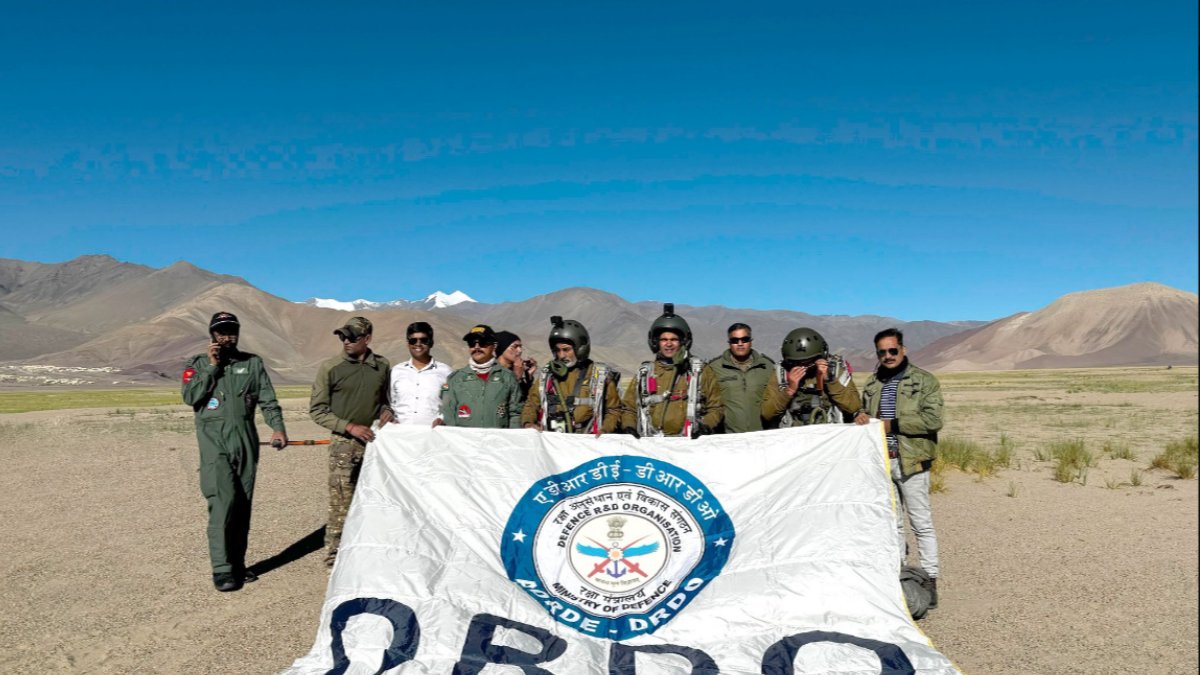
The trial was conducted at the Nyoma-Mudh Drop Zone at an altitude of around 13,700 feet. The location is among the world's highest drop zones and provides extremely challenging conditions for testing military parachute systems.
The successful trial was viewed as a step towards India’s self-reliance in defence technology.
The system was developed in India and is designed to help special forces conduct controlled parachute operations in difficult terrain and at high altitudes.
How did DRDO conduct the Ladakh Parachute Test?
Military jumpers exited at extreme altitude using the indigenous Military Combat Parachute System during the trial.
The jumpers deployed the parachute system successfully and landed safely at the drop zone.
The system has many components specifically designed for high altitude military operations. These include a para computer, oxygen equipment, and specialised suits that assist in high altitude work in adverse atmospheric conditions.
At an altitude of 13,700 feet, parachutists experience lower oxygen levels and extremely cold conditions. This is why high altitude testing is critical for such systems to be successful in demanding military tasks.
The MCPS is designed to ensure that parachutists can control their descent. It is capable of steering them towards a landing zone instead of just taking a vertical descent.
This precision can be particularly useful for special forces operating in mountainous or difficult terrain.
We have also run the system in the high-altitude region, and it’s done well, so now we are going to run it at even higher altitude.
According to DRDO information, the MCPS has been tested at altitudes up to 32,000 feet.
The successful Ladakh trial is a demonstration of how well our system performs under another demanding set of conditions.
Military Combat Parachute System (MCPS) designed and developed by ADRDE, DRDO was successfully tested at one of the world’s highest altitudes Drop Zones (Nyoma, Mudh DZ).
— DRDO (@DRDO_India) August 26, 2026
ADRDE test Jumpers Wg Cdr Rahul Jha Chief Test Jumper, MWO R J Singh, VM(G), MWO Vivek Tiwari executed the… pic.twitter.com/0wD82QdYo3
MCPS uses Indigenous Technology and NavIC
One of the main features of the Military Combat Parachute System is its high level of indigenous development.
The system has been developed and produced in India, reducing dependence on foreign equipment for specialised military parachuting operations.
The MCPS also integrates India's NavIC satellite navigation system.
NavIC, or Navigation with Indian Constellation, is India's regional satellite navigation system. Its incorporation into the parachute system can provide navigation information during airborne operations and assist personnel in reaching their intended landing areas.
The combination of controlled descent, navigation technology and specialised equipment can give special forces greater flexibility during parachute operations.
High altitude parachuting is particularly demanding because atmospheric conditions can change the behaviour of parachutes and affect a jumper's ability to control the descent.
Testing the system in Ladakh therefore provides valuable information about how it performs under challenging operational conditions.
Nyoma-Mudh Drop Zone is located in a strategically important region close to India’s borders. The high altitude and mountainous terrain are particularly advantageous for testing equipment for military operations in such environments.
The successful trial also supports India’s much larger strategy of developing critical defence technologies locally.
India has increasingly focused on reducing its dependence on imported defence equipment and developing specialised systems through organisations like DRDO and Indian defence manufacturers.
The indigenous MCPS is part of this wider push towards self-reliance.
Parachute systems are essential to special forces for operations in which personnel must go to places that are not accessible by ground or air transport.
A system that is controlled in descent and navigation can allow troops to land closer to their operational area and reduce the risk of high altitude jumps.
Hence the recent trial is particularly important in demonstrating that the parachute can open and get a jumper safely down to the ground.
It tests the ability of an integrated system to work together under extreme conditions.
The para computer, navigation capabilities, oxygen equipment and specialised clothing all contribute to the overall effectiveness of the system.
The successful landing of the jumpers at Nyoma-Mudh indicates that the system has performed well in one of the most demanding environments available for testing in India.
The previous trials at up to 32,000 feet also show that development of the MCPS has involved testing across different altitude ranges.
For India, the development of such systems can reduce reliance on imported military parachute technology and strengthen domestic defence manufacturing capabilities.
The integration of NavIC further demonstrates how India’s own technological systems can be incorporated into military equipment.
The latest test does not mean that development and evaluation of the system are necessarily complete. Military equipment typically undergoes extensive testing before it is inducted for operational use.
More trials and evaluation may help to identify where we can improve and verify reliability in different situations.
The successful Ladakh trial is, however, a great achievement for India at the level of defence technology.
The country's increasing capacity to create specialised equipment for difficult military environments has enabled it to test an indigenous combat parachute system at 13,700 feet in East Ladakh.
With further investigation and deployment, the MCPS could provide India’s special forces with a domestically developed parachute capability for precision, controlled descent and high altitude operations.
The trial is therefore another step towards India's larger goal of greater self-reliance in critical defence technologies.