The long-awaited Hubballi-Ankola railway project, which has been a much sought-after project in North Karnataka, the Malnad region and the coastal belt for decades, has got a new push with the Union Railway Ministry starting the land acquisition process.
The proposed railway project has now been declared a Special Railway Project for a public purpose, with an official notification issued through the Central Government's e-Gazette under the relevant provisions of the Railways Act, 1989.
The development is significant for a project that has been largely on paper since the late 1990s because of environmental issues, legal proceedings and delays in forest and wildlife clearances.
The new proposal is a major change from the previous one-line plan. The new project includes a 163-kilometre electrified broad gauge double railway line from Hubballi through Ankola to Ankola.
57 Tunnels Planned Through the Western Ghats
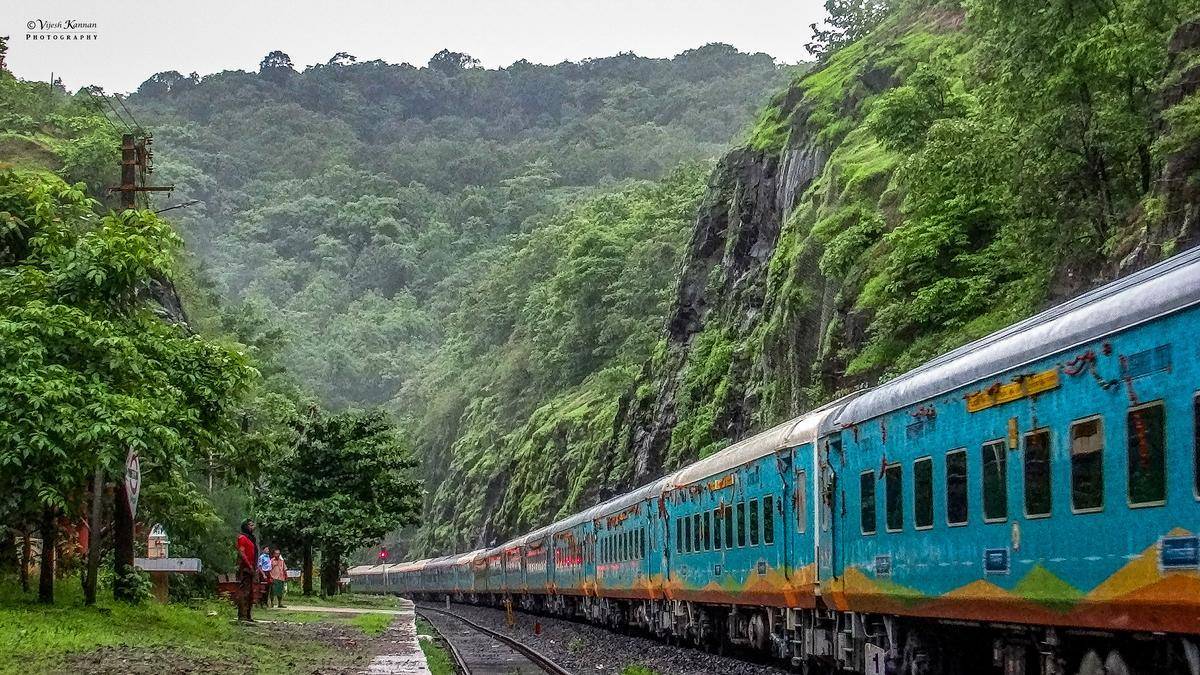
One of the most striking features of the revised project is the large number of tunnels proposed to reduce the impact on the ecologically sensitive Western Ghats.
The railway line will pass through the Western Ghats and forested areas for around 97km of the proposed route. To minimise surface disturbance to the landscape, the revised Detailed Project Report proposes 57 tunnels between Yellapur and Sunkasale.
The project also comprises about 13.89 kilometres of elevated structures and major bridges.
The tunnel-heavy design is intended to reduce the need for extensive cutting through forested terrain while allowing the railway line to negotiate the difficult topography of the Western Ghats.
The revised project cost is estimated to be in the range of about ₹16,435 crore to ₹18,424 crore, according to the information provided.
Land Acquisition Across 69 Villages
And the next step would be land acquisition.
The project will require private, government, and forest land across 69 villages in Dharwad and Uttara Kannada districts.
In Dharwad district, the project includes Hubballi and Kalghatgi taluks. Around 29 villages from these two taluks are included in the proposed land acquisition process.
In Uttara Kannada, the project has a much bigger footprint, covering 40 villages in Yellapur and Ankola taluks.
The villages in the project area are Kiravatti, Idagundi, Arabail and other areas in Yellapur taluk, while Sunkasale, Agasur, Balekuli and other villages are in the Ankola section.
The large list of affected villages highlights the size of the project and the time and cost of the land and administrative coordination necessary before construction can begin.
The project has not yet reached the construction stage
Although land acquisition is well within the reach of the committee and is viewed as the first step forward, the present development does not mean that construction will start right away.
Before construction on the physical construction can start physical works can proceed further procedures are needed.
The state government will have to take further steps in land acquisition. Forest and wildlife-related approvals are also an important part of the clearance process as well.
This is more important because the project passes through an environmentally sensitive part of the Western Ghats.
Vishweshwar Hegde Kageri, former Union minister and Uttara Kannada MP, has also pointed out that several permissions and procedures involving the forest authorities still need to be completed.
Environmental concerns were a major hurdle
Environmental objections have been a major factor in the long delay of the project.
The proposed railway alignment passes through parts of the Western Ghats, a region of forests and biodiversity. Environmental groups had objected to railway construction’s impact on forests and wildlife habitats.
In this way, the project was subject to legal and environmental review.
As a result, the project was given a significant direction in 2024 by the High Court, which instructed it to make a revised DPR in line with wildlife authorities.
Following this, the South Western Railway submitted a revised proposal. The revised report in February 2026 has now been followed by the latest land acquisition notification.
Why does the Hubballi-Ankola railway line matter?
The proposed railway line will have larger economic and connectivity implications for North Karnataka, the Malnad region and the coastal belt.
A direct railway connection between the Hubballi region and Ankola would improve connectivity between inland Karnataka and the coastal region.
The project might even help passenger movement as well as transportation of goods, and strengthen connections between agricultural, industrial and commercial centres.
For Uttara Kannada in particular, improved railway connectivity has long been considered an important infrastructure requirement.
Greater rail connectivity could also reduce dependence on road transport for certain types of freight movement, the project’s supporters say.
At the same time, we balance development and the environment
The revised project places great emphasis on tunnels and high-rise structures because of the difficult terrain and environmental sensitivity of the Western Ghats.
But that will only happen if the construction and environmental protections are also well balanced.
Obtaining forest and wildlife clearances, implementing mitigation measures, and ensuring environmental compliance will continue to be very important.
It's not so much to build a railway line; it is to develop the infrastructure at the same time, minimizing the ecological damage.
A Decades-Old Dream Moves Forward
The latest notification has encouraged the Hubballi-Ankola railway supporters.
North Karnataka, Malnad and coastal communities have been demanding the railway connection for decades. And so this is a significant development after years of legal, environmental and administrative hurdles.
Uttara Kannada District Railway Seva Samiti president George Fernandes has welcomed the development and thanked those who are working towards moving the project forward.
In light of this, the immediate focus is to complete the land acquisition process and secure the forest and wildlife-related approvals.
The Hubballi-Ankola railway project has been a long and difficult journey since it was conceived. With the new 163-km electrified double-line proposal, 57 tunnels and almost 13.89 km of elevated structures, the project has entered a potentially important new phase.
For the people of North Karnataka, Malnad and Uttara Kannada, the latest notification will finally transform a decades-old railway dream into a practical infrastructure project— and ensure that the fragile ecology of the Western Ghats gets adequate protection.