In January, the India Meteorological Department unveiled an AI-powered monsoon forecasting platform that aims at enhancing hyper-local, accurate and comprehensive meteorological observations throughout India.
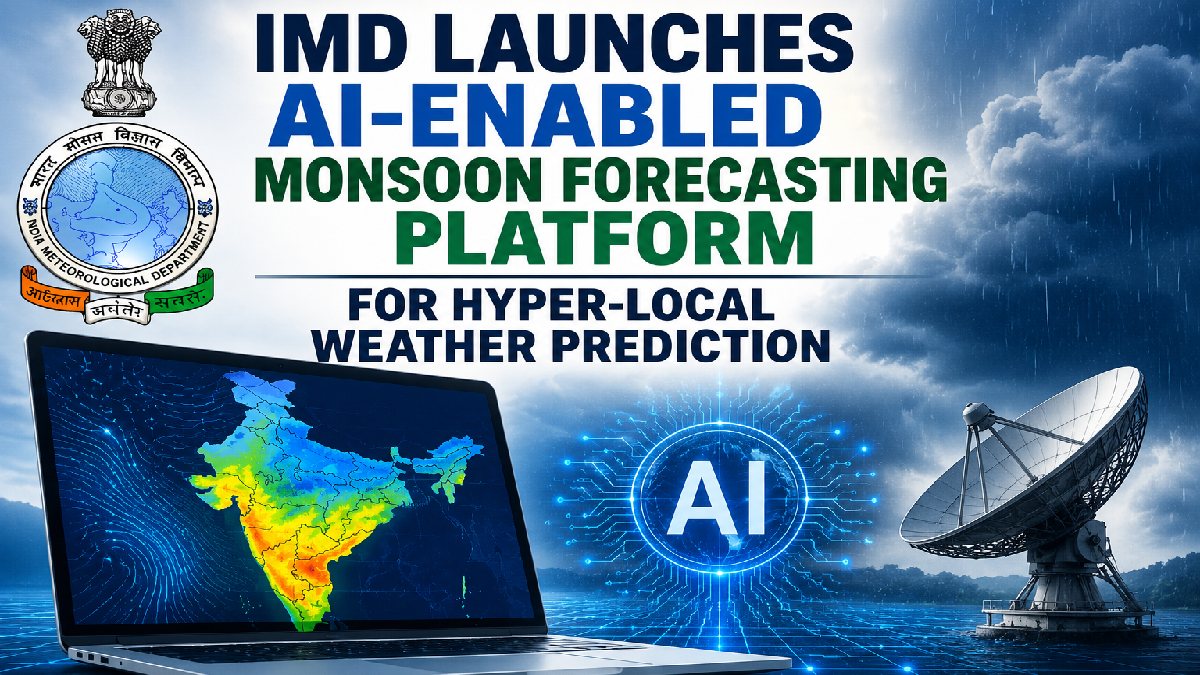
It is the latest step in the technological evolution of a country’s weather forecasting capabilities, in that India can benefit by vastly enhancing agricultural planning in anticipation of monsoon events, along with disaster and public preparedness on the same.
The new forecasting platform was introduced by Union Minister Jitendra Singh under the Ministry of Earth Sciences (MOES). The project features India’s first artificial intelligence (AI) based operational monsoon forecasting system that is capable of monitoring monsoon progression and patterns of rainfall with much more precision than traditional methods.
State officials added that the AI system would offer predicted probabilities and predict the progress of the monsoon up to four weeks in advance, each week. The forecasting system was originally envisioned to work with 16 states and over 3,000 sub-districts nationwide.
IMD, the Indian Institute of Tropical Meteorology and the National Centre for Medium Range Weather Forecasting have jointly developed the platform for forecasting. It integrates AI models, extended-range prediction systems and sophisticated statistical analysis techniques to create highly localised weather predictions.
The new technology entails a leap from sweeping weather forecasts (the so-called macroforecasting) to systems for impact-based forecasting that can enable real-time decision-making, officials said. Farmers will greatly benefit from the platform, allowing them to predict more precisely sowing methods, irrigation, crop defence, and harvesting operations.
Aside from agriculture, the system is supposed to provide help in disaster management, renewable energy, planning water resources and urban infrastructure development among other sectors. Authorities suspect hyper-local rainfall forecasts could reduce the impacts of disasters, including floods, landslides and intense weather.
IMD also recently launched a high-resolution rainfall forecasting service for Uttar Pradesh, alongside the monsoon forecasting platform. Combined with the use of AI-driven downscaling technology and radar, satellite and weather station information and data to enable forecasts of rain at 1-km spatial resolution as advanced as 10 days, the pilot project allows India’s pilot project to generate 10-day forecasts that are also updated up to 10 days in advance.
Union Minister Jitendra Singh said that over the last decade, India's weather forecasting infrastructure has seen an improvement in many of such projects, such as Doppler Weather Radars, advanced computing systems and digital dissemination platforms. Forecast accuracy for severe weather events is now nearly 40 per cent higher than a decade ago.
Experts believe that AI-based forecasting will transform India’s ability to confront climate-related challenges, as the number of climactic events rises year after year. The new forecasting ecosystem is expected to foster greater strength in India’s climate resilience while enhancing public safety and enhancing economic readiness.