The Centre has taken another major step to strengthen India's clean energy ecosystem by inviting Indian and global companies to establish ‘giga-scale ACC’ battery manufacturing facilities for grid-scale energy storage. This is a bid to cut the reliance on imported battery cells and support the rapid growth of renewable energy and electricity storage infrastructure.
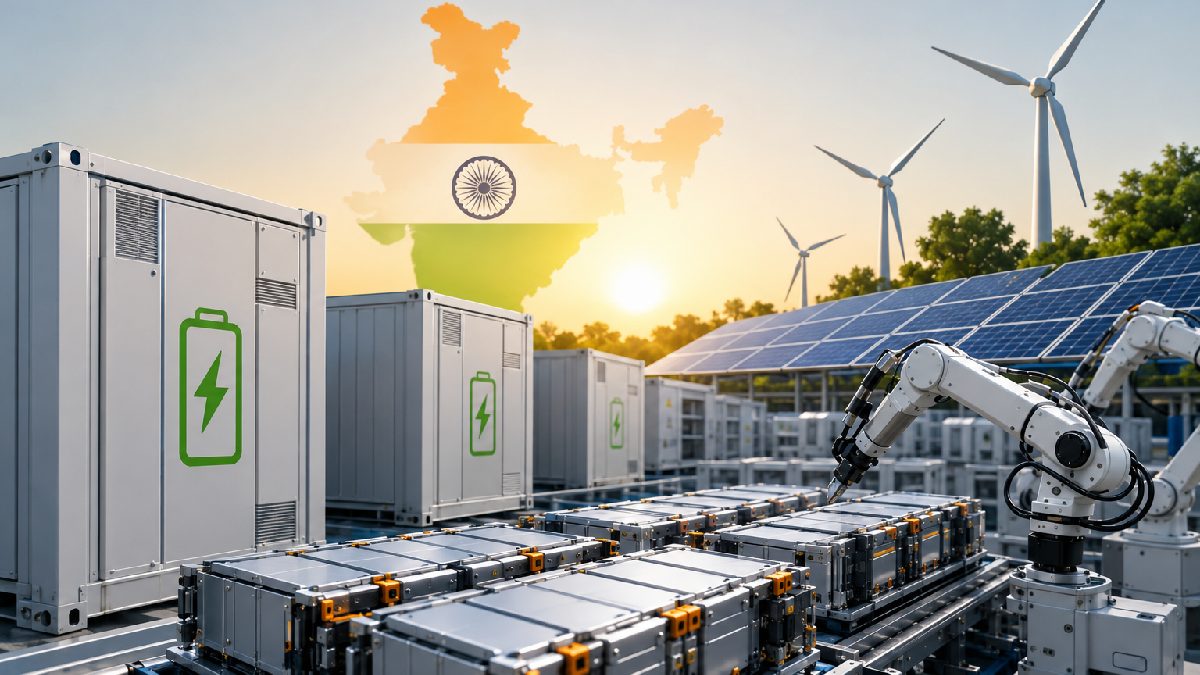
The Ministry of Heavy Industries (MHI) has issued a Request for Proposal (RFP) under the National Programme on Advanced Chemistry Cell (ACC) Battery Storage and it is calling on private companies, public sector enterprises, LLPs, investment funds and international companies to participate in the scheme. Companies selected under the programme will receive government subsidies under this program to build the manufacturing capacity and localise battery production.
Building a Domestic Battery Manufacturing Ecosystem
In the coming decades, the electricity demand in India will increase significantly as renewable energy production grows, electric mobility increases and the industry grows. As solar and wind power become a larger part of the energy mix, grid-scale battery storage will be essential for reliable electricity supply.
Battery energy storage systems can store surplus electricity generated during peak renewable production and release it when demand rises or renewable generation falls. It would enhance grid stability and reduce reliance on fossil fuel-based backup power.
Developing a domestic battery manufacturing industry is crucial not only for energy security but also to reduce imports, create jobs and make India a global hub for advanced energy storage technologies.
Subsidies Linked to Manufacturing Milestones
The companies will get financial incentives only if they reach manufacturing and localisation targets.
Successful bidders must create advanced battery manufacturing facilities with at least 25% domestic value addition within two years of the project's commencement. Within five years, companies should have domestic value addition of 40% and a minimum manufacturing capacity of one gigawatt-hour (GWh).
The government has stated that subsidies would be released only after these milestones are achieved under a formal ‘Programme Agreement’ signed between the selected company and the Government of India.
Flexible Manufacturing Model
The programme is flexible in the way companies start up.
Manufacturers can either build fully integrated battery production facilities or adopt a 'hub-and-spoke' model where different battery components are manufactured by multiple domestic suppliers and together meet localisation requirements.
This will help to grow the battery supply chain in India such as component manufacturers, material suppliers and technology providers.
States to Play a Key Role
State governments will also be key in getting investment under the scheme.
Each successful bidder will enter into a tripartite agreement with the Central Government, state government and manufacturing company.
States will be able to offer other incentives, including land allocations, infrastructure support, tax concessions and faster regulatory clearances to encourage companies to establish manufacturing facilities in their jurisdictions.
But the Centre has the power to review and modify these agreements before they are finalised to ensure consistency with the national programme.
Supporting India's Clean Energy Goals
The initiative aligns with India’s overall clean-energy strategy including ambitious renewable energy targets and efforts to improve manufacturing in India through the Atmanirbhar Bharat vision.
With solar, wind and other renewable energy growing rapidly, battery storage will become increasingly important for balancing power supply and demand. The domestic manufacturing will also help to reduce the reliance on imports from overseas battery suppliers as well as supply chain resilience.
Along with complementing the power sector, the programme would probably also create new investment opportunities, increase technological innovation and skills in manufacturing and become a means of creating jobs for manufacturing.
This new push will make India a high-level world market for next-generation battery manufacturing, as well as a green, energy-secure, and sustainable country.