India's government has rejected the notion that global passport rankings can be regarded as a universally accepted measure of a country's international mobility, arguing that there is no single global standard for assessing the strength of passports.
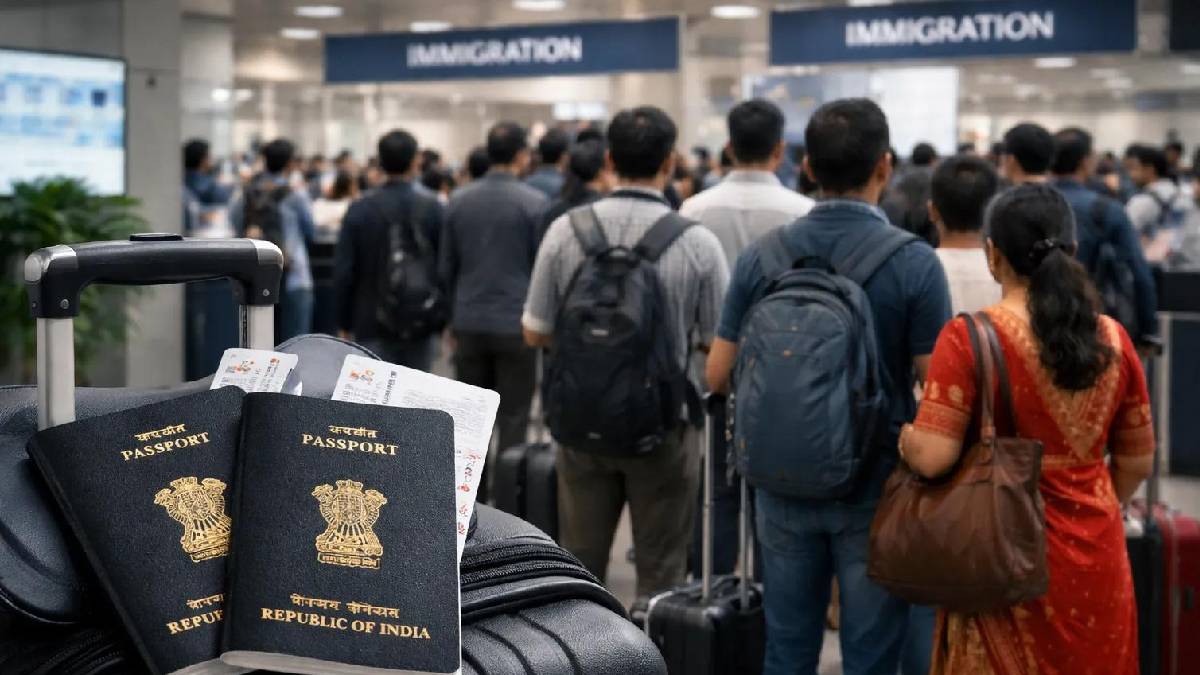
The government’s statement was made in response to a question in Lok Sabha about India's status in international passport rankings. Visa decisions are sovereign decisions for each country and are governed by several factors, including bilateral relations and reciprocity, the statement said.
As of now, the government also said 27 countries offer visa-free entry to Indian passport holders, with India continuing to engage foreign governments to advance travel facilitation for its citizens.
Government Questions Passport Ranking Methodologies
According to the government, passport rankings are prepared by private organisations using their own methods and certain parameters. Because there are no universally accepted criteria for comparing passports, no particular ranking can be considered a definitive global standard, the government said.
Minister of State for External Affairs Kirti Vardhan Singh said in a written reply that different organisations have different approaches to assess passport mobility.
The government’s response is in the midst of differing rankings for the Indian passport.
Global Citizen Solutions placed India at 125th in its ranking on June 30. The Henley Passport Index ranked India 80th, down from 85th in 2025.
The huge difference between rankings shows how different methods can impact a country’s position.
Visa Access Depends on Several Factors
The government explained that visa issuance is ultimately a sovereign decision taken by the country receiving foreign visitors.
For many reasons, a country's decision to provide visa-free access, visa-on-arrival facilities or other forms of simplified travel is influenced by several factors.
These are bilateral relations, reciprocity agreements, and policy-setting for immigration and travel.
Thus, the position of a passport in a private ranking does not necessarily provide a complete picture of India's diplomatic relationships or the ease with which Indian citizens can travel internationally.
We are constantly working with other countries to promote travel opportunities for Indian citizens, the government said.
27 Countries Offer Visa-Free Entry
The government also said Indian passport holders can now travel visa-free to 27 countries.
Hence, besides visa-free access, India has also been pursuing visa-on-arrival and e-Visa facilities with other countries as part of its efforts to promote global mobility.
Such arrangements will make overseas travel easier by not requiring travelers to go through lengthy visa application procedures before leaving.
The government said it is engaged with foreign countries on several international travel issues.
Regular Talks With Foreign Governments
The Ministry of External Affairs has regular communication with foreign governments on visa and immigration policies.
According to the government, these discussions cover visa-free travel opportunities, mobility and travel facilitation, visa overstays, passport security and immigration procedures.
The objective is to improve the travel experience for Indian citizens while also addressing concerns raised by partner countries.
Visa policies can change depending on diplomatic relations, security considerations, migration patterns and reciprocity. Thus, travel access can also evolve.
Focus on Passport Security
The government also indicated measures to make Indian passports and electronic travel documents compliant with international standards.
India has been working to align passport-related systems with the latest global guidelines, Kirti Vardhan Singh said.
The new security features in electronic travel documents comply with international standards set by the International Civil Aviation Organization (ICAO).
These measures are intended to strengthen document security and support smoother international travel and immigration procedures.
India Desires Greater Global Mobility
The government’s response indicates that it views international mobility as a wider diplomatic and administrative problem, not just one that has to be measured in terms of a single passport ranking.
India's engagement with foreign countries on visa policies is aimed at expanding visa-free, visa-on-arrival and e-Visa opportunities for its citizens.
While international passport rankings are still commonly followed by travellers and analysts, the government insists that differences in methodology mean they should not be taken as an absolute measure of passport strength.
The differences in the Global Citizen Solutions and Henley Passport Index rankings of India also demonstrate this.
So the government has underlined its continuing diplomatic efforts to improve travel access for Indian citizens while strengthening passport security and aligning travel documents with international standards.
With international mobility becoming increasingly important for tourism, education, business and employment, the expansion of visa facilitation remains a major area of India’s foreign-policy engagement.