In a country where the phrase "Atithi Devo Bhava" (The Guest is God) is embedded in social customs, weddings and housewarming ceremonies are regarded as open affairs. With the soaring cost of living and the cost of coordinating events, though, an entirely new form is developing in urban areas: a hardline strategy of cracking down on the “gatecrashing.”
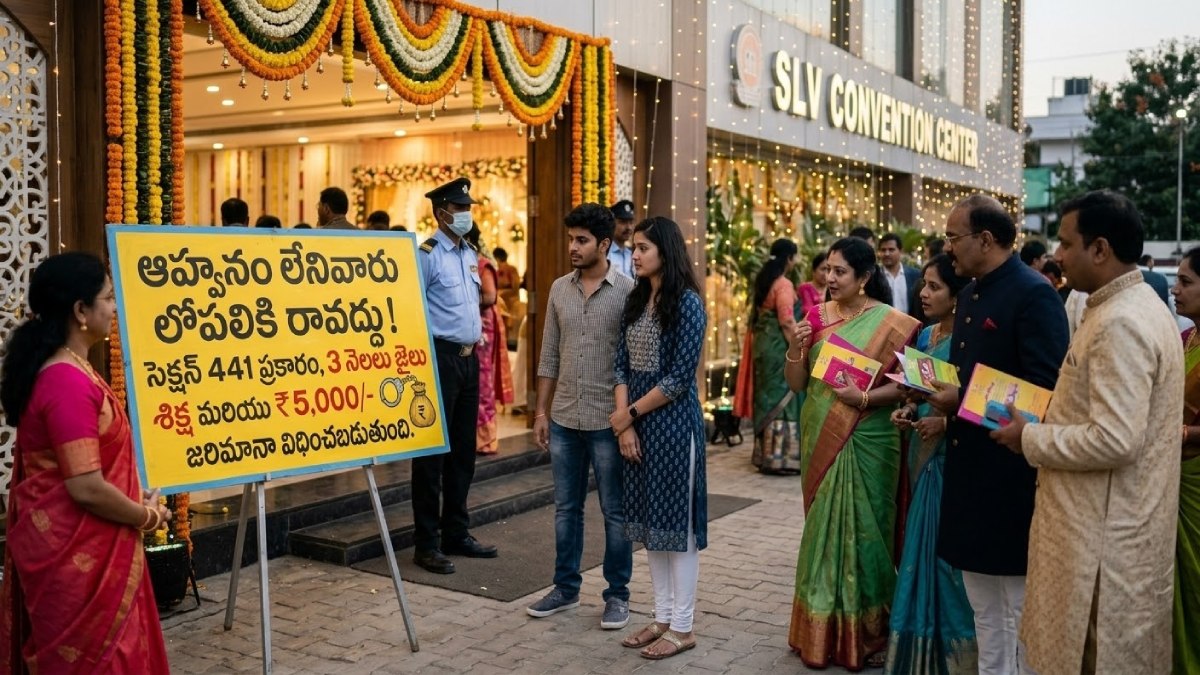
A picture of a warning board in Telugu hanging outside a function room has gone viral over social media recently. The board explicitly states that those who go into the premises without a proper invitation will be punished by a fine. This in turn aroused a debate about the legal consequences of uninvited people at private events.
The Viral Warning: Prison and Fines
The key poster in question tells everyone who tries to sneak into the affairs for a free meal, food and drink and entertainment exactly what its message should be. The procedure stipulates that anyone out of bounds of the wedding ceremony discovered in its premises will face legal action under Section 441, with three months in prison and a fine of ₹5,000.
Though somewhat draconian for a wedding venue, event organizers say “gatecrashing” has become a logistical nightmare in places like Bengaluru, Hyderabad and Mumbai. Per-plate prices are expensive for upscale venues with prices ranging from ₹800 to ₹3,000 and uninvited guests can be costly to budgets and seating arrangement.
Section 441 and BNS 329 Legal Perspective
Is it illegal to walk into a wedding uninvited, it’s true? The answer is what is meant by “Criminal Trespass.” Criminal trespass is a violation of the Indian Penal Code (IPC) Section 441 when a person enters or upon property in others possession so as to commit a crime or to intimidate, insult or annoy any person in the possession of such property. This has been reformed under Law, under Section 329 of the Bharatiya Nyaya Sanhita (BNS), after a recent update of the Indian Penal Laws and Criminal Code.

Marriage hall or private residence is treated as private property for the term of the lease or ownership, and therefore, to enter without the express or implied permission of host is a violation of laws in the field. If a host establishes the gatecrasher’s intent to “annoy” (through eating guests’ resources) or “insult” the host’s hospitality, the law allows for:
- Imprisonment: Up to three months.
- Fine: Up to ₹5,000 (or as applicable to the court).
- Both: For repeat offenders or aggressive behavior.
A Changing Social Landscape
The growing popularity of such warning boards embodies a modern change in social behavior. "In the past, extra guests were always approached with a smile, if anything, more recent events are often invite-only," it notes. "Due to space constraints around a venue and security concerns nowadays."
High-profile weddings nowadays often use bouncers or digital QR-code-based invitations to screen guests. As the “Atithi Devo Bhava” sentiment lingers, legal experts say the fun of “crashing a party” for free meal today is no longer worth taking the risk of a criminal record. As the viral board says, stay put, rather than spend 3 months in a cell on some plate of biryani.