Ladakh: Wildlife tourism in Ladakh is beginning to take off with the approval of the high-altitude nature conservation and wildlife safari by the government.
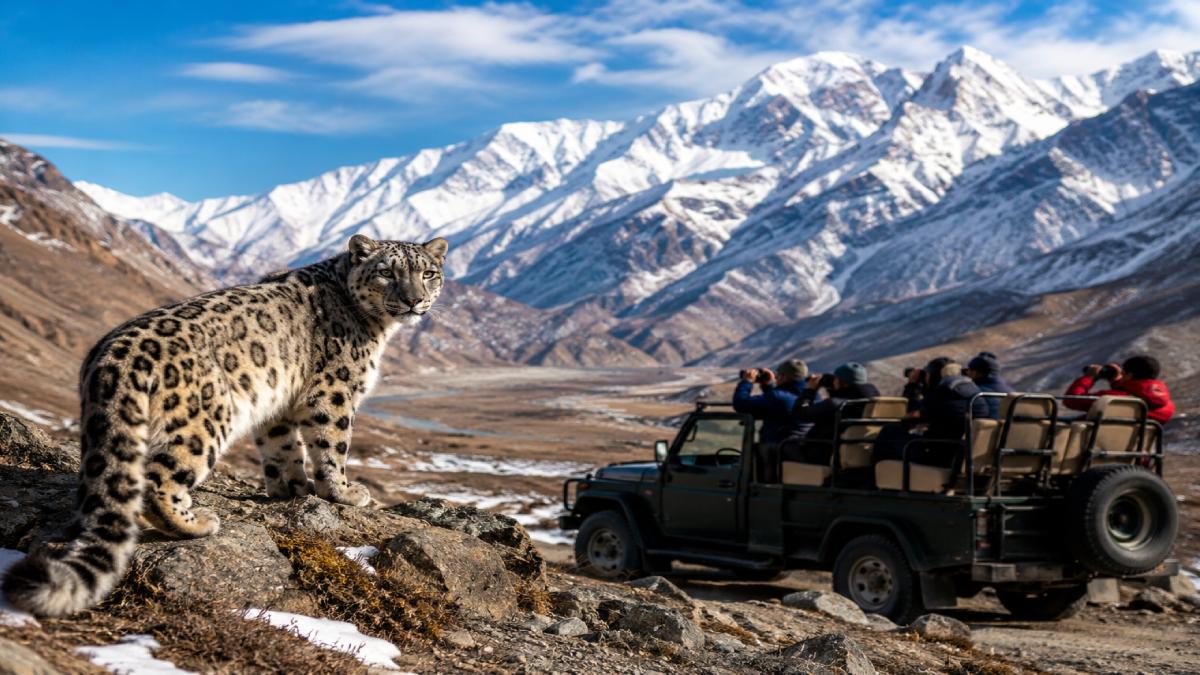
Snow leopard habitats and bird watching in the Union Territory’s upper reaches will be the focus and sustainable eco-tourism will be promoted, and the environment of the Himalayan mountains will be protected. The announcement has generated a great deal of interest for wildlife lovers as it has an organised way of going to see some of India’s most elusive mountain wildlife.
The initiative is coming at a time when Ladakh is increasingly known not only for its spectacular landscapes, but also for its biodiversity. Its cold desert environment allows for species that are particularly suited to high altitude and harsh weather conditions. The most famous one is the snow leopard, which is called the ‘ghost of the mountains’ because of its enigmatic nature and camouflage. The snow leopard lives in mountainous areas where sightings are very hard and it requires patience, local knowledge and close observation.
New safari on the basis of established wildlife and bird-watching trails will take in tourists and not create tourist routes through wildlife habitats and will be organised more to avoid illegal off-roading and disturbance to wildlife. With more structured tourism, authorities hope to get visitors to the right places and reduce the impact on the fragile alpine landscapes of the world.
This is particularly important as wildlife tourism has both positive and negative effects. It will create income for local communities, jobs for them and raise public awareness about conservation. But uncontrolled tourism can disturb animals, destroy vegetation and put pressure on delicate ecosystems. Ladakh’s high-altitude environment is particularly sensitive because recovery from natural loss of habitat is slow. So the safari’s approach puts conservation and tourism at the centre of the experience.
Snow leopards are among the most significant conservation symbols in Ladakh. India’s first national Snow Leopard Population Assessment, conducted between 2019 and 2023, estimated 718 snow leopards across the country. Ladakh had the largest estimated population of 477 animals, followed by Uttarakhand with 124 and Himachal Pradesh with 51. The assessment covered a large part of the potential habitat of the species and was an important scientific basis for conservation planning.
Ladakh’s Hemis National Park is already internationally recognized as a destination for people who want to see snow leopards. It has a total area of 4,400 square kilometres and is home to a wide range of high-altitude wildlife, such as snow leopard, bharal or blue sheep, Tibetan wolf and other species. Wildlife observations there are not done on a safari, which is far from nature in India’s forests and grasslands.
Instead of a safari where visitors can walk along relatively simple forest tracks, wildlife in Ladakh is shaped by mountains, deep valleys and vast open patches of open field with many miles of open countryside where a high altitude wildlife experience is made for them to do so at a higher height. Wildlife can be hidden away for a long period of time and sightings are never given a guarantee. That unpredictability is what makes snow leopard tourism so unique. People spend so much time scanning rocky slopes and mountain sides and valleys and seeing a glimpse of an animal that blends in almost perfectly is well to the rest of the animal's surroundings during a long and quiet day.
The new initiative is also consistent with Ladakh’s efforts to institutionalise conservation and its overall objectives. In June 2026, Lieutenant Governor Vinai Kumar Saxena approved the constitution of the Snow Leopard and High-Altitude Nature Conservation Society, or SHAN Conservation Society. The organization will work for wildlife conservation, scientific management, community involvement, eco-tourism and sustainable livelihood in areas inhabited by snow leopards and associated species.
Community involvement might be one of the most important elements of the new safari model. Local people know the landscape; wildlife movement and traditional practices. If tourism provides sustainable livelihood opportunities for local people, they can be active conservationists and not only observers of tourism development. Guides, homestays, transport providers and other local businesses could benefit from a well-controlled wildlife tourism economy.
Bird-watching is also part of that initiative. Ladakh has high-altitude landscapes that can provide a variety of bird species and therefore is a place of interest to nature lovers more than snow leopards. Wildlife observation, birding and mountain landscapes could help diversify tourism and increase the number of tourists to spend time in nature instead of just on a single species.
The initiative also highlights the growing significance of eco-tourism as a conservation tool. Tourism revenue can help with habitat conservation, awareness programmes, scientific monitoring and community development if systems are put in place. At the same time, visitor numbers, vehicle movement and wildlife observation will be regulated so tourism doesn’t harm the very ecosystems it seeks to highlight.
For wildlife lovers the prospect of exploring Ladakh's high-altitude habitats is an adventure unlike any other Indian safari. Instead of searching for tigers in the thick forests or elephants in the grasslands, a tourist in Ladakh may be looking up across huge mountain slopes to see a snow leopard. And it will probably be as much about the landscape as it is about seeing wildlife.
So the announcement is significant for the following reasons. It gives Ladakh a chance to create a different kind of nature tourism and to put conservation at the heart of the visitor experience. It also indicates a recognition of the ecological importance of the area and tourism in a turbulent high altitude environment.
As the initiative develops, its success will depend on balancing tourism with local livelihoods and wildlife conservation. Planning for this will be crucial and scientific monitoring and community involvement will have to be involved. Ladakh’s high-altitude safari would be a model for wildlife tourism and conservation in some of India’s most ecologically sensitive landscapes if well managed.
The snow leopard may be the big star but this is about conservation of an entire ecosystem at the heart of the whole ecosystem. Ladakh’s mountain ranges have many animals, birds and plant species that are adapted to survive in difficult conditions. A well-managed safari that is well-run and well-managed might help visitors feel the biodiversity of this biodiversity and support it better to help protect it.
So India's first high-altitude wildlife safari is more than a tourist attraction. It is an attempt to bring wildlife conservation, responsible travel and local participation into one of the country’s most beautiful landscapes. For tourists in the middle of a high altitude, seeing a snow leopard is an unforgettable experience; for conservationists, the bigger risk to them is that you just walk in and there’s no damage to the animals’ habitat.