NITI Aayog has commenced releasing an ambitious collection of 11 study reports depicting India’s potential growth road maps to becoming a Viksit Bharat by 2047 at the same time it demonstrates its commitment to Net Zero emissions. Three initial cohorts were announced on 9 February at the Ambedkar International Centre in New Delhi. The release was followed by a panel discussion, called “Ambition to Action: Balancing Growth and Green Transition.”
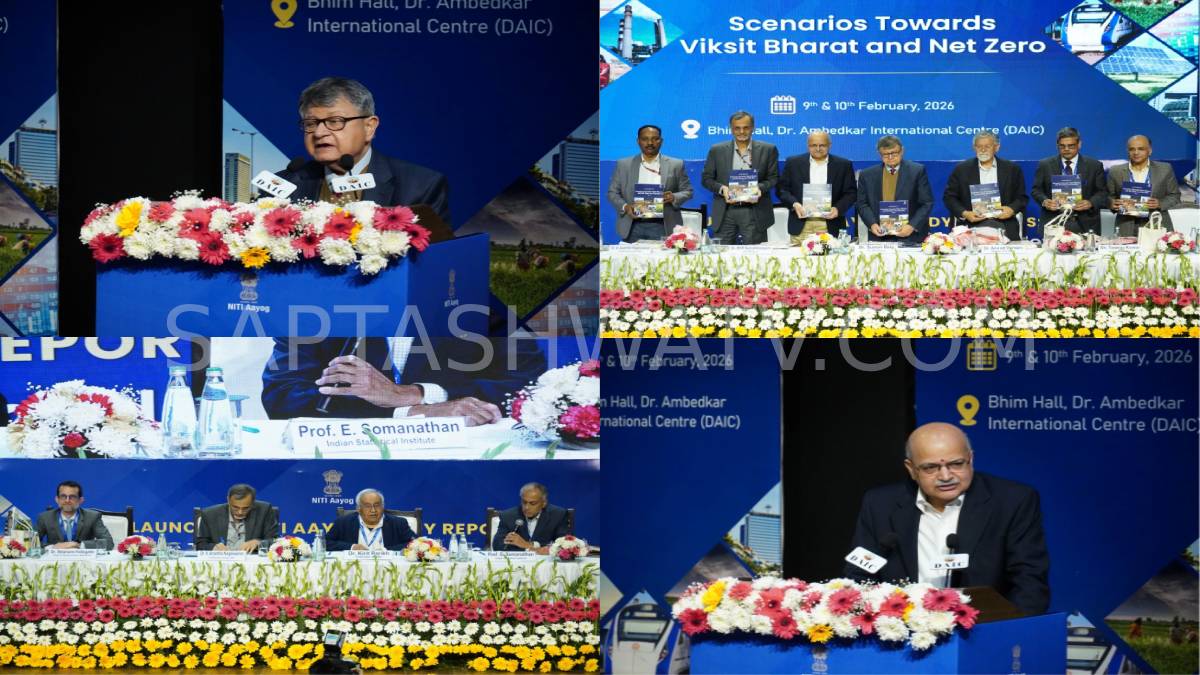
The gathering comprised key policymakers and experts, such as Suman Bery: Vice Chairperson, NITI Aayog; Dr. Arvind Virmani: NITI Aayog Member; B.V.R. Subrahmanyam, CEO NITI Aayog; Tanmay Kumar, Secretary, Ministry of Environment, Forest and Climate Change; and Dr. V. Anantha Nageswaran, Chief Economic Advisor in the Ministry of Finance.
The reports cover the various possibilities and argue that India could reach developed-nation status by 2047 with various modes of growth. They point out that electrification of end uses, cleaner energy mix, motivational changes (Mission LiFE) and implementation of circular economy would be key in harmonising economic growth with environmental consciousness.
It has been found that coal will remain important to India’s energy mix for decades, with the volume of use expected to increase until 2047 to sustain industrialisation and increasing demand. Simultaneously, adopting cleaner systems will demand unprecedented levels of investment. The studies estimate a total need of approximately USD 22 trillion, at least USD 6 trillion of which is projected to be issued from external financing sources.
The reports make a critical point that close to 85% of India’s 2047 infrastructure is not yet in place. This remains an unprecedented opportunity for the integration of low-carbon technologies, energy efficiency and climate resilience to be directly integrated into future assets, as opposed to retrofitting them at a later date. The analysis identifies India as one of the top candidates to become the world’s leader in the manufacture and deployment of clean technology.

What India might do differently is show how growth, inclusion and sustainability can work in tandem, and that India’s way has potential as a template for developing countries looking to, and especially from, the Global South.