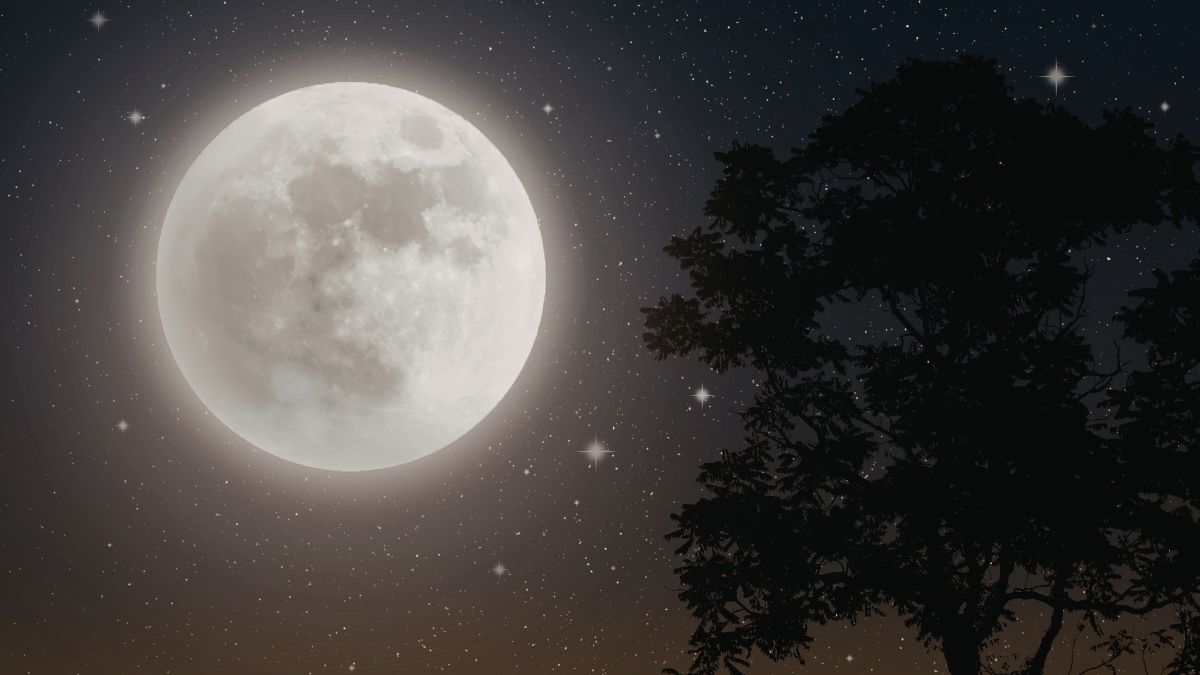
For as long as human beings have lived, the Moon has been our most solid celestial friend. We have watched it as a silver sickle, a glowing pearl, and a dark mystery. But tonight, people who gaze toward the west soon after sunset, the Moon will assume a rare personality: a happy, radiant “smile.” This evening there will be a rare astronomical phenomenon called a triple conjunction.
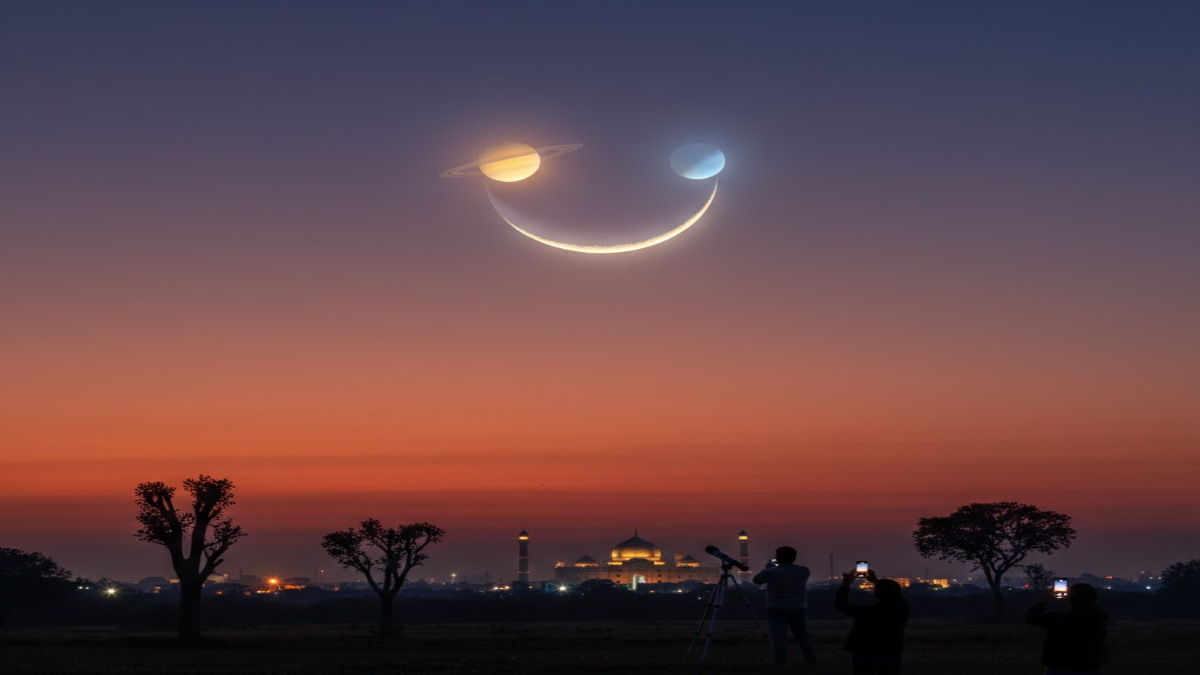
In the night sky, the Moon, the ringed giant Saturn, and the distant ice giant Neptune are going to align in order to form a "Cosmic Smile." The Anatomy of a "Smiling Moon." A celestial conjunction happens when two or more objects seem very close to each other in the sky from where we are on Earth.
Tonight’s alignment is notably noteworthy for location:
- The Smile: The Moon's crescent (around 26-28% lit) is in its waxing crescent state. Its slim, curving shape gives the perfect “mouth” of the face.
- The Eyes: Saturn and Neptune are above the lunar crescent. Saturn, emitting a very bright 1.0, will easily be seen as one of these "eyes." And Neptune (albeit much less bright) completes the trio.
How and When to Watch
You aren’t needed to go to sleep until midnight to catch this celestial grin. The best viewing times are 30 to 90 minutes after sunset.
Look West: Look for a place with a good view of the western horizon which will let your eyeful stretch out even further into space far from tall buildings or shrubbery.
The Naked Eye
Next to the crescent Moon, one can easily spot the constant, yellowish glow of Saturn. The Telescope Advantage: While the “smile” is visible to the naked eye, Neptune is much more elusive. At magnitude 7.9, it is too faint for the naked eye. To see the full “face” clearly, grab a pair of binoculars or a small telescope. An eyepiece will show Neptune in a tiny dot of pale blue.
Implications for Culture and Astronomy
In Indian culture, the Moon is referred to as "Chanda Mama," in simple, affectionate terms. Although we typically describe its beauty to children or liken it to a loved one’s face, seeing it literally “laugh” is a spellbinding example of the science of astronomy. On an astronomical level this incident offers a lesson in the exact choreography of our solar system.
Though these three bodies resemble neighbors tonight, they are millions of kilometers apart. Saturn lies more than a billion kilometers away, while Neptune is almost four times that distance. Tonight, the universe just happens to synchronize its clockwork so we have a reason to smile all over again. Don't miss this opportunity. The “Cosmic Smile” is a fleeting beauty that reminds us that there is the potential for a little whimsy in even the void.