A safety exercise was conducted at the Mahakaleshwar temple in Ujjain on August 7 to assess the strength and stability of a newly built overbridge before the anticipated surge of devotees for Nag Panchami. Temple security personnel jumped in a human loading test on the bridge as part of the exercise to determine if a pedestrian bridge reacts to concentrated and rhythmic movement of a walker (e.g., in a constant and rhythmic manner).
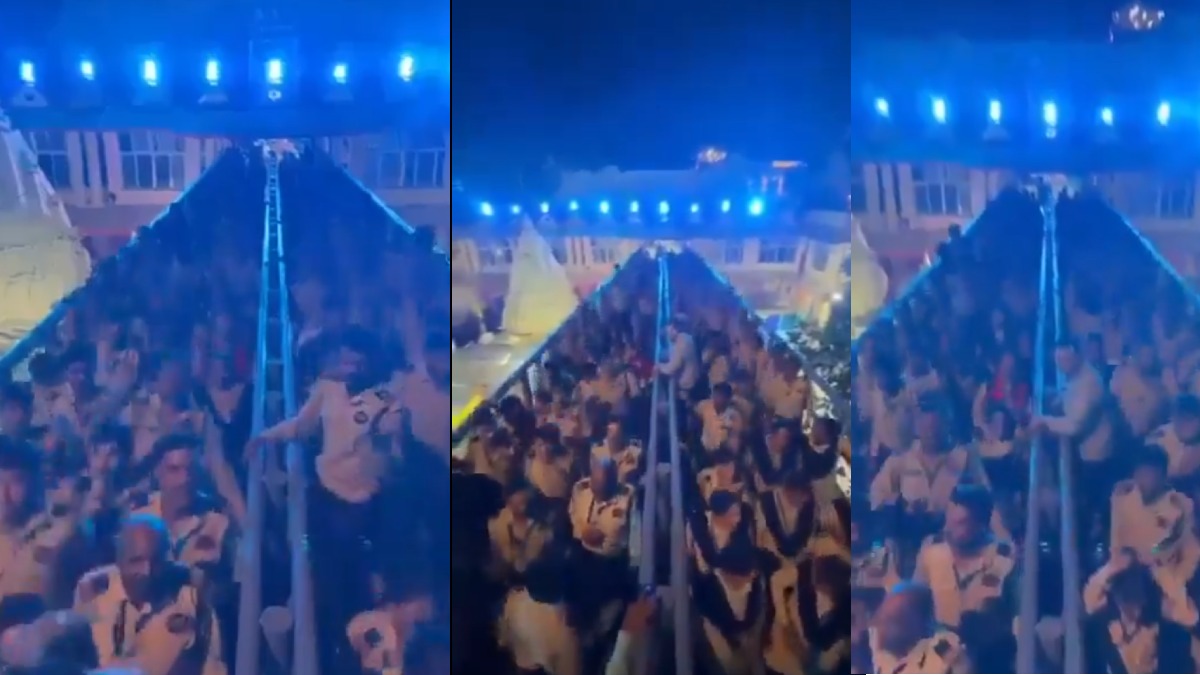
The test was carried out with the Nag Panchami festival in mind, when thousands of devotees are expected to visit the Mahakaleshwar temple complex and seek darshan at the Nagchandreshwar shrine. The shrine is situated on Mahakaleshwar temple premises and draws much more people to it during the festival. With the increased walking volume expected, the safety and load-bearing capacity of the routes used by the devotees has been also taken into account.
The Bridge Corporation and public works department personnel examined the overbridge during the exercise. The inspection included inspections of the critical structural components such as bolts and joints, and corrosion and other visible defects were checked. The inspection showed that there were no major problems in the structure, according to the information.
The coordinated jumping exercise drew attention because of its unusual appearance, with several guards moving simultaneously on the bridge. But human loading tests can be part of structural assessments for pedestrian bridges. Unlike ordinary foot traffic, synchronized movement can create repeated or rhythmic loading, enabling engineers to observe how a structure behaves under dynamic conditions.
Such tests are especially important for pedestrian bridges because large groups of people don’t just walk randomly. At religious festivals, public events, and at other events, crowds of people may walk at a similar speed or move in a common direction. Rhythmic movements may produce vibrations that are different from those of ordinary individual pedestrians. Testing the structure in such situations can be very useful for its performance.
The number of people using the overbridge should be kept to about 300 at a given time, officials said after the assessment, in order to avoid overload and allow for devotees to move about safely. Crowd management will be an important part of the arrangements, especially during peak times when many pilgrims could cross the bridge at once.
The inspection also underscores the larger issue of managing infrastructure at major religious destinations. During festivals and festivals of particular importance, temples like Mahakaleshwar always see sudden increases in footfall. Infrastructure that may be adequate in a normal setting may be challenged much more when large crowds arrive in a short period.
Though the physical inspection and human loading exercise provided an immediate assessment, some observers have suggested that authorities may also consider other non-destructive testing techniques. Structural elements can be examined using ultrasonic scanning without damaging the bridge. These are widely used in engineering inspections to look for internal flaws or weaknesses that are not readily visible by a traditional visual examination.
The recommendation of a 300-person limit also underscores the importance of integrating structural safety measures and good crowd control. A pedestrian bridge that is structurally sound can become difficult to manage if too many people are allowed on it at once. Obviously marked entry and exit points, trained people, an eye on crowd movement, and timely restrictions could be important to the festival.
The safety preparations are at a crucial time for Ujjain and will see more activity around Mahakaleshwar temple during Nag Panchami. The authorities are expected to keep devotees in the shrine and to keep the temple complex and all associated structures orderly.
The exercise on August 7 was therefore not only a demonstration but part of preparations that had been conducted to check the overbridge before the festival-driven walkways and the crowds come in. With no structural issues noted and officials recommending a controlled capacity, we now focus on crowd management and monitoring during the period of increased footfall.
As Nag Panchami approaches, the overbridge is expected to be an important part of the pedestrian movement plan around the temple. Regular inspections, compliance with the recommended capacity, and coordination of security and public works personnel could help devotees to move through the area safely during one of Ujjain's busiest religious occasions.