A Vande Bharat train broke its front nose cover after colliding with a buffalo on the railway tracks, and this brings to the fore once again the perennial issue of animals entering railway corridors. Information on the damaged train on the internet and images of the train are spreading, and discussions are being raised about railway safety, track fencing and how to prevent cattle from being able to make it onto high-speed rail routes.
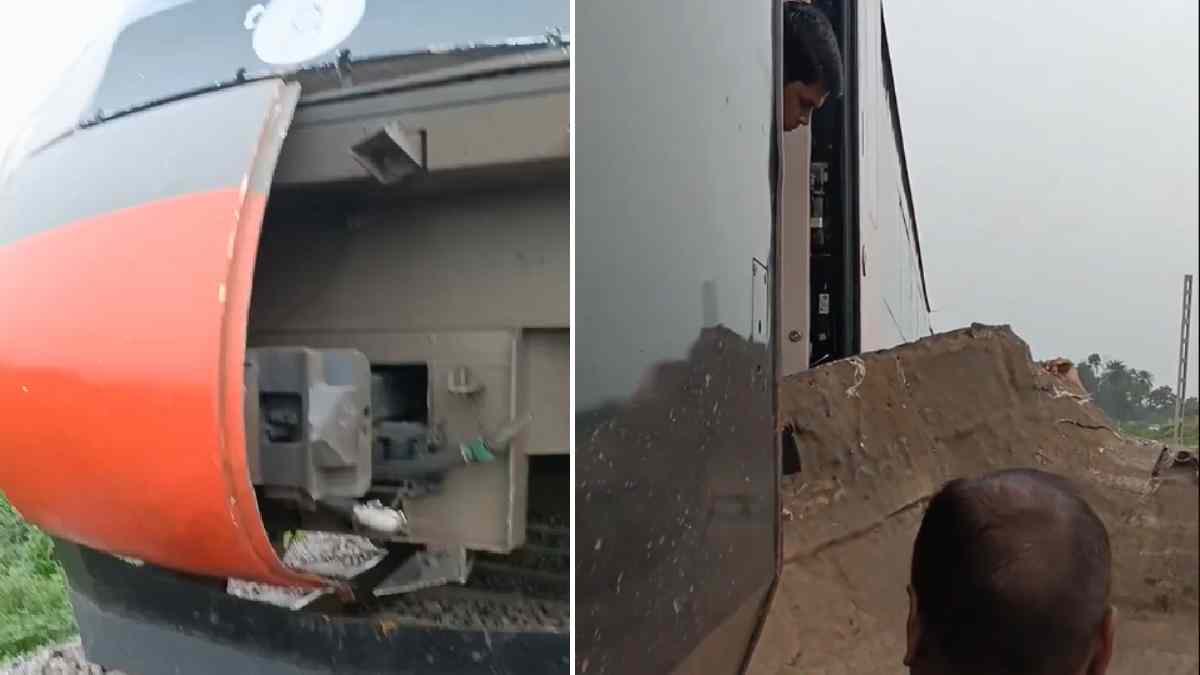
The collision reportedly damaged and detached a large portion of the train’s fibre-reinforced plastic (FRP) nose cover. While the damage may appear serious from the outside, the component is specifically designed to absorb the force of an impact and protect more critical parts of the train.
Indian Railways has previously stated that the coupler cover fitted at the front of Vande Bharat trains forms part of the aerodynamic nose cone and is made from fibre-reinforced plastic for protection against impact.
Why does the Vande Bharat Nose Cover break?
The front section of a Vande Bharat train is constructed to be aerodynamic and not only to absorb damage from impact but also to contain components that can absorb or sustain damage.
The FRP nose or coupler cover functions somewhat like a sacrificial component. Rather than transferring the entire force of a collision to other structural components, the outer cover can break or deform, and then be repaired or replaced.

An earlier official parliamentary response gives an example of this design in practice. In October 2022, the railway authorities reported some minor damage to the FRP coupler cover and its brackets following a cattle collision with the Vande Bharat train. The train was able to make its way to the destination, and the damaged parts were repaired at the Mumbai Central depot.
This means that a broken nose cover does not necessarily indicate major structural damage to the train.
Cattle on Tracks remain a Railway Safety Challenge
Cattle are not allowed on railway tracks, and these trains are moving fast, so a lot of people don't know about this.
Indian Railways has previously reported thousands of cattle run-over incidents across its network. According to government data, 27,057 cattle run-over incidents were reported in 2019-20, 19,960 in 2020-21 and 28,727 in 2021-22. In the 2022-23 financial year, until January 23, 2023, 26,180 incidents had been reported.
The railway network has taken several measures to solve the problem, such as removing vegetation and garbage from the areas where cattle and other animals are more likely to enter railway corridors and training train crews to whistle at these places where cattle and other animals are more likely to enter railway corridors.
Calls for Better Track Fencing
This buffalo collision has also revived calls from railway users for strengthened fencing on vulnerable sections of railway tracks.
Supporters of large fencing say the walls can keep cattle and other large animals from entering tracks (in high-speed corridors) and from getting out. Such precautions can reduce the chances of collisions, delays and damage for animals on the tracks.
With India expanding its network of semi-high-speed Vande Bharat services, the issue is even more crucial. According to the Ministry of Railways, Vande Bharat trains are designed to operate at an operating speed up to 160 kmph on suitable routes, and their design speed is 180 kmph.
At such speeds, even a collision with a large animal can produce considerable impact forces.
The Vande Bharat train collided with a buffalo on the tracks, causing the front portion of the train to break. 💔
— Neend Ki Rani 😴 (@Neend_Ki_Rani) September 17, 2026
Is this what happens to the Indian train that breaks down so easily😭 pic.twitter.com/BeJ20A85ZH
Damage to Nose Cover Does Not Mean Train Is Unsafe
Although photographs of a damaged Vande Bharat nose can be alarming, the outer FRP component is not the primary structural shell of the train.
Indian Railways has said that the Vande Bharat coach shell itself is made of high-grade steel, while the front coupler cover is made from FRP to absorb impact.
The design thus allows the outer component to take damage while protecting the train’s more important systems.
But the fact that this collision occurred is indicative of the need to prevent such collisions in the first place. Beyond damage to railway equipment, animal strikes can lead to delays in operations and risk to human life at the train station and to animals.
Focus on Prevention
As India's semi-high-speed rail network expands, preventing animals from reaching railway tracks is going to be an essential safety consideration. Fencing in vulnerable areas, keeping trackside surroundings clear, and knowing cattle-prone areas can supplement the safety systems already in place on current trains.
Vande Bharat trains also have other safety technologies like the KAVACH automatic train protection system on the route. The government says KAVACH is designed to provide train protection and collision-prevention capabilities.
The buffalo collision therefore is another reminder that safety in rail is more than the technology installed inside a train. Keeping animals off fast tracks is still an important part of protecting passengers, railway infrastructure and livestock.