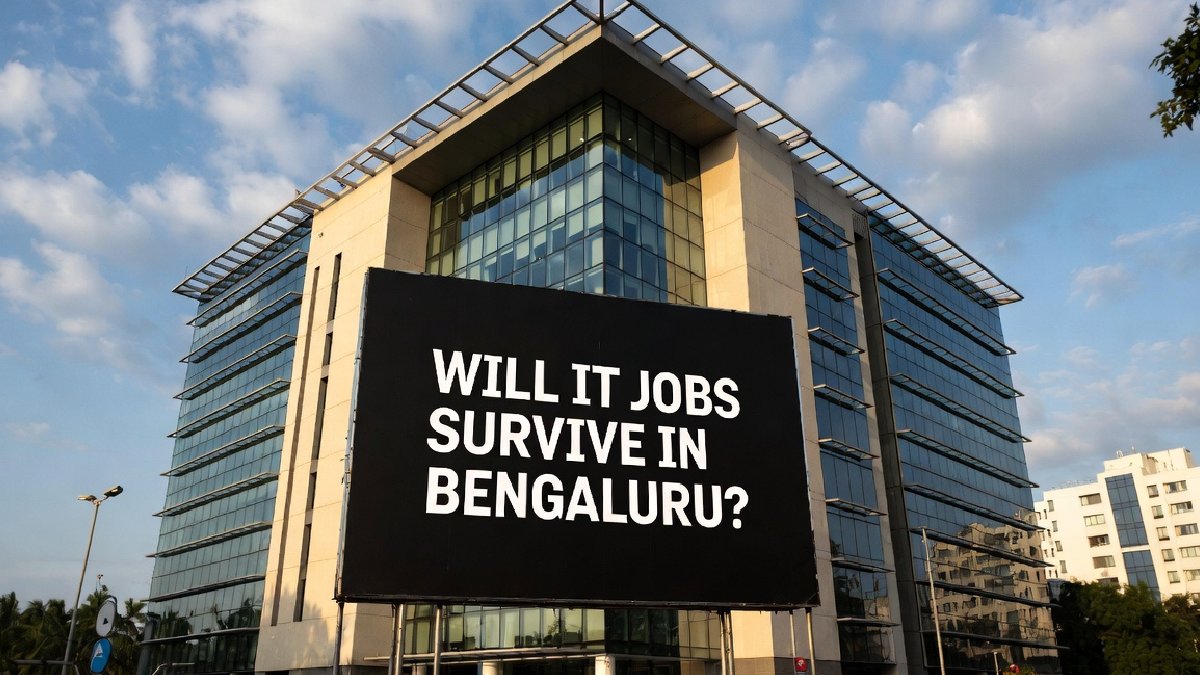
Bengaluru has been the “Silicon Valley of Asia” for decades, the city of countless code lines, booming salaries, and a job market viewed as the bulletproof option. But new realities are already being established in February 2026. The “Survival” of IT jobs in Bengaluru is no longer about quantity but rather a transition towards a high-skill, AI-native ecosystem.
1. The End of Mass Recruitment
The traditional “services” model, which saw top firms hire tens of thousands of freshers every year, has hit a wall. Over the first nine months of FY26, the top five IT employers in India added a minuscule number of net employees compared to years earlier. That’s not a sign of the industry’s demise so much as it’s becoming leaner. Artificial intelligence agents are taking over the repeated tasks, basic manual testing and entry-level coding jobs, which is leaving a so-called "K-shaped" job market in which low-skill roles disappear while high-skill demand remains unmet.
2. The Rise of GCCs
Global Capability Centers (GCCs): while traditional service companies are waning, GCCs are on the rise. In 2026, Bengaluru was also the place where the Fortune 500 companies go to build their research and development (R&D) hubs. These centers are not seeking “resource” padding, they are recruiting architects and data scientists and cybersecurity specialists. For the qualified professional, the job market has made itself more approachable and has gotten closer to the place of innovation, usually paying better—and having a stable career.
3. AI “Tsunami” and Upskilling
AI has not led to a “job apocalypse” but it has led to a “role displacement”. GenAI tools are used every day by about 40% of the city’s IT workforce. Professionals who do not have an upskilling in prompt engineering, AI/ML integration and cloud architecture may find themselves redundant. But for people who oversee AI systems themselves, job security has never been so high. In 2026 the industry consensus is clear: AI will not take your job, a person using AI will.
4. "Beyond Bengaluru" and Infrastructure Strains
The Karnataka Government’s IT Policy 2025-2030 is driving companies to Tier-2 cities, such as Mysuru and Mangaluru to alleviate the pressure on Bengaluru’s infrastructure. As traffic congestion and housing costs break record amounts, “survival” in Bengaluru is also an issue of having a hybrid work culture. The city is slowly evolving into a “Smart Hub” (in particular North Bengaluru), but many IT jobs are moving to satellite cities to ensure a better quality of life.

The Verdict
IT jobs in Bengaluru will not only survive; they will shape the next decade of world technology. But that “comfort zone” of halfway through the 2010s is not around anymore. In Bengaluru's 2026 landscape, to survive, an IT professional has to transform from "coder" to "solution architect" who can deploy AI and provide the work of five people.