
Karnataka’s government English-medium school programme has come under scrutiny after a study by the Kannada Development Authority reportedly revealed a huge gap in English language skills in Classes 6 and 7. This raises questions about whether bilingual education is effective for children, especially in terms of developing real-life communication skills in English.
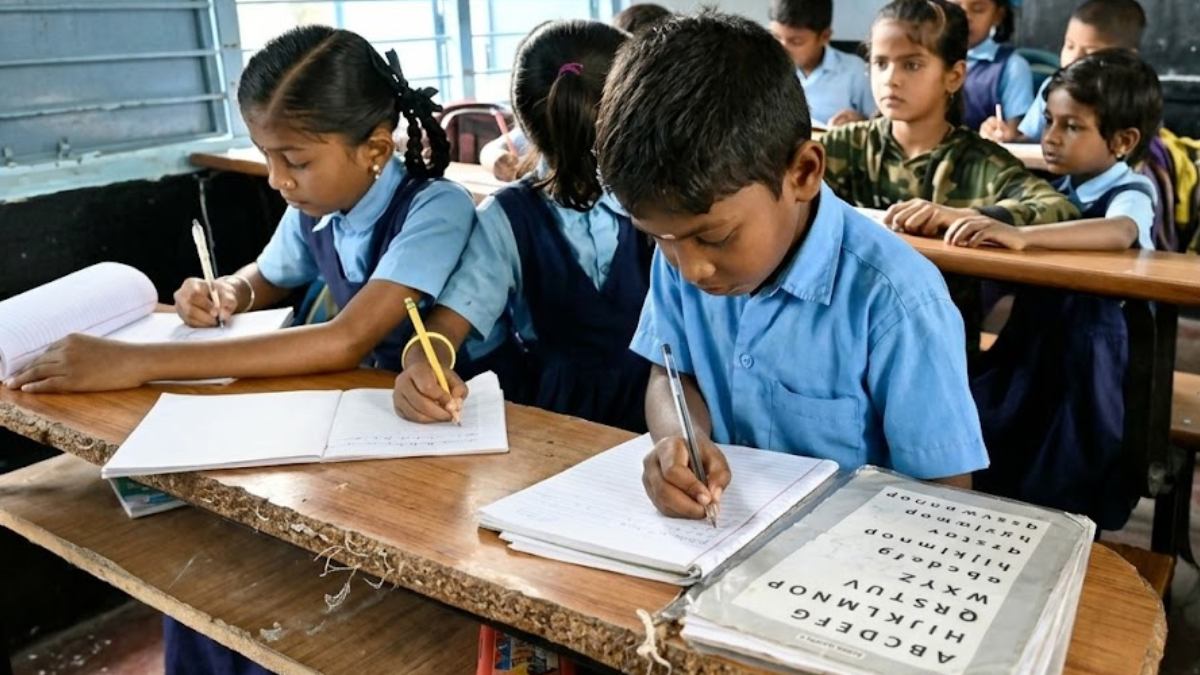
Many students can read English text but struggle to understand its meaning, construct independent sentences, participate in conversations, and write accurately, the study shows. The report also indicates that some seventh-grade students simply can’t narrate a short story in English, which raises concerns about the effectiveness of classroom language instruction.
The study was carried out by education experts including Dr. G.S. Jayadeva and Dr. Krishnamurthy Hanur. The Kannada Development Authority has sent its findings to the state government and recommended improvements in language teaching methods and a stronger foundation in the mother tongue.
The findings will have an impact on the debate on Karnataka’s bilingual education policy to grow English proficiency and retain Kannada as an important language for learning.
Karnataka English-Medium School Scheme Faces Questions
Karnataka introduced its government school bilingual education policy during the 2018–19 academic year. It sought to expand English-medium instruction in government schools and to support Kannada learning.
English-medium sections were introduced in the 2019-20 academic year in 1,000 government schools in the first phase. In 2020-21, the programme was expanded to another 1,400 schools.
The initiative continued to grow over the next few years
According to the information provided alongside the study, permission to introduce bilingual classes in an additional 4,134 schools during 2025-26 was granted.
A report from April 2026 showed bilingual instruction was introduced to 9,522 schools for Classes 1 to 5. The state expects to extend bilingual teaching to Class 6 for the 2026–27 academic year.
However, the Kannada Development Authority's assessment suggests that expanding English-medium instruction alone may not be enough to produce the expected learning outcomes.
The concern is whether students are acquiring the language skills to interpret lessons, communicate confidently, and learn English independently.
Students Struggle With Speaking, Reading, and Writing
The assessment focused on students in Classes 6 and 7 across four key language skills: listening, speaking, reading, and writing.
According to the findings, students have problems in several areas of English language learning.
Reading without comprehension: Some students can read English passages but struggle to understand their meaning. This suggests that recognising words and reading sentences aloud do not necessarily translate into comprehension.
Limited speaking skills: Students reportedly lack confidence when speaking English. Expressing ideas independently, narrating stories and participating in conversations remain challenging for some learners.
Difficulties in sentence construction: The study highlights weaknesses in forming independent sentences and using English in everyday communication. Students who depend heavily on memorised answers may struggle when asked questions that require original responses.
Writing and spelling problems: Students also face difficulties writing without spelling errors. These gaps can affect their ability to express ideas clearly in written assignments and examinations.
Taken together, the results suggest a disconnect between textbook-based learning and the practical application of English. Some students may be memorizing lessons without a deeper understanding of the language, the report says.
Memorization-Based Learning Raises Concerns
One of the main issues highlighted in the assessment is the reported dependence on memorization rather than practical language use.
Students may be able to reproduce answers from textbooks or recall passages taught in class, but they may struggle to apply the same knowledge in new situations.
Language learning requires regular opportunities to listen, speak, read, and write. If classroom practice is primarily focused on memorizing answers and preparing for exams, students don’t get many opportunities to practice spontaneous communication.
A student who has memorized a story may find it difficult to narrate it independently or explain its meaning in their own words. Reading a passage out loud does not mean that the student understands its message.
The findings of this study underline the importance of assessing language comprehension and communication skills alongside textbook knowledge.
Kannada Development Authority Recommends Stronger Mother-Tongue Learning
The report emphasizes the importance of the mother tongue as a strong foundation for children’s education. It recommends strengthening Kannada learning while improving English instruction through more effective teaching methods.
The underlying concern is not necessarily that English should be eliminated from government schools, but that the introduction of English-medium classes should be accompanied by appropriate teaching support and measurable learning outcomes.
A strong foundation in a child’s familiar language can help develop comprehension, reasoning, and the ability to express ideas. Teachers can then build connections between concepts understood in Kannada and the corresponding vocabulary and expressions in English.
The report also recommends child-centered and communication-based language teaching. This approach can include storytelling, classroom conversations, group activities, reading exercises, role-playing, and creative writing.
These activities can give students more opportunities to use English in meaningful contexts rather than relying purely on memorized material.
What the Findings Mean for Karnataka’s Education Policy
The study comes at a time when Karnataka is expanding bilingual instruction across its government school system. The findings could prompt policymakers to examine whether existing classroom practices, teacher preparation, and learning assessments are adequately supporting students.
Introducing English-medium sections can increase access to English instruction, but the quality of teaching remains essential. Teachers need suitable training, age-appropriate learning materials, and classroom strategies that help children develop all four language skills.
Regular assessments could also help schools identify students who can read words but struggle with comprehension, or those who understand lessons but lack the confidence to speak.
Providing additional language support in the middle-school years may be particularly important for students who have progressed through several grades without developing basic communication skills.
The reported findings should not automatically be interpreted as proof that the entire English-medium initiative has failed. The study examined selected government schools, and its findings should be considered alongside details about the sample, assessment methods, and differences between schools.
Nevertheless, the concerns highlight an important challenge for Karnataka’s education system: expanding access to English instruction must go hand in hand with improving actual language proficiency.
As the state considers extending bilingual education to more grades, the focus is likely to remain on whether students can understand what they read, communicate their ideas confidently, and use English effectively in real-life situations, while continuing to build a strong foundation in Kannada.







Comments