
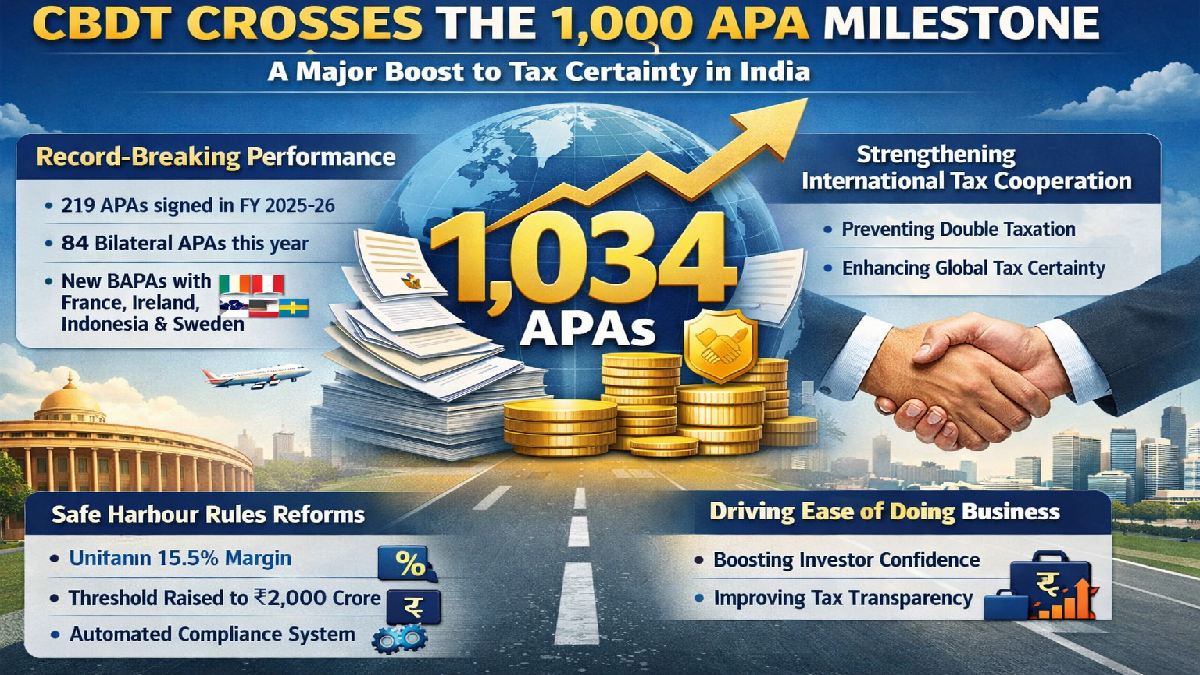
The Central Board of Direct Taxes (CBDT) has signed 219 Advance Pricing Agreements (APAs) during the 2025-26 financial year in India. This brings the total number of APAs since 2013 to 1,034; with this increase in number going to help the organization enhance tax certainty and dispute resolution.
Record-Breaking Performance
The year is notable for having the highest number of APA signings in a year. 84 BAPAs were concluded to date (84 BAPAs were signed; the most were ratified; this was also double that set by 65, which was a record number from FY 2024-25, which was already set last year as well as the previous. Most notably these agreements were signed with 13 countries that are a source of several of India’s core tax treaty partners like the United States, United Kingdom, Japan, Singapore, and Australia.
Another highlight this year is the achievement of India’s first bilateral APAs with France, Ireland, Indonesia, and Sweden - in terms of global reach and credibility of the APA programme.

Strengthening International Tax Cooperation
Bilateral APAs help prevent double taxation and guarantee cross-border tax certainty for businesses in the jurisdictions. International corporations rely on the CBDT to have more predictability as well as risk avoidance through negotiating mutual agreements in their friendly jurisdictions.
Safe Harbour Rules: Efficient
This model is complemented by the Safe Harbour Rules (APA, 2016), which provide a simpler and more cost-efficient way to determine transfer pricing margins. They cover a host of international transactions (IT services, IT-enabled services (ITES), contract research, intra-group financing) and thus provide an international framework for dealing with global trade.
The Finance Act 2026 has further cemented this framework with the introduction of new reforms:


- The consolidation of various technology service categories from different sectors into a single “Information Technology Services” segment
- Prescribing a uniform margin of 15.5%
- Increasing the eligibility threshold from ₹300 crore to ₹2,000 crore
- Introducing a more automated and system-driven compliance mechanism
The changes are in place to manage administrative burdens; that is, increase transparency and safety.
Driving Ease of Doing Business
The APA programme allows taxpayers to determine the transfer pricing strategy and methods in advance for up to five years, making them less susceptible to uncertainty and disagreement. Together with the new Safe Harbour Rules for Indian taxation, it will help make the government of India a consistent, transparent, and investment-friendly government.
Hence, the symbolic crossing of the 1,000 APA mark is important, but it is also a sign of increased trust of taxpayers in India’s tax administration system. With the CBDT continuing to improve the framework and enhance the ease of operation of its service, it will help make India an attractive place to invest.







Comments