
A glacial lake outburst flood (GLOF) in Bhutan has prompted flood warnings in parts of Assam and West Bengal. The sudden rise in water levels in Sankosh River was worrying officials, who have activated emergency response measures, disaster management teams, and asked residents living near vulnerable riverbanks to move elsewhere.
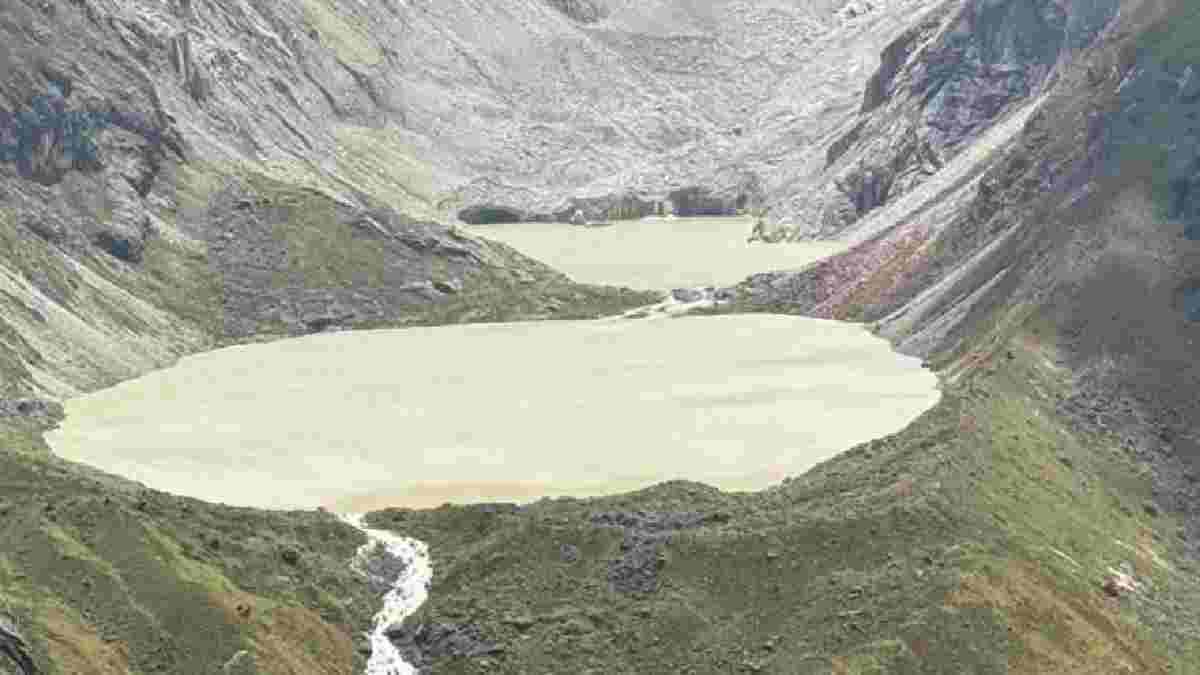
The incident took place on Thursday evening at Shintaphu Lake (Shintaphu Tsho) below Wakila Mountain in Bhutan’s Gasa district. The lake is in the upper reaches of the Mo Chhu river basin, which forms part of the Punatsangchhu basin. After entering India, the river is known as Sankosh.
The sudden release of water from the glacial lake has prompted authorities in both countries to keep a check on downstream conditions. India’s Centre has issued an advisory warning of a “rapid rise” of the Sankosh River (bordering Bhutan) and other rivers downstream.
Shintaphu Lake Outburst Damages Infrastructure in Bhutan
The glacial lake outburst has already affected local infrastructure in Bhutan. A solar-powered irrigation system in Dochhukha-Dzomlingthang-Ritsa Chiwog under Guma Gewog of Punakha was partially damaged by floodwater.
The irrigation facility was set up earlier this year to meet water shortages in the area but the outburst has rendered it useless and the system stopped reportedly. Authorities have not yet finished assessing the damage.
Floodwater also carried debris onto a section of Punakha-Gasa Highway near Dzomlingthang, which affects local transportation.
“So far there are no casualties but officials are still monitoring the situation as the full extent of the outburst and downstream effects remain unclear,” they said.
Shintaphu Lake is one of Bhutan’s 17 potentially dangerous glacial lakes. An official at the National Centre for Hydrology and Meteorology said that a water-level monitoring station was installed at Taktsimakhang, but it had not sounded an alert when initial reports about the outburst came in.
Flood Alerts Issued in Assam and West Bengal
The Indian government has issued an advisory warning of a sudden rise in the water level of the Sankosh River following the incident.
In West Bengal, Alipurduar district is one of the areas where a flood threat looms. In Assam, Dhubri district has also been put on alert as it is close to the river system.
Warnings have also been issued across parts of North Bengal — Darjeeling, Jalpaiguri and Cooch Behar.
The advisory said floodwater could reach the India-Bhutan border in six to eight hours. District administrations have been asked to keep a watch on river levels, coordinate with disaster management agencies and take precautionary measures.
NDRF and SDRF personnel have been put on standby around Tufanganj and Boxirhat in Cooch Behar district (both near the Sankosh River and the Assam border).
Thousands of Residents Shifted to Safer Locations
Authorities in West Bengal have started moving people out of areas that are vulnerable to flooding.
Superintendent of Police Amit Kumar Shaw said 4,000 to 5,000 people had been shifted to temporary shelters made in school buildings. More than 6,000 other residents were also shifted to safer places.
SDRF personnel, police officers and Civil Defence teams were pressed into service to help with evacuation and emergency arrangements. NDRF team was also on its way to support ongoing response operations.
The local authorities have stocked dry food, drinking water and toilet facilities at the temporary shelters.
Shaw said the intensity of water flow had eased slightly. But a red alert remained in place for the Sankosh river system.
He asked people to remain calm while following instructions given by local authorities and disaster management agencies.
#WATCH | Alipurduar, West Bengal: On the preparedness for the effect of a Glacial Lake Outburst Flood (GLOF) at Shintaphu Lake in Bhutan, SP Amit Kumar Shaw said, "First of all, I would like to tell the residents of the district that there is absolutely no need to panic. The situation is currently under control. We are in constant touch with the authorities in Bhutan. Our police team, the District Magistrate (DM) and the Block Development Officer (BDO) with their respective teams, along with all relevant agencies and stakeholders are working together in close coordination. Our SDRF team is present, and an NDRF team is also on its way. A Civil Defence team is also deployed. We have already moved approximately 4,000 to 5,000 people into shelters, utilizing school buildings as relief centers. Additionally, more than 6,000 people have been relocated to safe areas...based on the current flow of water—and the latest information we have received—the intensity has decreased slightly, but we remain on high alert...the police, the DM’s office, and the BDO’s office have made arrangements for dry food and drinking water. We have also ensured that other necessities, such as toilet facilities, are provided. We will wait to see what the situation looks like in two hours. We are fully prepared and ready to handle any emergency that may arise. A red alert is currently in effect for the Sankosh river system...over the next few hours, we expect to see water flowing through the Sankosh River, likely accompanied by dead fish, as well as large pieces of wood and concrete debris..."
— ANI (@ANI) October 30, 2026
Political Representatives Appeal for Immediate Evacuation
West Bengal Forest Minister and Kumargram MLA Manoj Kumar Oraon appealed to people living along the Sankosh River in Alipurduar district to shift to safer places.
In a video message, he said that the water surge could reach Kumargram within one to one and a half hours. He asked people not to ignore evacuation instructions and take necessary precautions.
Darjeeling BJP MP Raju Bista also issued a public safety appeal asking people living near Sankosh and its tributaries to be alert and move away from riverbank areas.
In a post on X, Bista asked people in the Darjeeling hills, Terai and Dooars regions to remain cautious as authorities were monitoring the situation.
The appeals follow concerns that a sudden increase in river discharge could affect settlements, roads, and agricultural areas along the downstream river system.
Alipurduar, West Bengal: District administration and police remain on alert amid fears of flooding as residents living near the Sankosh River and other rivers express concern over possible water inflows from Bhutan, SP Amit Kumar Shaw says, "People are slightly in panic, and my appeal to everyone is that there is no need to panic in any way. We are in alert mode, the administration is fully prompt, and all agencies are actively working, so there is no issue. We hope that within two to three hours, we will reach a resolution and address whatever trouble the public is facing..."
— IANS (@ians_india) October 30, 2026
What Is a Glacial Lake Outburst Flood (GLOF)?
A glacial lake outburst flood (GLOF) is when water accumulates in a lake formed by melting glaciers and suddenly bursts out.
Glacial lakes generally form when meltwater accumulates behind natural barriers of ice, rocks, and loose glacial debris. Barriers can become unstable because of rising water levels (landslides), landslides (avalanches), erosion, or structural failure (avalanches).
When the natural barrier breaks or gives way, large volumes of water can rush downstream in a short time.
Unlike ordinary river flooding, GLOFs can carry enormous quantities of rocks, mud, ice, and other debris. The flow can damage bridges, highways, houses, irrigation facilities, and agricultural land.
Mountain communities are especially vulnerable because steep valleys allow floodwater to move rapidly over long distances.
Why the Sankosh River Is Under Close Watch
The Sankosh River flows from Bhutan into India, so downstream communities in Assam and West Bengal could be vulnerable to sudden changes in water discharge.
A rapid rise in river levels can threaten settlements near the river banks (especially low-lying areas).
Authorities therefore monitor water levels and coordinate evacuation to minimise risks to residents.
The initial reports suggest that the intensity of the water flow has decreased, but we don’t know yet how big the overall impact of the Shintaphu Lake outburst will be.
Residents in vulnerable areas have been urged not to go near riverbanks, to stay away from flooded roads, and to follow official evacuation instructions.
Disaster response teams have been sent in, and temporary shelters are up and running, but authorities are still preparing for emergencies as they monitor the situation across Sankosh River system.






Comments