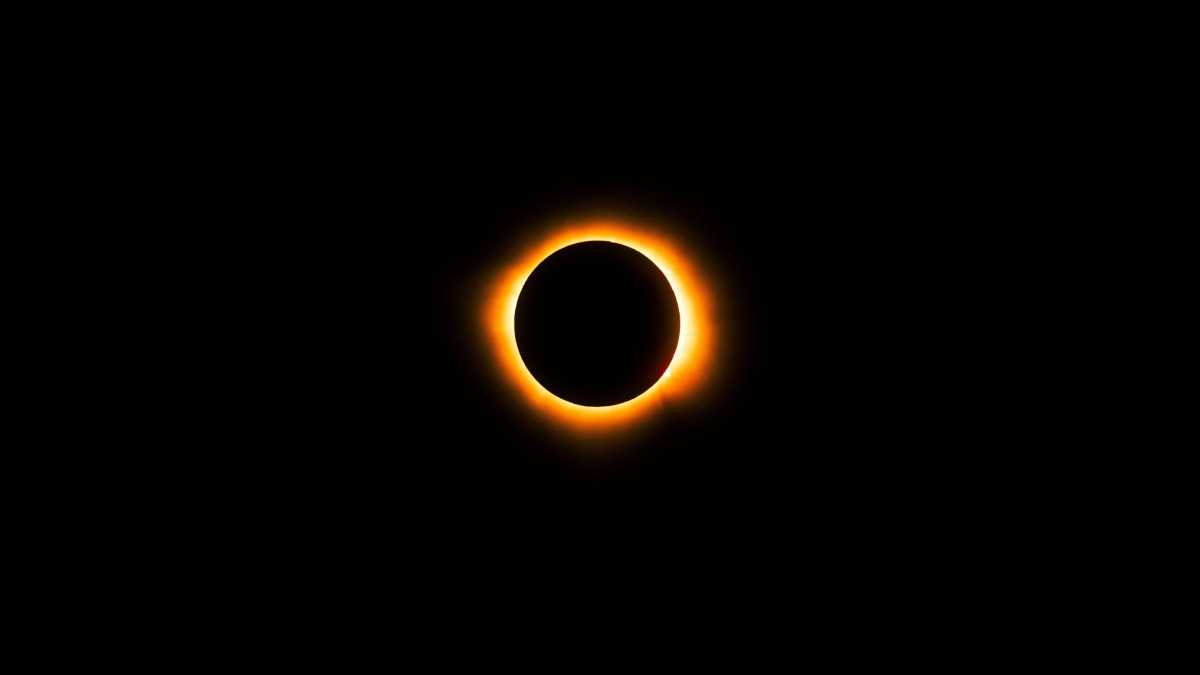
This February, sky watchers look forward to a stunning spectacle. Whereas total solar eclipses bring the day to a standstill, an annular eclipse presents a different geometric aesthetic that turns the Sun into a luminous halo. The upcoming eclipse on February 17, 2026, will last for about 4 hours and 32 minutes (from start to finish).
The Global Timeline (IST) astronomical data shows the eclipse will be in Indian Standard Time, like this:
- Partial Eclipse Begins: 3:26 PM IST
- Annular Phase (Ring of Fire) Starts at 5:12 PM IST
- Maximum Eclipse (Peak Stage) 5:42 PM IST
- Partial eclipse ends: 7:57 PM IST
The "Ring of Fire" effect the Sun's outer outlines glistening like a golden hoop will finally take full effect around 5:42 PM IST, lasting for about 2 minutes and 20 seconds at the peak.
Why Does Such a ‘Ring of Fire’ Happen?
This sort of eclipse occurs because the Moon moves on an elliptical path. On February 17, the Moon will be near its apogee (the farthest point from Earth). It's further distant, so it looks slightly smaller in the sky than the Sun. When the two are perfectly aligned, the Moon can nest itself within the Sun’s diameter, leaving the outer “annulus” or ring uncovered.
Visibility: Is it visible in India?
The short answer is no. The path of annularity for this eclipse is fairly remote, largely crossing Antarctica and segments of the Southern Ocean.
- Annular Visibility: The full ‘Ring of Fire’ will be visible to just a handful of research stations in Antarctica.
- Partial Visibility: It will appear partial eclipse in South Africa, Argentina, Chile and southern Atlantic as if Sun had a "bite" taken out of it.
- Asia and India: The alignment takes place over the Southern Hemisphere when the Sun is either below the horizon or at a different point for Asian coordinates. As such, India will not see any aspect of this eclipse.
India Does Not Have “Sutak” or Religious Prohibition
Because the eclipse cannot be seen through the Indian sky, traditional Vedic astronomical rules claim that there is no Sutak period (inauspicious time) to be observed. No fasting or special post eclipse events (which would normally be part of the visibility zone) would be required: temples will continue open.
How to Watch Online
In India, while you can’t see it from your balcony, you don’t have to miss the show. NASA and a series of international observatories (such as TimeandDate) will stream the high definition live feeds from Antarctica.
Pro Tip: Watching a live stream is the safest way to experience the event. If you are heading to a visibility zone, don’t ever see the Sun without certified ISO 12312-2 eclipse glasses, as the “Ring of Fire” still produces enough radiation to damage your eyes permanently.