
A thick blanket of smog shrouded several parts of northern India on Monday (November 9) after Diwali celebrations as air pollution spiked in Delhi, Haryana, Punjab and western Uttar Pradesh. National capital recorded its highest post-Diwali AQI (Air Quality Index) in five years while several neighbouring cities had very poor/severe air quality.
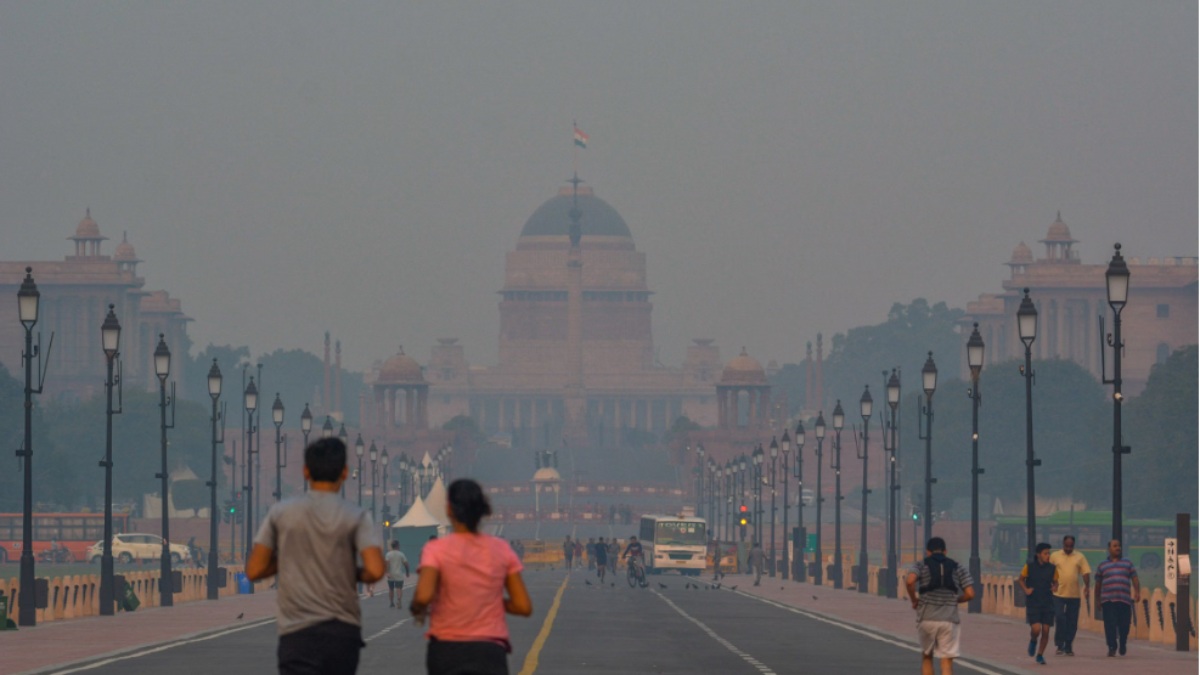
Delhi’s overall AQI was 371 at 10 am on Monday (very poor) as per CPCB data. It was marginally lower than the average AQI of 376 recorded on Diwali (November 8), the capital’s most polluted Diwali in five years.
The poor air quality caused by firecracker emissions was worrying because it combined existing pollution sources with unfavourable weather conditions.
Delhi Records Highest Post-Diwali AQI Since 2021
The AQI in Delhi was 371 at 10 am on Monday which is the highest reading for a post-Diwali day since 2021 (as per CPCB data reported).
Of the 51 stations monitoring air quality in the capital on Monday morning, 14 reported ‘severe’ air quality; another 33 were in the ‘very poor’ category and four had ‘poor’ air quality.
The highest station-level AQI was 439 at DTU (severe category). The overall AQI of the city was 370 at 8 am which rose to 371 in the morning.
The comparison with previous years also shows how bad things are. Delhi’s average AQI on Diwali this year was 376 compared to 345 in 2025, 328 in 2024, 218 in 2023 and 312 in 2022. In 2021 it was 382.
The data show that pollution was high all through this year’s festival period.
Western Uttar Pradesh Among the Worst-Affected Regions
Pollution levels rose in Western UP too with several cities reporting very poor air quality. Some parts of Ghaziabad, Meerut and Saharanpur also fell in severe category.
Of the 24-hour average readings reported till 4 pm on Monday, Noida had AQI of 332; Ghaziabad was at 324; Baghpat was at 305 and Bulandshahr at 303. Meerut’s AQI was 269; Shamli 275; Muzaffarnagar 225 and Hapur 202.
Greater Noida recorded an AQI of 252.
Pollution levels were different elsewhere in Uttar Pradesh too. Lucknow had AQI of 245; Kanpur 221; Prayagraj 241; Varanasi 274 and Gorakhpur 261.
Some cities recorded lower readings. Bareilly had AQI of 102 and Vrindavan had 110; Agra was at 187, Mathura at 169; Firozabad 176, Jhansi 144 and Pratapgarh 141.
Although these figures were lower than those reported in several western UP cities, they still showed varying degrees of air pollution across the state.
Haryana and Punjab Also Report Deteriorating Air Quality
The post-Diwali pollution spike was not limited to Delhi and Uttar Pradesh. Cities in Haryana and Punjab were also reporting high AQI levels too.
In Haryana Bahadurgarh AQI was 400 (very poor category) Charkhi Dadri 389 and Rohtak 378.
Other cities also reported high pollution levels: Faridabad AQI was 350, Kaithal 347, Gurugram 345, Bhiwani 340, Manesar 333, Ballabhgarh 316 and Narnaul 305.
In Punjab Jalandhar and Mandi Gobindgarh recorded AQI of 336 each. Ludhiana was at 292, Amritsar 257 and Patiala 221. Chandigarh (joint capital of Punjab and Haryana) had comparatively lower AQI of 148.
The readings showed that the deterioration in air quality extended across several parts of northern region.
Doctors Report Breathing Difficulties and Eye Irritation
The deteriorating air quality also raised health concerns in these cities. Doctors in Meerut said patients coming with breathing problems, asthma-like symptoms, throat infections and eye irritation after Diwali increased.
People in Gurugram also had breathing problems and irritation in their eyes during the pollution.
Fine particulate matter (PM2.5) is what to watch for during these episodes tiny particles can travel deep into the respiratory tract and even into the bloodstream. Exposure can worsen existing respiratory and cardiovascular conditions; children, older adults and people with health problems are particularly at risk.
The pollution episode also shows how multiple sources contribute to the problem fireworks can add to the burden from exhaust fumes, construction dust, industrial activity and other sources; low wind speeds and atmospheric conditions that limit pollutant dispersion can make it worse.
Ghaziabad Steps Up Dust-Control Measures
While pollution levels continued to rise Ghaziabad Municipal Corporation stepped up dust-control activities at pollution hotspots.
Mechanical road sweeping, water sprinkling and other measures were taken to reduce dust in the city. City Health Officer Mitlesh Kumar said civic body had stepped up these operations because of bad weather conditions.
These measures are meant to reduce dust pollution but they don’t deal with every source of poor air quality. Controlling emissions from vehicles, industries, construction activity and other sources is still necessary for improving air quality over the long term.
What the AQI Categories Mean
The Air Quality Index is used to communicate the level of air pollution and its health impact. Under India’s national AQI classification readings between 301 and 400 are very poor, 401 to 500 are severe.
A reading of 371 therefore means very poor air quality in Delhi. The station-level reading at DTU (439) is severe.
People living in polluted areas can reduce exposure by limiting strenuous outdoor activity near busy roads and pollution hotspots. People with respiratory or heart conditions should follow medical advice and if symptoms worsen seek help immediately.
The pollution episode after Diwali has once again brought the seasonal air quality challenge in northern India into focus. Firecrackers did cause the initial spike but sustained improvement will take action on multiple sources of pollution and monitoring beyond the festival period.



Comments