China has achieved a breakthrough in its rapidly advancing space program with its first controlled recovery of a reusable rocket booster. That makes China one of the few countries that can develop reusable launch technologies as the space industry has changed forever after SpaceX.
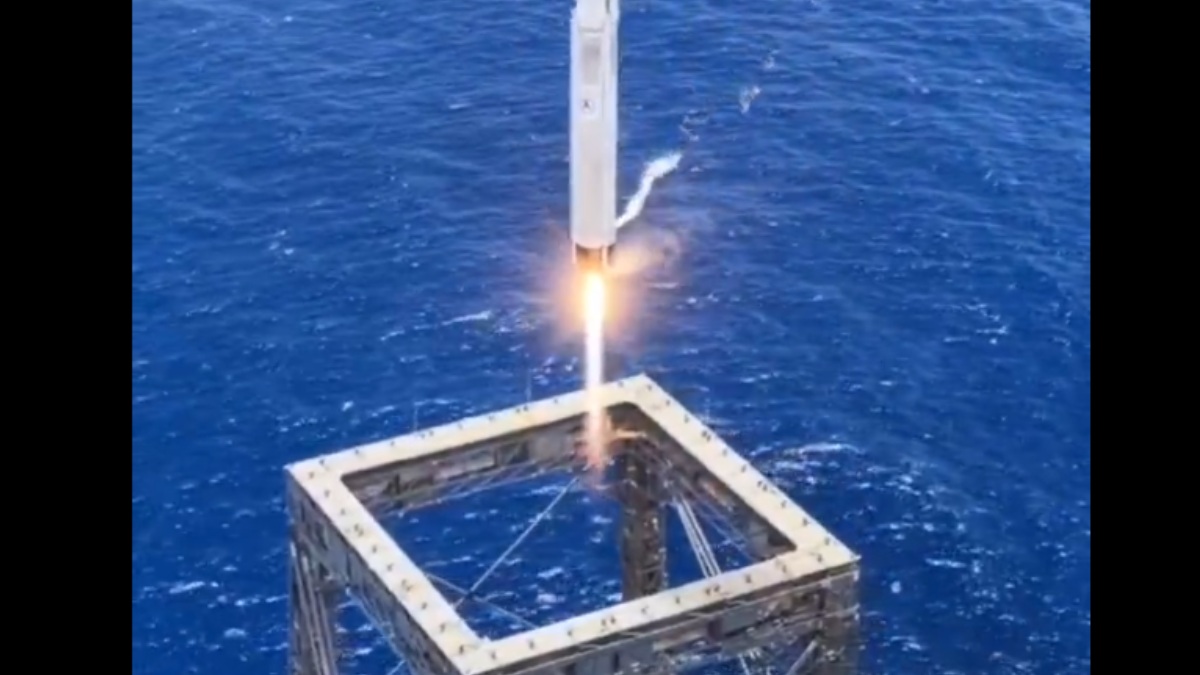
The successful recovery is a significant technological achievement with China aggressively investing in next-generation launch systems that will lower the cost of space missions and increase the frequency and efficiency of launches.
Reusable rocket technology is widely considered one of the most important innovations in modern spaceflight. Rocket boosters used to be discarded after each launch; space missions became very expensive due to the need to build new hardware for every flight.
Reusable systems allow boosters to return safely to Earth, undergo inspection and refurbishment, and fly again, at less than a cost.
China's controlled booster recovery has made huge progress in guidance systems, propulsion technology, precision navigation, autonomous flight control, and landing capabilities. In order to successfully return a rocket booster, a complex onboard software needs to be in place to control the vehicle during its descent along with constant adjustments to maintain stability and accuracy.

The recovered booster performed a careful descent with several engine burns to reduce speed before landing in a controlled manner, which is so crucial to the design of a booster that it has to withstand great aerodynamic loads and remain in a stable position during re-entry and landing.
The victory is in line with years of research by Chinese aerospace organizations and commercial launch companies to develop reusable launch vehicles capable of competing in the rapidly evolving global space industry.
SpaceX revolutionized commercial spaceflight by demonstrating routine booster landings and repeated reuse of its Falcon 9 rockets. Reusable rockets have greatly reduced launch costs and enabled the fast deployment of satellites, scientific and commercial space missions worldwide, as well as a wealth of satellites, research, and industry projects.
China's latest success is also a reflection of the growing global interest in reusable launch systems. Many countries and private aerospace companies are investing in similar technologies to make access to space more economical and sustainable.
Experts believe that reusable rockets could benefit China's space ambitions in space development, which would be of great benefit to Chinese national-level space ambitions like satellite constellations, lunar exploration, deep space missions, space station operations, and even crewed missions beyond low Earth orbit.
The country's space program has grown rapidly in the past two decades. China has launched its own space station, sent many lunar missions, deployed Mars exploration spacecraft, and has increased its satellite capabilities, from communication to navigation to Earth observation and science.
Reusable launch technology will become increasingly important in the face of increasing worldwide demand for satellite launches. Telecommunications, climate monitoring, navigation, disaster management, agricultural observation, and internet connectivity are all increasingly dependent on affordable access to space.
In this way, companies can attract more interest from universities, startups, research institutions, and new commercial space companies by reducing launch costs for satellite launch costs to make satellite deployment more accessible to them.
The development also enhances China’s position in the fast-growing commercial space industry. Meanwhile, world investment in launch services, satellite manufacturing, space-based communications, Earth observation, and space exploration is growing, creating huge opportunities for countries that are able to offer competitive launch capabilities.
Achieving reliable booster recovery requires a wide variety of advanced technologies including high-performance engines, lightweight materials, thermal protection systems, autonomous navigation, precision landing algorithms, and advanced telemetry networks.
Engineers need to ensure that recovered boosters are structurally sound after flight and can be efficiently inspected, refurbished, and certified for future missions. Successful recovery of reusable launch systems is at the heart of the economic success of reusable launch systems in terms of recovery time and maintenance costs between launches.
Environmental experts have also pointed out some sustainability advantages of reusable launch vehicles. Manufacturing fewer rocket stages may decrease material consumption and industrial waste, but the overall environmental impact depends on fuel type, production processes, and launch frequency.
China's investment in reusable launch systems fits well with its wider strategy of enhancing its technological self-reliance and development in advanced aerospace engineering. Continued development in launch technology will support future scientific missions, commercial satellite deployments, and international space cooperation.
That successful controlled recovery of the rocket booster is not only an engineering achievement but also a sign of China’s growing ability to participate in one of the most technologically demanding sectors of modern science and engineering.
A historic day in China’s space program!
— Mao Ning 毛宁 (@SpoxCHN_MaoNing) July 10, 2026
China’s Long March-10B has successfully completed its maiden flight—and recovered its first stage via a sea-based net. This marks the country’s first-ever controlled rocket recovery. A major leap toward reusable launch capabilities.… pic.twitter.com/FWuQXLltaD
As reusable rocket technology is becoming a reality in space exploration, China's latest milestone will likely accelerate the development of research, testing, and operational processes. In the future, we expect the launch to be based on recovery reliability, booster reuse, and low cost of operation.
The achievement underscores an ever-changing global space landscape in which reusable rockets are transforming how nations and private companies access space. This successful controlled recovery is an important step toward China’s much-needed development of a more efficient, sustainable, and competitive launch capability for the future to follow and for decades to come.