Hoover, one of the most celebrated engineers, humanitarians and public servants in American history, was born on August 10, 1874. He went from a hard-knocker childhood to a career as a mining engineer, businessman, humanitarian administrator and eventually the 31st President of the United States. He was president from 1929 to 1933, and so his achievements before and after that time in the White House give us a better picture of American and world history.
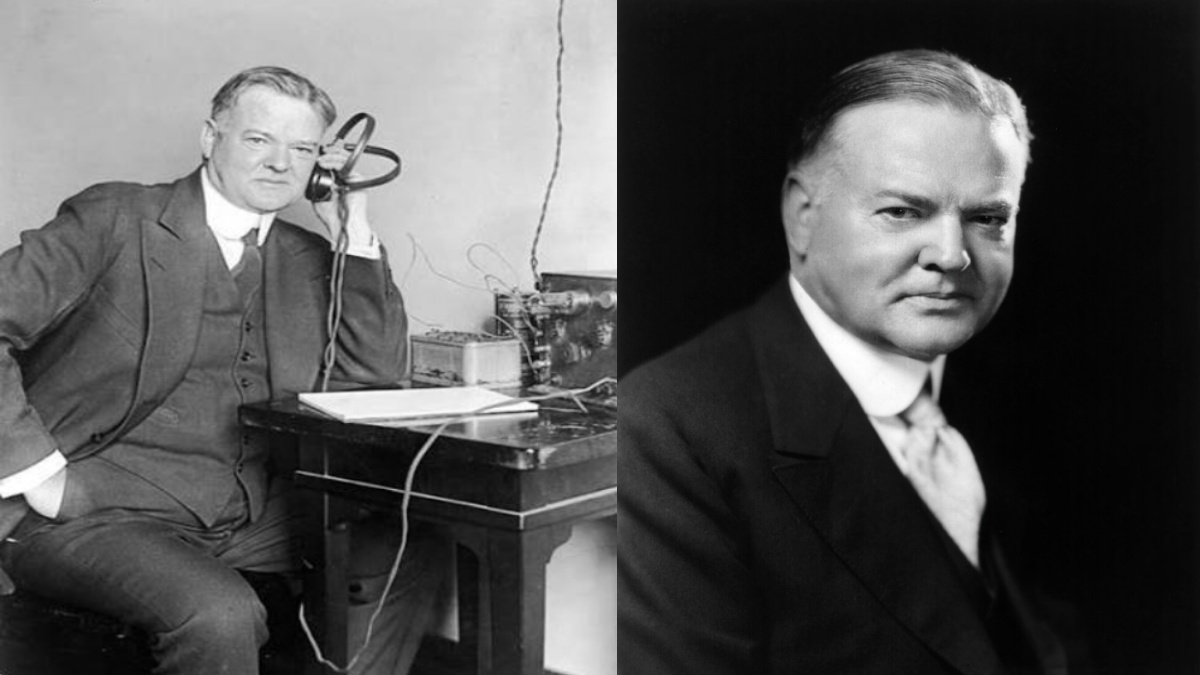
Herbert Clark Hoover was born to Jesse Clark Hoover, a businessman and farm equipment store owner, and Hulda Randall Minthorn Hoover, a teacher and Quaker minister. Hoover suffered tragedy early in life when his parents died before he turned ten. He was raised by relatives in Oregon. His childhood helped mold the discipline, independence, determination and self-reliance that he would take with him through life.
Hoover went to Stanford University and was part of the first graduating class of the university. He earned a degree in geology in 1895 and quickly became a successful mining engineer. He traveled to many countries in the world, including Australia, China, and Russia. Hoover was one of the most widely respected mining consultants of his time, with his technical skills, business background and international experience. His success in the private sector also enabled him to accumulate considerable wealth before he went into public life.
Hoover’s international reputation grew considerably during World War I when he was involved with one of the largest humanitarian relief efforts of the century. He was the head of the Commission for Relief in Belgium and helped to provide food and essential supplies to civilians affected by the war. The operation involved multi-faceted global coordination, fundraising, transportation and distribution networks. Hoover’s organisational skills made him a respected humanitarian leader.
His relief work did not end with the war. Hoover was at the forefront of programmes aimed at giving food and aid to those in need in Europe where hunger and economic hardship were at an extreme level. His humanitarian work was quite different from the image he was able to project later on of his presidency. He was widely regarded as an administrator who could manage an enormous relief effort in such difficult circumstances.
Hoover entered the U.S. government as Secretary of Commerce from 1921 until 1928 under Presidents Warren G. Harding and Calvin Coolidge. He supported economic development, infrastructure, technological progress, standardisation and cooperation with private industry. His engineering background was very much an influence on his administration style, and he focused on efficiency, planning and modernisation.
Hoover won the 1928 US presidential elections by a big margin and became the 31st president of the United States and was elected on March 4, 1929. His presidency began with a good economic outlook and only months later, the Wall Street Crash of October 1929 resulted in a severe economic downturn that turned into the Great Depression. Businesses collapsed, banks failed, unemployment increased and millions of Americans were in peril.
Hoover's administration launched numerous measures to respond to the crisis, including public works projects and economic recovery efforts. But the scale of the Depression was so great that his response was seen as inadequate and his administration was very much identified with the economic agony in which the nation was then at. Hoover was defeated by Franklin D. Roosevelt in the 1932 presidential election.
Hoover was still active in public affairs even after leaving the White House. He served on government commissions and helped to improve the efficiency of federal government. His later work showed that his passion for public service remained well beyond his presidency.
Hoover’s personal life was also closely connected to public service. He married Lou Henry Hoover in 1899 and they had two sons. Lou Henry Hoover became an influential First Lady, promoting education, volunteer activities and youth organisations. She also had a keen interest in outdoor activities, languages and public service.
Herbert Hoover lived through enormous changes in American and world history. His life was entangled with some of the most important events of the 20th century between industrialization and the First World War and the Great Depression and the post-World War II period. He died in New York City, on October 20, 1964.
Hoover's legacy to today is often based on his presidency in the Great Depression. But if you look all over his life, you see an even more complex person. He had already established himself as an internationally successful engineer and businessman before taking on politics. His humanitarian work in the days and years before World War I showed that he could organise large-scale relief efforts and as Commerce Secretary he showed his desire for modernising American economic management.
On Herbert Hoover’s birthday on August 10, his life is about perseverance, technical expertise, humanitarian commitment and public service. His development from a child of Iowa who grew up in a state of poverty to an internationally respected engineer, humanitarian, cabinet secretary and US president is one of the most amazing stories in American politics.
Hoover’s legacy is not just in terms of the economic crisis he had to navigate during his years in the White House; his engineering achievements, international humanitarian efforts and decades of public service are still part of his legacy.