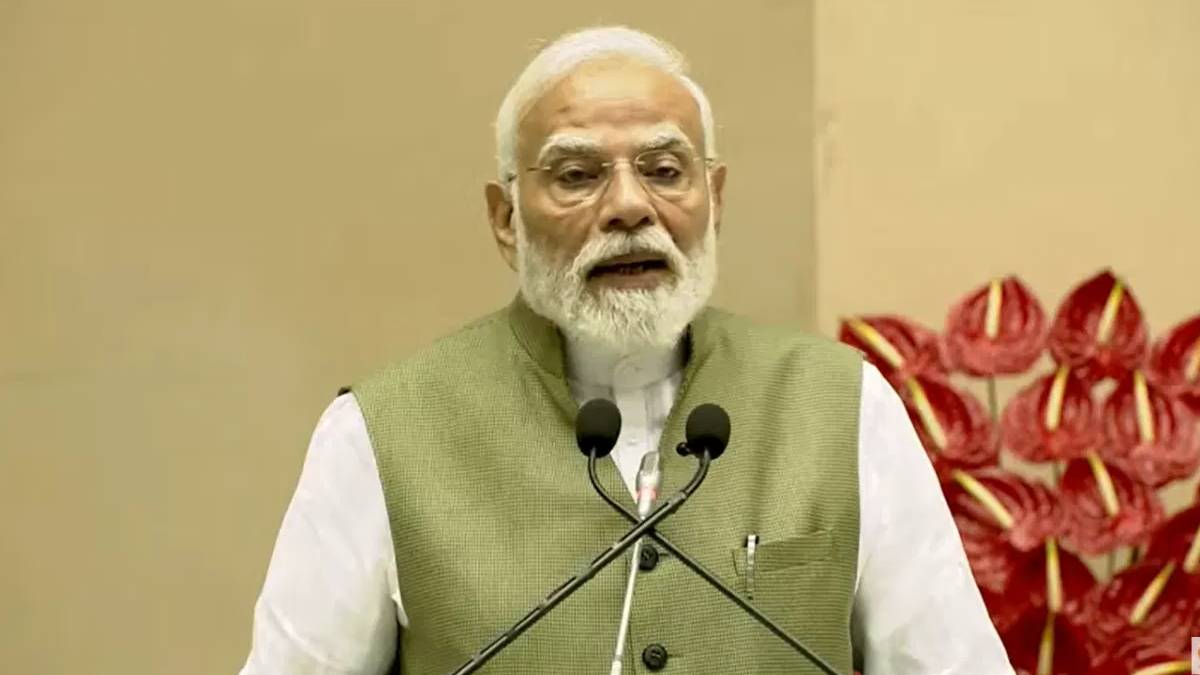
Narendra Modi spoke to the Indian diaspora in Australia for the first time during his trip and expressed satisfaction with the great relationship between India and Australia with the contribution of the Indian community to Australian society as a whole.

Thousands of people came from all different cultural and professional backgrounds to the event, reflecting the growing presence of our diaspora and how it is supporting the progress of our countries’ relationship.
In his speech, Prime Minister Modi said that the Indian community in Australia is one of the most important bridges between Australia and India. He cited the role of the Indian community in Australia as a key link between the two countries’ people of origin in Australia and Indian professionals, entrepreneurs, innovators, scientists and researchers, students, healthcare professionals, and business leaders who are contributing to the Australian economy, innovation, and multicultural identity.
The Prime Minister told us that India and Australia have strong democratic values and respect for the rule of law and a commitment to a free Indo-Pacific region. Cooperation between the two countries has grown considerably in recent years in respect of trade, defence, education, renewable energy, critical minerals, technology, and maritime security, he said.
Modi underlined India’s fast economic transformation, saying that the country is one of the fastest growing major economies in the world based on infrastructure, digital innovation, manufacturing, and clean energy investment.
He asked the Indian diaspora to be part of India's growth story through investments and knowledge transfer, entrepreneurship, and collaboration with Indian institutions.
The Prime Minister also stressed the importance of the India-Australia Comprehensive Strategic Partnership, which has enabled collaboration in such areas as defence and cybersecurity, science, innovation, and higher education.
Both sides have been working to deepen economic engagement through trade agreements and measures to increase market access and bilateral investment.
Education is still one of the most important pillars of India-Australia relations. In Australia, there are thousands of Indian students who attend higher education each year, making India one of the largest sources of international students.
Modi acknowledged the importance of educational exchanges for the development of long-term people-to-people ties and the establishment of research collaboration and skills.
The Indian diaspora, one of the fastest growing migrant communities in Australia, has become an important component of information technology, healthcare, engineering, academia, finance, hospitality, and public service. Modi praised the community for preserving Indian culture while also contributing to Australia’s multiculturalism.
The cultural heritage of India was highlighted as well in traditional events such as music, traditional dance, and displays representing the country's linguistic and regional diversity. The community participation was very strong and showed that many overseas Indians are emotionally attached to their homeland.
In addition to cultural ties, Modi also highlighted the growing cooperation in emerging areas such as artificial intelligence, digital public infrastructure, space technology, renewable energy, and critical mineral supply chains.
Australia has a large amount of lithium and other essential minerals which are crucial for electric vehicles and clean energy technologies, and India is expanding its manufacturing capabilities in these areas very rapidly.
Defence cooperation has also grown substantially in recent years. Joint military exercises, maritime cooperation, and sharing of intelligence have helped build strategic trust between the two nations as they face regional security challenges in the Indo-Pacific. Modi also said that India will work closely with Australia to promote peace, stability, and a rules-based international order.
Bilateral economic agreements have seen a steady rise in trade between India and Australia. Both countries are still looking for new markets in agribusiness, mining, education, pharmaceuticals, technology, renewable energy, and advanced manufacturing.
The Prime Minister also spoke on India’s digital transformation, including financial inclusion, digital payments, startup development, and innovation. He encouraged young people from the diaspora to take advantage of the opportunity to partner with Indian businesses and research institutions.
Thank you for joining me in Melbourne tonight @narendramodi.
— Anthony Albanese (@AlboMP) July 9, 2026
Our Indian community has contributed so much to the story of modern Australia.
And it’s made our country a better place.
Tonight we celebrated the special relationship between Australia and India. pic.twitter.com/slM3P33XBO
The gathering ended with a strong message of friendship and cooperation, which we can see in the ever-increasing closeness between Delhi and Canberra. Many diaspora responses were enthusiastic and reflected the general interest in India’s growing global profile and hope for a better relationship with Canberra.
As India and Australia continue to work together in different areas of cooperation, the Indian diaspora is a critical link between the two democracies. The people-to-people ties, shared values, and collaboration in the next phase of the India-Australia partnership were reinforced by PM Modi’s address.