India’s expanding middle class will have a central role in the country’s economic growth in the next 50 years, Minister Nirmala Sitharaman said at the Rencontres Economiques d’Aix-en-Provence in France. In a panel call for ‘How to Promote the Rise of a New Middle Class’ the minister said how rising incomes, growing consumption and the spread of economic opportunities beyond metropolitan cities are changing India’s growth story.
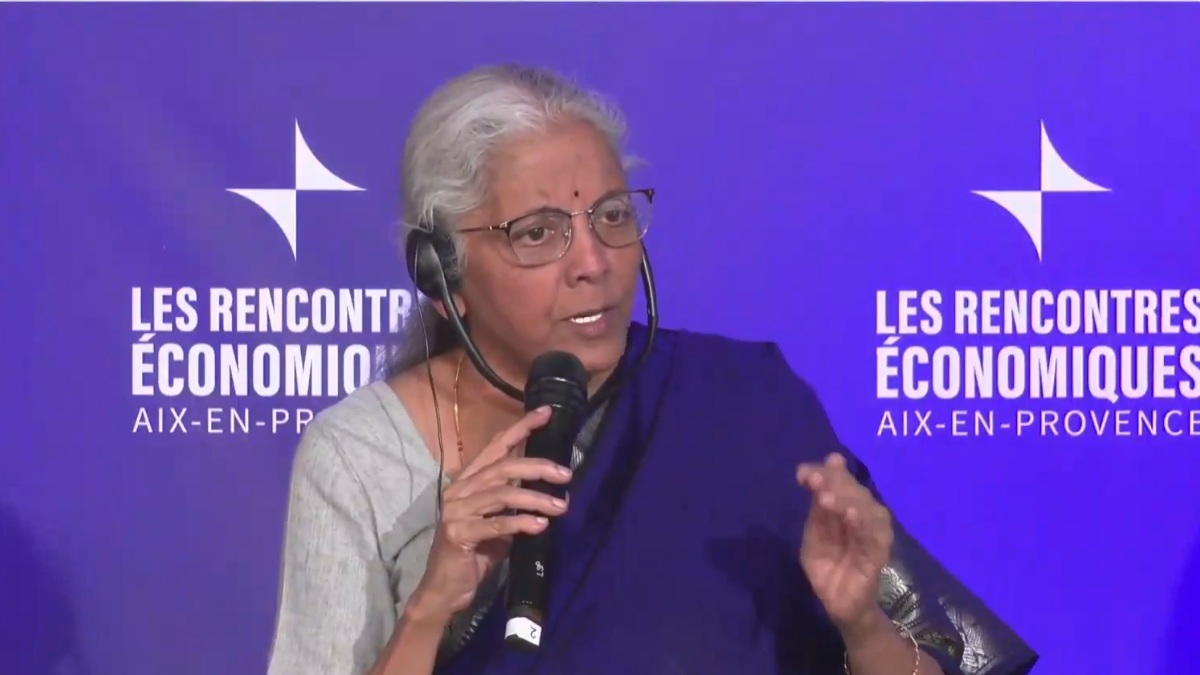
Sitharaman said the middle class now accounts for nearly 31 per cent of India's population and has been steadily growing since the country’s economic liberalisation, registering an annual growth rate of 6.3 per cent. She says this segment is no longer just a beneficiary of economic growth, but it is now the engine of its growth.
The Finance Minister said roughly 93 per cent of consumer spending in India is expected to come from the middle class and relatively wealthy households. She said India's consumption story is no longer focused on major metropolitan cities and purchasing power is increasingly centred on Tier-2 and Tier-3 cities.
"We think 93 per cent of all spending in India will be because of the middle class or the slightly affluent consumers. This middle class is not concentrated only in metropolitan cities. India's development model has ensured that the middle class is spread across Tier-2 and Tier-3 cities as well," Sitharaman said.
And this broader distribution of income and consumption, she said, is building a more balanced regional development across the country.
"We see the middle class not just as beneficiaries of growth, but as the engines of growth. Their consumption is what is driving the economy forward," she said.
Sitharaman also pointed to a study in the OECD that India is expected to surpass China by middle-class population between 2030 and 2035. She said India has been able to withstand the COVID-19 pandemic because of strong domestic demand—which is the pillar for growth.
The Finance Minister also said nearly 500 cities would become the hubs of the future economic life in the country, showing the rapid development of the country’s rapidly changing economic geography. They would also be important centres for business, manufacturing, services and employment and will help accelerate inclusive growth, she said.
Sitharaman highlighted government schemes to enhance the middle class: financial inclusion programmes, rationalisation of Goods and Services Tax (GST), collateral-free credit schemes for small businesses and affordable housing initiatives under the Pradhan Mantri Awas Yojana (PMAY).
The minister also said the government is investing in the development of skills to prepare the workforce in Artificial Intelligence (AI) for the digital economy and the government is taking steps to prepare them for the future with the help of the new technology and is investing in skill development. AI-based training camps on AI-based strategies such as AI training camps for local governments, for new digital economy jobs and digital training camps, we will be holding AI-centered training camps in districts at the local level in partnership with private companies to equip people with the skills for the future and get them prepared for the opportunities provided by the digital economy.
Sitharaman also highlighted the growing importance of Micro, Small and Medium Enterprises (MSMEs), stating that the sector contributes almost 40 per cent of India’s exports. Many MSMEs are now adopting AI-based solutions to enhance productivity and compete for markets and create demand for professionals with knowledge on emerging technologies, she said.
She added that India has become a preferred place for Global Capability Centres (GCCs) and data centres with a large pool of skilled professionals and fast-growing digital infrastructure. India is now one of the top global companies’ priority locations for innovation, AI adoption and digital transformation, she said.
Sitharaman said India's demographics, increasing middle class and expanding digital economy are positioning India as one of the world's fastest-growing major economies. She said investment in skills, technology and inclusive development should continue to be made in India’s economy and the middle class would be the driver of growth in the future.