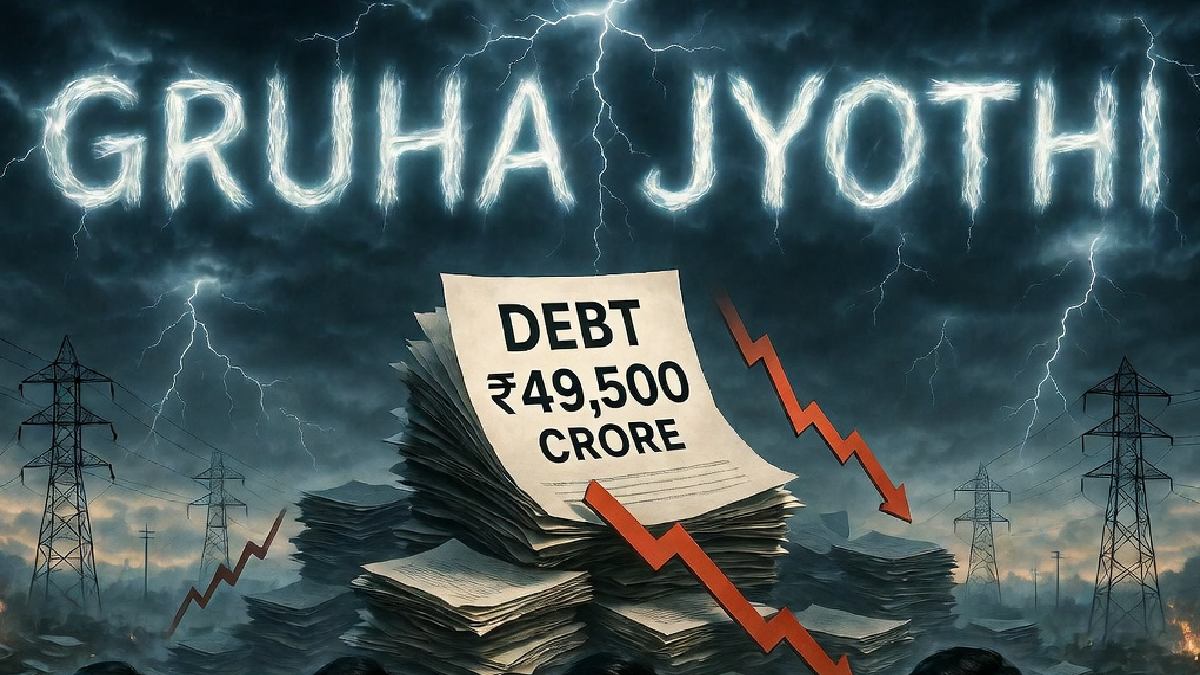
Under the ambitious Gruha Jyothi scheme which disburses up to 200 units of free electricity to over 1.6 crore households in Karnataka the state’s power distribution companies (ESCOMs) have a serious financial problem. As of early 2026, the five largest electricity supply companies BESCOM, HESCOM, CHESCOM, GESCOM, and MESCOM, collectively held ₹49,500 crore of debts with losses in revenues in the 2024-25 fiscal year reaching almost ₹8,863 crore.
It has been so dire that in recent months ESCOMs have sought a heavy lift from Karnataka Electricity Regulatory Commission (KERC) to remain afloat, a demand met with furious opposition from industry.
ESCOMs The Debt Trap: ESCOMs by the Numbers
The financial load is not evenly divided, as the BESCOM from Bengaluru has heavy burden of debt and loss on average. The great expense of power acquisition along with the difference between authorized supply price and true income has created a persistent shortage.
ESCOMs: Financials Breakdown (2024-25)
| Company | Loss (₹ Crore) | Loan (₹ Crore) |
|---|---|---|
| BESCOM | 5,476 | 22,000 |
| HESCOM | 1,500 | 11,000 |
| CESC | 1,030 | 5,200 |
| GESCOM | 766 | 8,500 |
| MESCOM | 96 | 2,800 |
The Coming Tariff Rise and Resurgence of a Stakeholder Against Industry
To close this ₹8,863 crore void, the utilities are advocating for a tariff revision going out from April 2026. It has faced significant opposition from the Federation of Karnataka Chambers of Commerce and Industry (FKCCI). However FKCCI takes a stance: the industry body believes that a hike would hit SMEs the hardest.
Because most domestic consumers are provided with the Gruha Jyothi subsidy, the share on a price increase usually rests with the industrial and commercial sectors through cross-subsidization.

Operational Inefficiency: FKCCI and its fellow consumer groups have argued that ESCOMs shouldn't raise rates, but attempt to reduce AT&C losses and recover over ₹10,000 crore of unpaid dues from different public departments.
Is Gruha Jyothi the Most Culpable?
With the government insisting that it pays ESCOMs for the Gruha Jyothi subsidy (about ₹13,000 crore per annum), fund releases continue to take time to complete and the cost of power purchase has increased, constraining utilities' liquidity. This has created a gap between the Average Cost of Supply (ACS) and the Average Revenue Realized (ARR) and allowed the companies to rely on high-interest loans to cover the daily operating expenses. As the KERC reserves a stance on the tariff petition, a balancing act is required for the state: a popular welfare program against driving its power infrastructure to the brink of bankruptcy.