A political controversy began Saturday when party workers appeared at the RJD’s Lok Bhavan march carrying a toy AK-47. Images and videos of the demonstration spread widely as criticism and the “Jungle Raj” narrative of the RJD’s previous rule in Bihar became more and more prevalent.
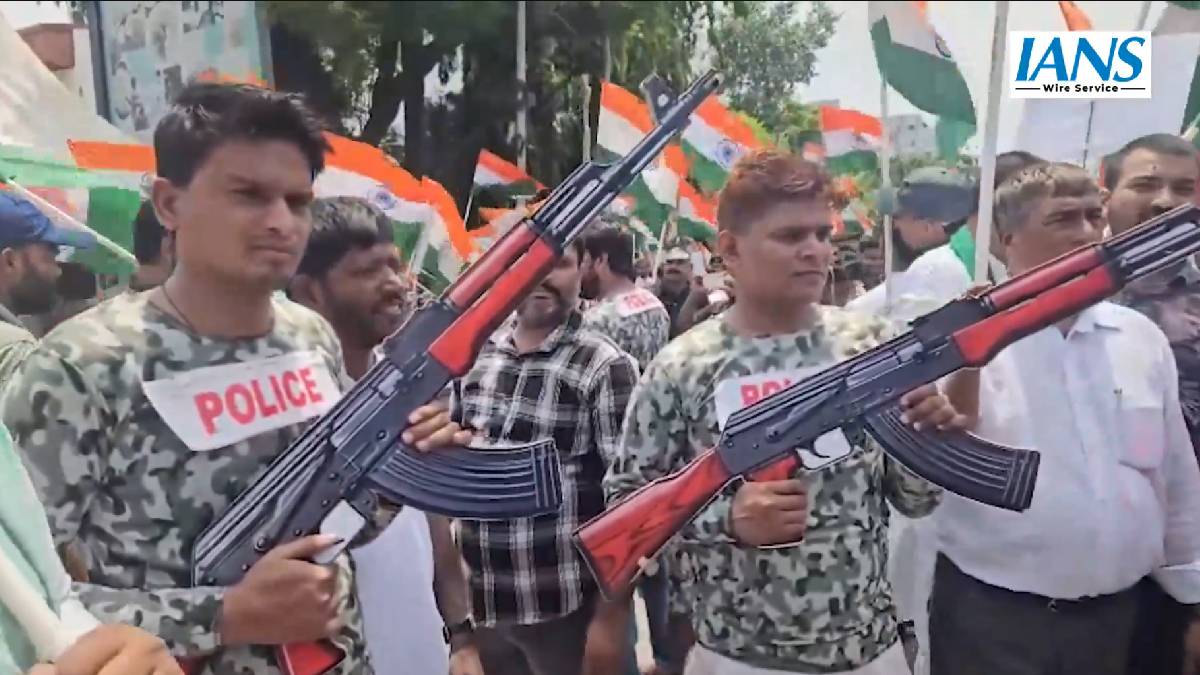
The presence of the replica weapon at a political demonstration immediately attracted attention because the AK-47 has strong associations with armed violence and crime. The object was clearly a toy, but it was at a political march, and opponents had a chance to attack the RJD for its political image and history.
The march itself was organised as part of the RJD’s political mobilisation in Bihar. Party workers and supporters took to the streets to raise their demands and demonstrate against the government. But the image of a worker carrying a toy firearm was one of the most talked-about aspects of the event.
Opponents of the RJD used the incident to revive the term “Jungle Raj” that political rivals used to refer to when Lalu Prasad Yadav and Rabri Devi were in power in Bihar. The term has since been associated with lawlessness, crime and weak governance during that time.
The latest incident has become more than a toy prop. It has entered into the larger political battle about Bihar’s governance record and the RJD’s political identity.
Patna, Bihar: An RJD worker was seen carrying a toy AK-47 during the party’s Lok Bhavan march as part of the protest pic.twitter.com/YP6PBMiRD5
— IANS (@ians_india) August 19, 2026
Supporters of the RJD could also argue that a toy or a replica object carried by one worker is not something to represent the official stance of the party. Political rallies often have symbolic props, slogans and theatrical displays to attract public attention.
But if the political context is election-oriented, the imagery is likely to be a source of serious controversy. Photographs from rallies can spread quickly on social media, and are often political talking points within hours.
The “Jungle Raj” label is still one of the most frequent political attacks against the RJD. The party’s opponents have often used the term (at least in law and order, governance and the state’s political history) in relation to the state’s political history. RJD leaders and supporters have vehemently rejected and often blamed those who are against the party for resorting to past narratives rather than addressing today’s problems.
The latest episode illustrates how political symbolism can quickly become part of a larger electoral story. A toy weapon might have been a visual prop, but the resemblance to an actual assault rifle has given ammunition to opponents who want to associate the RJD with one chapter of Bihar’s political history.
That is also in response to Bihar’s intense political rivalry, and political parties are constantly mobilising supporters and communicating messages. Demonstrations like the Lok Bhavan march allow parties to demonstrate their power and put their opponents under political pressure.
Political organisers have also been questioned about whether demonstrations should not contain images of violence that could be seen as threatening or glorifying violence. Even if the weapon is a toy, it can cause a lot of controversy in a politically charged public gathering.
The RJD’s challenge is to avoid the incident from overshadowing the issues the party wanted to raise through the march. But for its political opponents, the image will only reinforce their criticisms of the party’s governance record.
It is important to distinguish between political rhetoric and facts. A toy AK-47 does not prove that the RJD supports violence or lawlessness. And references to “Jungle Raj” are political characterizations and remain part of a partisan debate about Bihar’s history.
But the incident illustrates how a single image can be politically potent. In an age when rally footage can reach millions of people through social-media platforms, strange visuals tend to get more attention than speeches or policy announcements.
Once political activity picks up, the episode will serve to reinforce the narrative of both sides. The RJD will continue to put its political demands on display, and its opponents will use the toy weapon as evidence to back up their criticisms of the party’s political culture.
For now, the toy AK-47 seen during the RJD’s Lok Bhavan march has become the centre of a fresh political row. But whether that is a short-lived social media spat or becomes a larger campaign issue will depend on the political parties’ approach in the days to come.