
Argentina’s celebrations after reaching the FIFA World Cup 2026 final have been marred by controversy when midfielder Giovani Lo Celso and defender Nicolás Otamendi put up a banner that refers to the Falkland Islands after their dramatic semifinal victory over England.
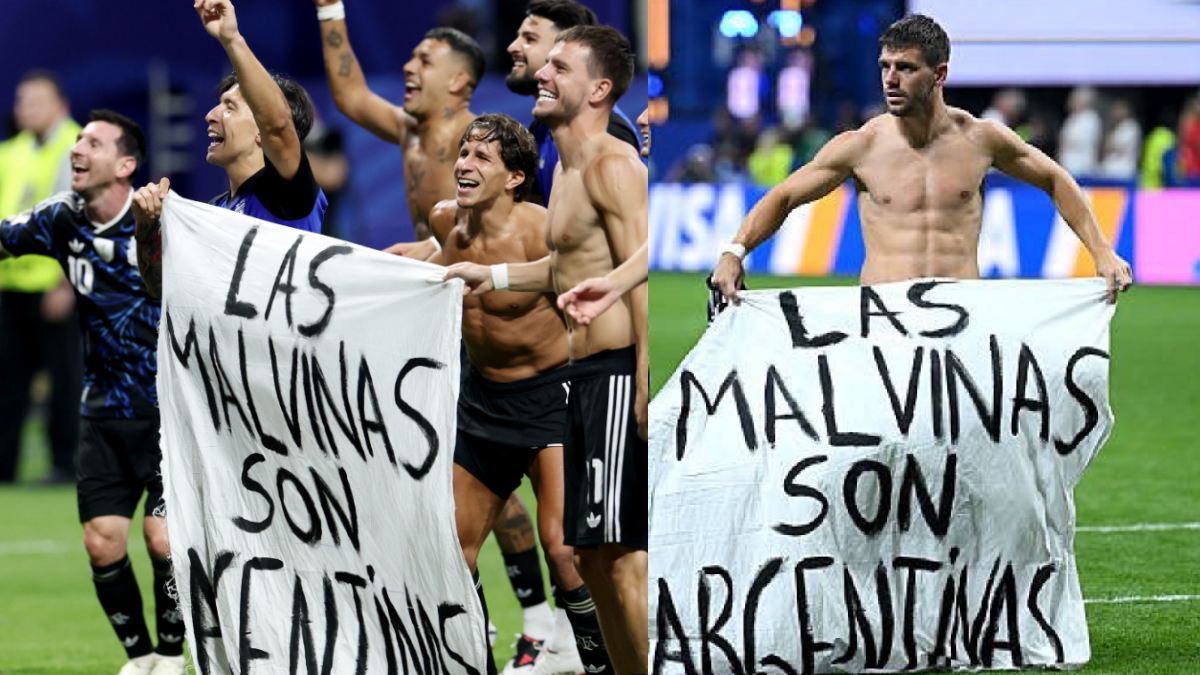
Argentina secured a place in the World Cup final with a comeback victory today against England in Atlanta. And although the players and supporters were so proud of the victory, just after the final whistle was the story of the world for reasons more than football.
Lo Celso was holding a banner that read “Las Malvinas son Argentinas” (“The Malvinas are Argentine”), a slogan used in Argentina’s long-standing claim to the Falkland Islands. Otamendi took a picture of the banner which he said came from supporters in the stand.

The gesture has triggered a wide debate because the Falkland Islands— called Las Malvinas in Argentina— remain in the midst of a decades-old sovereignty debate between Argentina and the United Kingdom.
Both players have strong English football ties. Lo Celso played for Tottenham Hotspur and Otamendi had a great time with Manchester City in the Premier League.
Could FIFA Take Action?
The celebration could now attract the attention of FIFA.
The IFAB and FIFA have strict rules that don’t allow political, religious or personal messages to be projected on the field and in the stadium during official games and tournament celebrations.
According to IFAB’s Laws of the Game, players are not allowed to display political slogans, statements, or symbols on their equipment or clothing. In case of violation this is also the case the competition organiser, national football association or FIFA can impose punishment.
If FIFA found the banner to be a political message, Argentina’s players or team could face disciplinary proceedings. FIFA has not yet issued an official response to this.
Argentina's Vice-President Adds to the Debate
The controversy started when Argentina’s Vice-President Victoria Villarruel publicly supported the players.
She posted on X:
"The Falklands are Argentine! They banned bringing them to the stadium and forgot that we carry them in our blood and our hearts."
Her comments also linked the on-field celebration with the long-running political dispute between Argentina and the United Kingdom.
What Is the 'Las Malvinas' Dispute?
Falkland Islands, located about 480 kilometres off Argentina’s eastern coast, are a British Overseas Territory, but have been claimed by Argentina for generations. In Argentina they are referred to as Las Malvinas.
The sovereignty dispute dates back to the early 19th century. Britain reasserted control over the islands in 1833, but Argentina has always held that the territory belongs to it.
The dispute reached its worst point in 1982, when Argentina’s military government invaded the islands, leading to the Falklands War.
The war lasted from 2 April to 14 June 1982 and concluded when Argentina surrendered to Britain after taking back the islands. The war took the lives of 649 Argentine soldiers, 255 British soldiers, and three Falkland Islands civilians, according to historical records.
While diplomatic friction continues to occur between the islands, the UK still maintains administrative control after a 2013 referendum in which an overwhelming majority of Falkland Islanders voted to remain a British Overseas Territory.
Celebration Overshadowed by Political Controversy
Argentina’s victory in the final secured another World Cup place and it was expected to dominate headlines for purely sporting reasons. But the post-match display has brought the attention back to one of the longest-standing territorial disputes in the world.
Whether FIFA will investigate the incident is undecided but the banner has already led to debate on where football celebrations end and political messaging start across the globe.




Comments