
The 8th Pay Commission is expected to undertake structural changes to pay models of main government employees and pensioners in India. Formalized in November 2025, the commission will begin operation as of January 1, 2026, guided by Justice Ranjana Prakash Desai, retired Supreme Court judge. It’s been tasked with reviewing wages, pensions and service conditions for alignment with high cost of living and increasing costs.
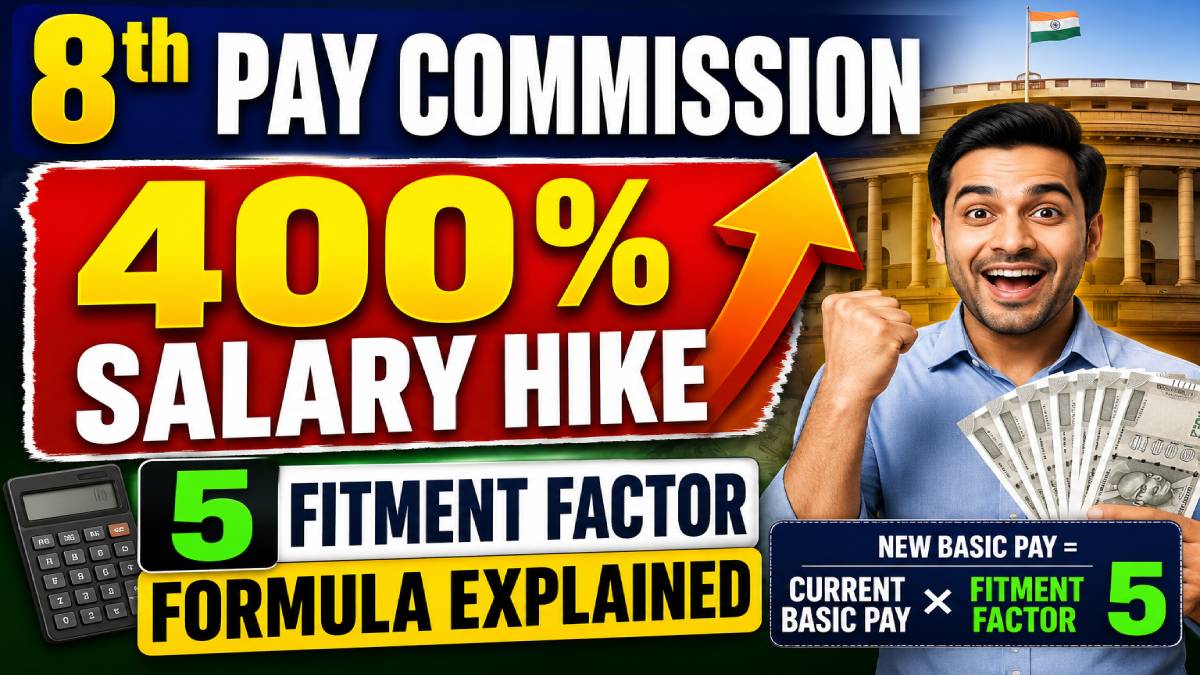
The second, and perhaps the most discussed factor in the 8th Pay Commission, is a potential 400 percent increase in salary. This radical increase is due to the concept of the fitment factor, which is a multiplication on what is actually a simple basic wage. The fitment factor was 2.57 as per the 7th Pay Commission. Proposals are in place for the proposed adjustment with the next revision in range between 2.28 and 3.83; ranges for fiscal scenarios and inflation.
Should it pass, that would increase minimum pay above ₹18,000 to between ₹41,000 and ₹69,000, a big lift in incomes for millions. The implications of this revision will be significant. More than 48.62 lakh employees and 67.85 lakh pensioners will stand to benefit.

In addition to remuneration, the commission’s recommendations will influence pensions, allowances including HRA and TA and welfare measures. Additionally, the Dearness Allowance (DA), projected to reach 60% by 2026, is believed to get folded into the salary base, making it easier and allowing pay more take-home to be realised.
But such a hike would also present many problems. Experts say the fiscal strain on the government may be significant and public finances will likely be stretched. It may extend to periods of 18–24 months between commencement and delivery, with arrears due from January 2026.
Higher government salaries could also trickle down to private companies, leading to greater pressure to raise wages across sectors. Put simply, the 8th Pay Commission is not merely about numbers, it's about preserving dignity, fairness, and sustainability for India's workforce. Through tackling inflation and updating pay structures, it seeks to strike a balance between the best interests of workers and economic realities, altering the financial map for millions of families.

The 8th Pay Commission in India is expected to initiate significant salary amendments for central government staff and pensions. It was set up officially in November 2025, starting from the 1st of January 2026 with Justice Ranjana Prakash Desai, a retired Supreme Court judge, being its chairperson, and leading the charge.
The commission’s job is to evaluate wages, pensions and service conditions in line with increasing living standards and inflation. One of the biggest debated elements of the 8th Pay Commission is about 400% salary hikes expected to be a 400% increase by the fourth year is to be raised by the 8th Pay Commission.
It examines pay systems and regulations on the commission. This significant increase is directly related to the formula fitment factor, a multiplier of preexisting basic pay. The fitment factor was established as 2.57 at the 7th Pay Commission. Proposed for updating for the next time, two to three of the ranges of 2.28–3.83 are suggested based on fiscal and inflationary concerns. If approved, this could lift the minimum salary from ₹18,000 to ₹41,000 to ₹69,000 and increase incomes for tens of millions exponentially. It will have a domino effect on this revision. An additional 48.62 lakh employees will stand to benefit, as will 67.85 lakh pensioners.
Outside of salaries, the commission’s recommendations will influence pension schemes, allowances like HRA and TA, and welfare schemes. There is also speculation that the Dearness Allowance (DA), set to be brought up to 60 per cent by 2026, will be folded into the base pay, reducing complexity and increasing take‑home levels even more. But such a steep increase is accompanied by problems.
Experts suggest the financial pressure on the government would be high, straining public money. The timeline for implementation could also be time-consuming across 18–24 months, with pay-offs due in January 2026. And higher government compensation will be passed onto the private sector as well, as wages will probably change across industries.
Ultimately, the 8th Pay Commission is not as much about money as people, they are about justice, dignity and sustainability for India’s citizens. In working at the intersection of rising inflation and the modernisation of wage conditions it tries to strike a balance between welfare of employees and the economy, redefining financial lives for more than a million families.








Comments